Applying Kubernetes Operator Patterns to AI Agent Lifecycle Management
Declaring agents in Git lets operator loops govern them at runtime.
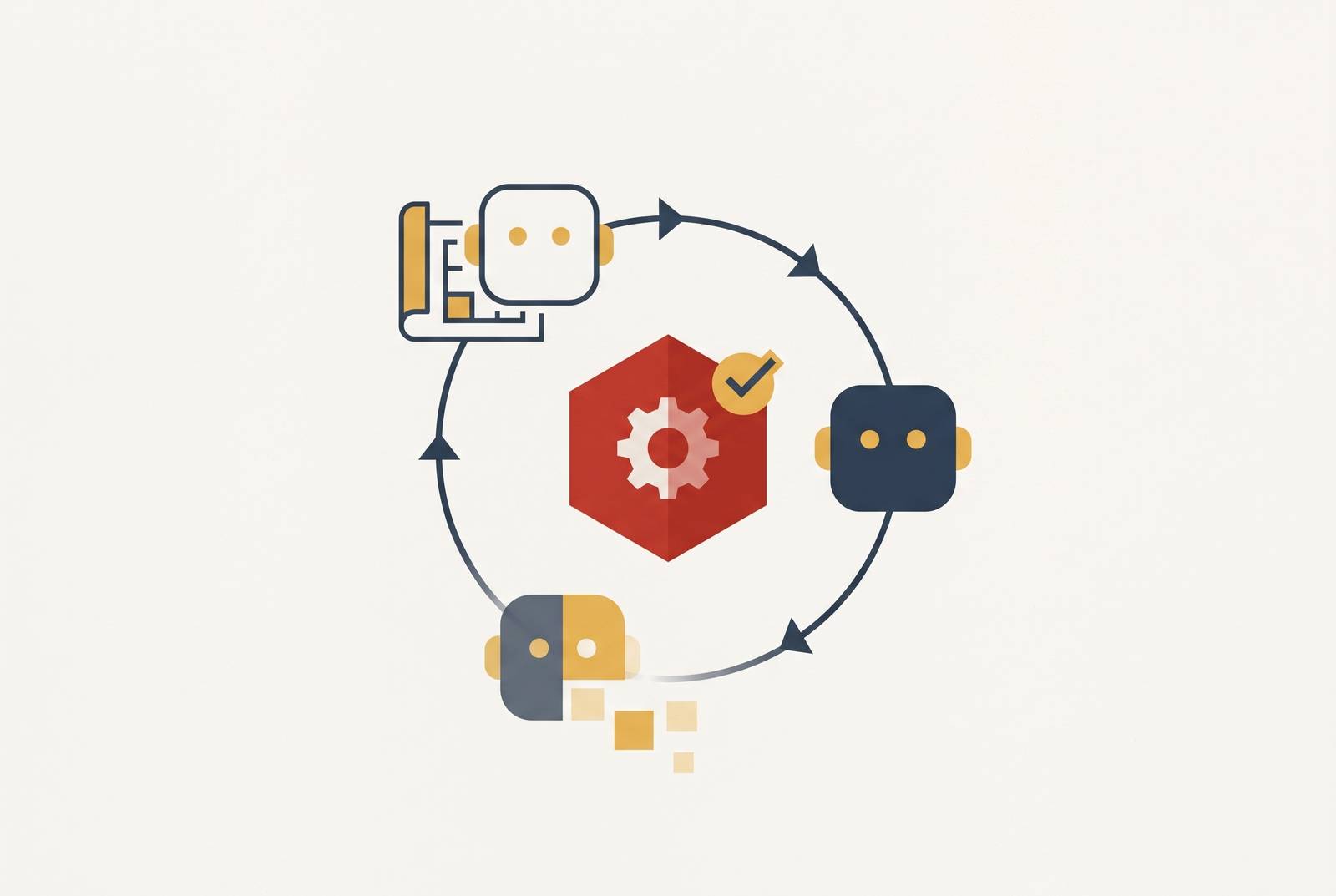
Agents-as-code means defining AI coding agents as version-controlled YAML files in a repository, so changes to their behavior go through normal pull request review. Kubernetes operator patterns put those definitions to work through a watch, analyze, act, and reconcile loop. The platform governs agent behavior continuously throughout execution.
Why AI coding agents break the assumptions that existing deployment patterns were built on
An AI coding agent can appear to need nothing more than a container. Under production load, however, its behavior differs from that of a conventional microservice with a predictable execution path. An agent chooses tools based on intermediate results and may continue working after the originating request has ended. Its resource needs change during execution. Forecasting consumption from request volume alone therefore misses the work happening inside each reasoning loop.
That work also produces state that outlives the container. Conversation history, task checkpoints, and intermediate reasoning belong to the workflow across the lifetimes of the pods running it. The task must survive the loss of a pod. Running generated code, calling internal APIs, and writing to repositories also require security boundaries that an ordinary application container does not enforce on its own. Each additional iteration can consume tokens, compute, and external API calls, allowing one uncontrolled workflow to affect unrelated workloads.
These are organizational scaling problems. Context Kubernetes: Declarative Orchestration of Enterprise Knowledge for Agentic AI Systems identifies five such problems, namely scheduling, permissions, health monitoring, state management, and auditability. Improving the agent primitive does not supply that missing infrastructure. A fixed list of expected scenarios also cannot cover every combination an autonomous agent meets. Production requires a layer that can govern unpredictable work without depending on a prediction of every execution path.
How the operator loop maps onto the agent lifecycle, step by step
The Kubernetes operator pattern supplies that governing structure. Its loop watches events, analyzes how current state diverges from desired state, acts to close the gap, and reconciles the result. For agents, the distinction between an Agent and an AgentRun makes this concrete. The definition can stay in place and govern the work as individual containers and sessions come and go.
Watching maps directly to observing agent triggers. A pull request, a CI failure event, a labeled GitHub issue, or a Slack reaction can initiate a run. Analysis then determines what response would move the system toward its declared state. A traditional controller makes that comparison with hardcoded logic. The Context Kubernetes paper proposes using LLM-powered analysis to reason about combinations that the controller’s authors did not foresee, while keeping the controls around it in place.
Acting maps to the agent’s permitted interventions. These may include writing code, opening a fix PR, calling an internal API, or escalating to a human. Authority remains bounded by an allow-list of actions. Replacing fixed analysis with model reasoning does not require granting the model unrestricted execution, and escalation remains a valid action when autonomous work cannot resolve the gap.
Reconciliation then rechecks the outcome to verify that an attempted action succeeded. Opening a fix PR is an action whose outcome still requires verification against the desired state. The loop supplies the retry-and-verify behavior agent workflows need, but retries must have limits. Otherwise, the machinery intended to correct failure becomes the mechanism that sustains a runaway task.
How do you store AI agent definitions in Git for normal code review?
Desired state must be declared before it can be reconciled. For agents-as-code, that declaration is a YAML specification stored in the repository and versioned like application or infrastructure code. Changes go through pull request review before they reach production. Reviewers can examine intended behavior, permitted tools, and configuration changes as one artifact rather than reconstructing them from invocation parameters and environment variables. Earlier versions also provide a defined rollback target.
Snowflake makes this approach concrete with CREATE AGENT... FROM SPECIFICATION. Its YAML specification covers models, orchestration, instructions, tools, and tool resources. Agent behavior is declared rather than assembled through procedural code. This qualifies as a concrete example of YAML-based agent definition, but a declarative interface alone does not establish a version-control workflow. Storing the specification in a repository, reviewing it, and promoting it turn it into desired state that is governed.
The Context Kubernetes paper applies the same principle to knowledge-architecture-as-code. Its YAML manifest declares the intended context and knowledge state, while reconciliation detects drift from that specification. The distinction is important for platform evaluation. Supporting YAML input is narrower than supporting a lifecycle in which declared state remains the reference against which runtime behavior is assessed.
Prompt-level instructions reduce the probability of unwanted behavior, whereas runtime policy constrains what execution can actually do. The Model Context Protocol provides standardized connections to external systems and tools, but its tools can be discovered at runtime through tools/list. A declared tool allow-list is therefore a separate governance control that must be supplied alongside MCP discovery. Once the repository states what an agent may access, the execution platform must enforce that boundary.
Scoped permissions and isolated execution: treating each agent run as a first-class platform workload
A manifest names authority but cannot enforce it alone. Runtime controls must bind each agent to a dedicated identity, restrict its permissions, and isolate its execution from neighboring workloads. These boundaries are especially important for agents that execute generated code, whose execution requires stronger controls than serving HTTP requests. When dependencies change, credentials span multiple domains, and resource use is hard to predict, shared credentials and prompt-only restrictions are too weak a basis for production.
Kubernetes provides distinct controls for distinct boundaries. A unique ServiceAccount gives each agent an identity, while RBAC binds that identity to minimal permissions, such as viewer, with cluster-admin outside that minimal scope. ResourceQuota limits CPU, memory, and pod counts. NetworkPolicy restricts communication to approved services, and a Job gives each execution its own container, memory space, and lifecycle. Together with retained workflow state and telemetry, these primitives support the scheduling, permissions, health monitoring, state management, and auditability that organizational deployment requires.
Session credentials make the identity boundary more precise. They should be minted fresh for each session, used exclusively for that session, and revoked on completion. Sandboxed execution with gVisor or Kata Containers isolates untrusted code paths. For CI sandboxes, read-only mounts can prevent writes to protected repositories or container images, while capability removal, privilege restrictions, and process and resource limits constrain damaging execution. The declared task and its permitted write access must remain consistent.
A prompt can discourage unauthorized access, but an enforced permission boundary denies access outside its scope. Isolation likewise depends on the controls surrounding a Job. Workload identity through SPIFFE/SPIRE adds a verifiable cryptographic identity, and SPIRE’s SVID issuance logs provide evidence that can support the audit trail.
Budget caps and cost control as a first-class reconciliation concern
CPU and memory limits do not bound LLM consumption. An agent can stay within its compute allocation while spending tokens and making external API calls over and over. Token budgets and spend caps thus need to be enforced in the same system as runtime resource limits. Their purpose is to constrain the next action. A finance dashboard reviewed after execution cannot serve that purpose.
The operator analogy is direct but requires explicit implementation. ResourceQuota already governs declared infrastructure consumption, while agent-specific controls must enforce token and currency limits at the session level. Kubernetes does not gain those controls simply because an agent runs in a pod. The desired financial state must be part of what the platform reconciles, with bounded retries preventing unsuccessful work from consuming the budget indefinitely.
Token limits catch runaway use within a workflow, while currency limits set a spending limit that engineering managers and finance teams can use. Neither control substitutes for the other. Both must take effect before the agent can exceed its declared allowance, because post-hoc monitoring only spots a breach after it happens.
Cost policy also affects how permitted work is performed. Model routing belongs in the manifest, with simpler steps assigned to less expensive models and more capable models reserved for high-risk reasoning. Versioning makes that routing policy reviewable and consistent. Prompt caching is an infrastructure optimization that can reduce repeated context costs for agents working on the same codebase while leaving limits necessary. Platform configuration, rather than each agent author’s discretion, is the appropriate place for it.
Observability and audit trails as the feedback loop that closes the operator reconciliation cycle
Enforcement changes what an agent can do, but reconciliation also needs evidence of what happened. The platform must record tool calls, model calls, code diffs, and retries, attributing them to an agent identity, trigger, and session. Those records feed the next analysis step. Without them, a controller may know that it launched an action without knowing whether the action moved the workflow toward desired state.
A runaway loop may keep a normal request rate while using far more tokens in each request. Span-level traces with input and output token counts reveal the difference. OpenTelemetry is emerging as a vendor-neutral standard for agent telemetry in 2026, supporting traces across multi-step, non-deterministic workflows. The useful unit of observation is the work within the run.
Cost attribution and auditability share this operational record. Tags including user_id, feature, deployment, and agent_run_id help attribute consumption, but tags alone do not satisfy audit requirements. Tamper-evident automatic logging, timestamps, model identity and version, input/output traceability, and decision-provenance records add the necessary evidence. Workload identity and session-level credentials connect actions to their authority.
EU AI Act Article 12 makes automatic event logging a compliance concern for systems that fall under it. The supplied regulatory context gives December 2, 2027 as the date for the standalone high-risk Annex III obligations that apply here. The article requires automatic logging while leaving the “per user, per system, per time period” formula unspecified. Identity and span-level records can support that obligation, but their presence alone does not establish compliance. Operationally, the immediate requirement is equally strict because without outcome evidence, the controller cannot know whether reconciliation succeeded.
What the operator pattern gives engineering teams that ad hoc agent deployment does not
The operational difference appears when a run deviates from expectations. An unmanaged process may have implicit behavior, shared credentials, and no defined limit on retries. Desired state sets out how the agent should behave, scoped credentials set out what it may do, and resource and budget limits keep execution within bounds. Reconciliation then evaluates the result instead of leaving completion to the process’s own judgment.
These controls also change how teams investigate failures. A reviewed manifest identifies the intended behavior, while an attributable execution record shows the actions taken under it. The two can be compared. With implicit configuration and incomplete logs, that comparison instead depends on reconstructing both intent and execution after the incident. Observability is therefore useful not only for diagnosing an agent but also for determining whether the platform enforced its own policy.
The model is not the dividing line between prototype and production. Running Claude Code or a comparable coding agent on a laptop demonstrates the agent’s capability. Managed execution adds declared configuration, isolated sandboxes, credentials minted and revoked per session, and continuous audit trails. Those are platform properties. Changing the underlying model does not supply them, just as improving an agent’s reasoning does not solve organizational scheduling or state management.
Engineering teams should design the orchestration layer alongside the agent deployment, establishing governance from the outset. Adding scheduling, isolation, and auditability to an unmanaged system effectively means building that layer after the fact. Operator-pattern thinking establishes those responsibilities before autonomous work spreads across the organization. It makes production readiness a property of the governed lifecycle.