Audit Log Requirements for AI Coding Agents in Regulated Environments
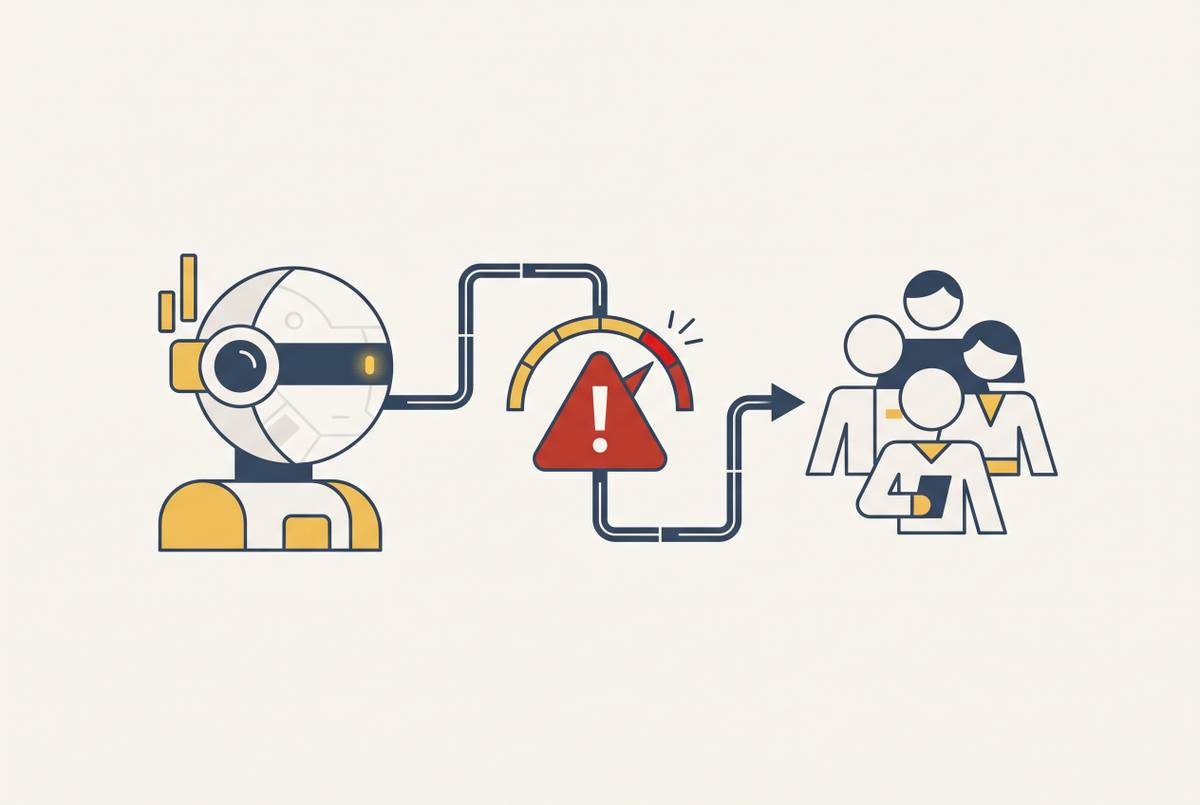
Regulators now demand immutable audit trails that capture what AI agents actually did.
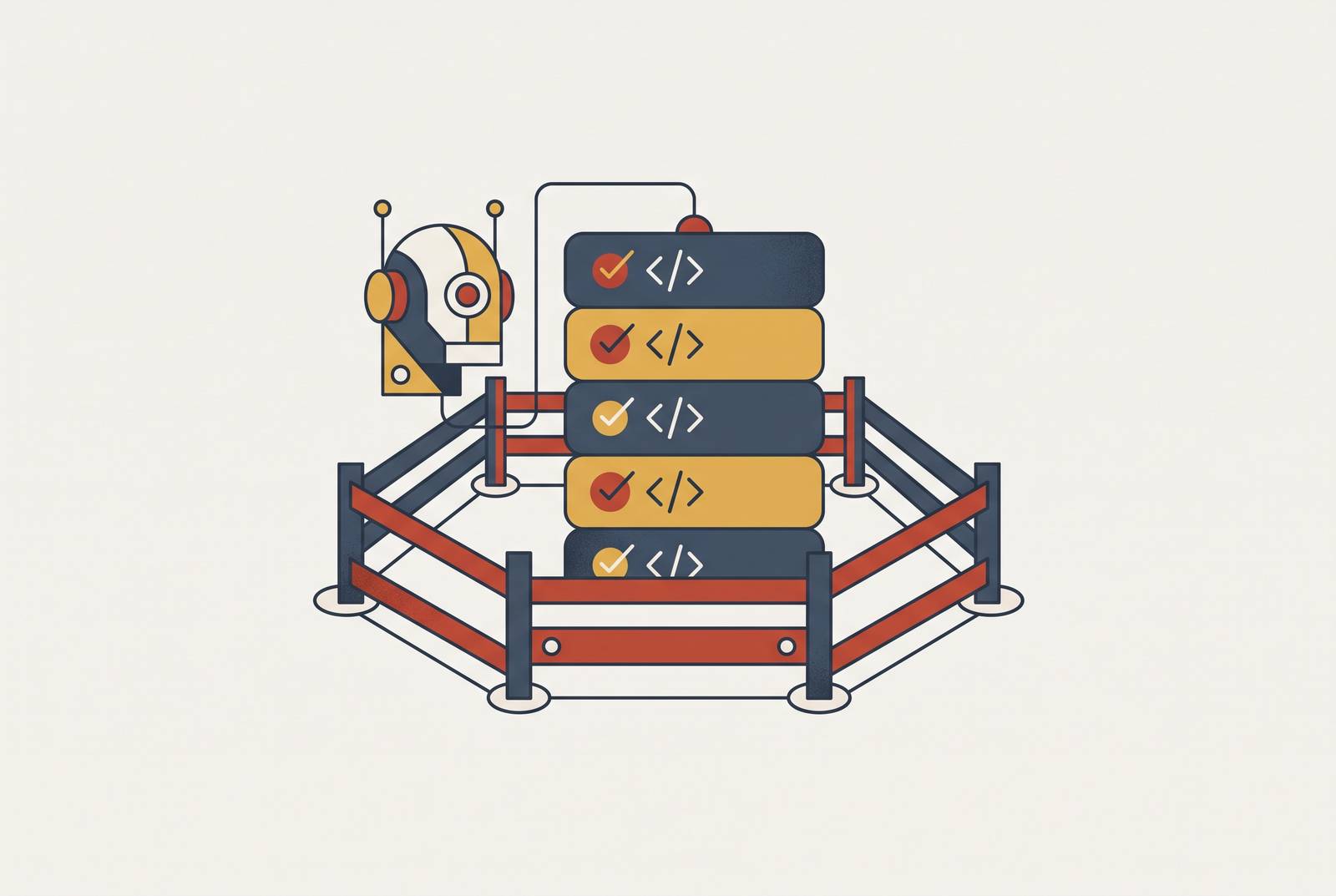
Coding agents have moved audit logging out of the DevOps backlog and into the compliance department, and the reason is structural: these systems act on real infrastructure, autonomously, in ways that no existing log practice was built to capture. This piece maps what a defensible audit record for a coding agent must actually contain, against the regulatory frameworks now enforcing that requirement.
Why existing log practices cannot capture coding agent behavior
Traditional software logging works because traditional software is deterministic. A call stack traces accountability cleanly because control flow is linear: the program does what the code says, every time, and when something breaks, an engineer finds the line responsible. AI coding agents violate that assumption in three ways simultaneously. They reason across time rather than executing a single fixed path, they invoke external tools such as APIs, databases, CI/CD pipelines, and secrets stores, and they produce outputs that depend on context that shifts between one execution and the next. None of that fits the mental model that application logging was built around.
A prompt log paired with a completion log does not constitute an audit trail. It records what the agent was asked and what it said back, but it says nothing about what the agent actually did to a production system, why it believed it had the authority to do it, or which policies applied to that action at the moment it happened. Those are three separate questions, and a transcript of a conversation answers none of them.
The gap is widening rather than closing. Gravitee's State of AI Agent Security 2026 found that 48% of production AI agents run with no security or governance monitoring at all, and that figure sits alongside a fleet that keeps expanding faster than governance tooling can be built out, so the raw count of unmonitored agents keeps climbing even where monitoring rates inch upward. Layering onto that is a speed mismatch: a compromised agent can exfiltrate millions of records before a 24-hour audit cycle even completes its first pass, because detective controls sized for human-speed violations were never built to catch a machine acting at machine speed. Multi-agent systems compound the exposure further. When one agent delegates work to another, data can be combined or exposed in ways that breach compliance obligations even though each individual agent, taken alone, stayed inside its stated permissions.
That is the problem this article is built to answer: can an organization prove what its agent did, why it believed it was authorized to do it, and under whose authority it acted? Everything that follows is an attempt to specify what that proof looks like.
The regulatory frameworks now requiring specific logging capabilities for AI agents
Three regulatory tracks have converged on the same demand, and none of them are treating it as aspirational anymore: comprehensive, immutable audit logs, with enforcement mechanisms attached.
The EU AI Act is the most concrete of the three. Article 12 takes effect on August 2, 2026, and requires that high-risk AI systems technically support "automatic recording of events (logs) over the lifetime of the system," with those logs retained for a minimum of six months. The article is explicit that this logging capacity has to be built into the system's core design; adding an audit layer as an afterthought does not satisfy it. The August 2, 2026 enforcement date activates the compliance-intensive provisions: transparency obligations for AI-generated content under Article 50 and active enforcement powers, though the Annex III high-risk system requirements themselves were pushed to December 2, 2027 by the Digital Omnibus regulation, which entered into force in late July 2026. Whether any given coding agent falls under the high-risk category depends entirely on what it is deployed to do: an agent writing an internal CRUD application occupies different regulatory ground than one operating inside employment, lending, healthcare, or critical infrastructure systems. The Digital Omnibus proposal first surfaced in November 2025 as a delay mechanism. By late June 2026 it had cleared both the European Parliament, on June 16, and the Council, on June 29, with entry into force on July 27, 2026; engineering teams building compliance infrastructure now have an actual date to work from rather than a hoped-for extension.
HIPAA's Technical Safeguards impose their own logging floor, requiring activity logs retained for six years, and the current state of the field is not encouraging: most healthcare AI agent deployments fail HIPAA compliance outright because standard AI architectures were not built to satisfy Technical Safeguards mandates in the first place. An organization cannot tell an auditor that its controls prevented unauthorized agent access to patient data without producing logs that demonstrate those controls actually fired on every access attempt. Policy documentation describing what should happen carries no weight without technical evidence of what did happen.
Financial services regulation runs on a similar principle with a longer retention window. FINRA and SEC rules require audit trails tied to trading and advice to be kept for up to seven years, and the U.S. Treasury's Financial Services AI Risk Management Framework applies the same standard used elsewhere in this piece: evidence that a control operated.
NIST's AI RMF 1.0, released in January 2023, remains the current core framework, since no version 1.1 has been released as of 2026, and its updated MEASURE function guidance has become the de facto baseline for US federal procurement and enterprise vendor questionnaires. The international AI management system standard is now the framework enterprise procurement teams verify against when onboarding AI-powered vendors. At the state level, Colorado's AI Act, SB 24-205, takes effect June 30, 2026, and requires impact assessments and transparency documentation for high-risk AI decisions, documentation that is only possible to produce if an audit trail already exists to draw it from.
Enforcement has already arrived, and it is not limited to AI developers making false claims in isolation. The FTC imposed a twenty-year audit order on Workado after the company marketed an AI detection tool as "98 percent accurate" when it performed at roughly coin-flip accuracy. That order is a clear signal that regulators have stopped extending the benefit of the doubt to unverifiable AI performance claims. Not every coding agent deployment sits inside a formally regulated category today, but the direction of travel is unmistakable: enterprise procurement and compliance review are converging on the same audit-trail requirements that regulation is imposing directly, so building this capability is a sound investment regardless of an organization's formal regulatory exposure.
What a compliance-grade audit record must contain
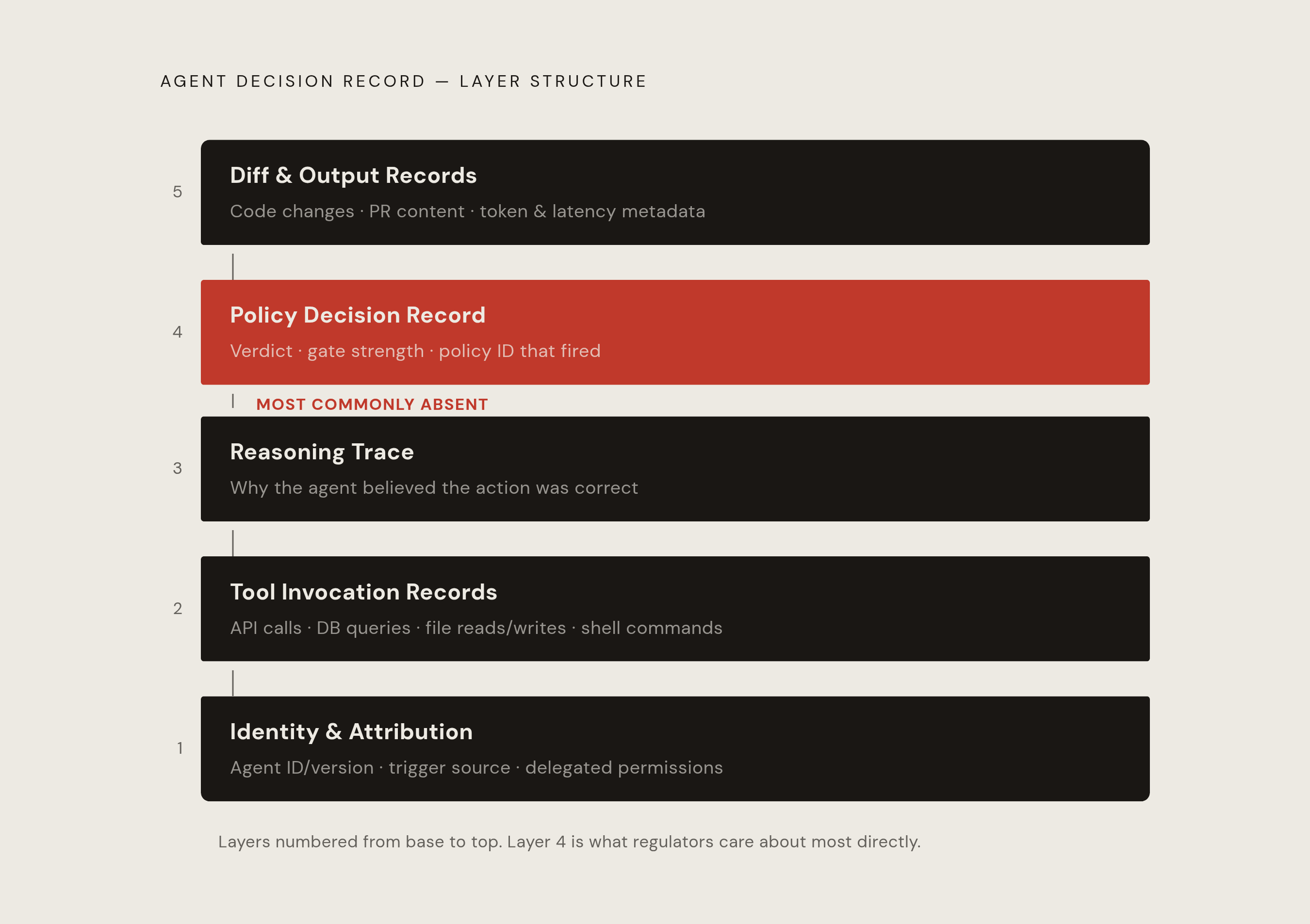
The structure emerging across these frameworks has a name: the Agent Decision Record, built not to help an engineer debug a failed run but to answer a regulator's or a lawyer's questions after the fact, namely who authorized the action, what context the agent had, what it decided, whether that decision matched policy, and what effects it produced in the real world.
Identity and attribution come first. A compliance-grade record needs the specific agent identifier and version running at the time, not just the underlying model name, because configuration changes behavior. It needs to record who or what triggered the interaction, whether a human, a scheduled job, or an upstream agent, and it needs to capture the exact permissions delegated for that specific execution rather than the full set of permissions the agent could theoretically exercise. A support agent and a financial reporting agent should never share API keys or database credentials, since separation is what makes attribution, investigation, and scope limitation possible in the first place.
Tool invocation records form the next layer, and most teams have skipped it. Every API call, database query, file read or write, and shell command the agent executes needs a timestamp, along with the specific tool or API invoked, the parameters passed to it, and the response it returned. Every agent run, every file touched, every pull request submitted needs a logged timestamp and user identity attached to it. Prompt and completion logs record what the agent was asked to do; tool call logs record what it actually did to production infrastructure, and only one of those two things is evidence.
The reasoning trace matters because it is what separates knowing an agent deleted a file from understanding why the agent believed deleting that file was the correct action. Regulatory traceability requirements demand proof of why an agent took a specific action, what data informed that action, and what governance policy applied at the moment of execution. A reasoning trace also becomes the record an organization relies on when reconstructing agent behavior under legal discovery: a log without a reasoning trace shows what happened, but it does not show what the agent understood.
The policy decision record deserves the most attention here: it is most commonly absent from existing systems, and it is what regulators care about most directly. A prompt-and-completion log is a record of intent and response. It is not a record of governance. Gate strength is not a cosmetic detail. Two separate deployments can produce byte-identical action logs while sitting in entirely different positions relative to Article 12 compliance, because one system actually blocked the risky action and the other merely annotated it after letting it through. The signed entry that satisfies a regulatory review needs the verdict, the gate strength, and the specific policy ID that fired, because together they make the gate's bindingness something a reviewer can check directly rather than infer from whatever outcome happened to result.
Diff and output records round out the technical core. The audit trail needs the actual code changes, the pull request content, or the configuration modification the agent produced, in full, not a summary of what changed. Latency and token metadata belong here too, since both model token spend and any downstream compute the agent's actions trigger need to be tracked as part of the record.
Multi-agent pipelines need a delegation chain layer of their own. When one agent spawns or hands off work to another, the audit trail has to capture that handoff, including the scope of authority that moved with it. This matters because multi-agent interactions can produce data flows that breach compliance requirements even when no single agent involved exceeded its own permission boundary, as when a compliance reporting agent ingests unmasked personal data from a data quality agent's intermediate output without either agent individually doing anything out of bounds. A static policy set enforced once at session start cannot catch that. Governance has to evaluate at the level of each individual request, checking every action an agent takes rather than the session as a whole.
Why audit and enforcement must happen simultaneously
A governance layer that reviews logs after an agent has already acted is not a governance layer at all in the eyes of a regulator evaluating a high-risk system. If the only thing standing between an agent's action and a compliance review is an observer checking logs after the fact, that system is already out of compliance, because what's required is runtime governance: enforcement and audit happening at the same instant.
The architecture this demands is specific. Every time an agent proposes an action, it needs to hit a gate that does two things at once: evaluate the action against deterministic rules to permit or deny it, and write a tamper-evident record of that exact decision, in that exact moment. This is what the gate-as-audit-source pattern, sometimes called middleware interception, is built around. The audit trail is not a side effect the system happens to produce while doing its real job; it is a primary output of the governance layer itself, generated in the same operation that decides whether the action is allowed to proceed.
There is a real cost to this design. Inserting a governance gate into every tool call adds latency to every agent action, but in a regulated environment that latency is what purchases the legal right to keep operating the system. Agents act at machine speed, and a compromised agent can exfiltrate data well before a 24-hour audit cycle even gets underway. Detective controls calibrated for human-speed misconduct cannot catch an incident unfolding at machine speed. Runtime enforcement is what closes that window, because it stops the action at the moment of the decision rather than flagging it a day later.
The architectural implication follows directly from this. Governance logic cannot sit in a sidecar process or get shipped off to a downstream SIEM for later analysis. It has to live in the critical path of every single tool call the agent makes, evaluating and recording before the action executes, not after.
The technical standard for log immutability and tamper-evidence
None of the record-keeping described above satisfies a regulator if the underlying log can be quietly edited after the fact. A log that is merely access-controlled, where only authorized personnel are supposed to modify it, is a fundamentally different object from a log that is technically incapable of being altered without leaving evidence of the attempt. Only the second kind functions as regulatory evidence; the first is just a document that an organization has promised not to touch.
The technical baseline for this is an append-only log architecture built on hash chaining, using SHA-256 as the minimum hashing standard. In a hash-chained log, each entry incorporates the hash of the entry before it, so altering any single record breaks the chain in a way that's mathematically detectable rather than something an investigator has to take on faith.
Storage has to be write-once: the system architecture itself does not permit UPDATE or DELETE operations against audit records once they're written. That is not a permissions setting that an administrator could override under pressure; it is a property of the storage layer itself. And batches of log entries need cryptographic signatures applied at the batch level, so that even bulk tampering across many records at once produces a verifiable break rather than a silent edit.
This is the property that ties the entire audit architecture together. A policy decision record with a verdict, a gate strength, and a policy ID means nothing to a regulator if the record itself could have been rewritten after the incident it describes. Immutability is a specific, checkable technical property, one an organization cannot simply assume about its own systems, and it is the property regulators will ask an organization to demonstrate, not merely describe.
Sources
- Top enterprise coding agents in 2026
- AI Agent Audit: The Complete 2026 Governance and Compliance Guide
- Your compliance team will ask for an AI agent audit trail before August 2. Here's the part most teams haven't built. - DEV Community
- AI Agent Data Governance: The Enterprise Playbook for 2026
- State of AI Agent Security Report 2026