Why GUI-Configured Agents Are Ungovernable at the Framework Level
Dashboard toggles can't be reviewed, versioned, or independently enforced.

Agents-as-code means defining an agent’s tools, credential scope, network rules, and configuration in YAML or Markdown+YAML files committed to Git. Those definitions go through pull requests and review, and are enforced before the agent runs. GUI-only configuration is ungovernable at the framework level because dashboard state cannot substitute for a versioned authorization policy that deployment infrastructure enforces independently.
Why coding agents are now a team-level security boundary, not a personal tool preference
The unit of work delegated to a coding agent is now a repository-scoped task. Agents plan changes, edit across files, run tests, and open pull requests with little need for someone to watch over them. They can also execute shell commands, call external APIs, and run for hours. A choice in the configuration can decide whether a system that runs for hours can reach production infrastructure.
Anthropic’s 2026 Agentic Coding Trends Report characterizes 2025 as the transition from experimental tools to production systems, with engineers increasingly orchestrating long-running agents. Spotify makes that shift concrete. By November 2025, more than 1,500 AI-generated pull requests had merged into production, backed by validation, sandboxing, and quality gates. That volume cannot be governed through individual developers’ preferences. The security perimeter now includes the configuration under which delegated work executes, so responsibility for it belongs at team level.
What governance of an agent configuration actually requires
Version control means every change to an agent’s behavior is diffable, reviewable, and revertible through the same discipline applied to infrastructure changes. Machine-enforceable semantics mean permission boundaries are declared in a form that tooling can evaluate at runtime. Attributable audit trails connect every action to a named human identity and the configuration state under which it occurred. Scoped, session-bound permissions use least-privilege credentials minted for the session and revoked on completion, rather than standing credentials inherited from a developer. These are properties of storage and deployment.
Every session must map to a named human identity so that access reviews, offboarding, and accountability work. Audit logging must cover file access, shell commands, pull request creation, and API calls, with records flowing into the enterprise SIEM under the applicable retention requirements. Permissions must separate read paths from destructive ones. Enterprise security reviews already ask for SSO mapping, SIEM-connected logging, PR policy gates, and sandbox isolation because an activity log alone cannot show that an agent had permission to act.
Why GUI configuration cannot satisfy that standard by design
A toggle or dropdown writes state into an internal store. When that store is the sole authority, the configuration has no canonical text representation that can be reviewed in a pull request or compared against an approved version. Branch protection, required reviewers, and CI checks cannot govern a permission change that never goes through them.
A permission granted entirely through a dashboard cannot be blocked by the repository’s required reviewer or evaluated by its policy checks. Runtime enforcement presents the same structural problem. The permission set must be derived from a source of truth the agent cannot modify, rather than depend solely on the system holding the mutable settings. Otherwise, the framework has no independent authorization contract against which to constrain execution.
Credential scope exposes the practical consequence of that gap. GUI-configured agents usually get the developer’s standing credentials instead of credentials that last only for the current session. PocketOS founder Jer Crane reported that an AI coding agent deleted the production database and all volume-level backups in a single API call to Railway. The agent’s authority allowed its destructive action to destroy both.
An execution log may show what happened without preserving the approved configuration that made it possible. A dashboard change log does not automatically close that gap. Records in the tool’s own store do not, by themselves, establish immutability, SIEM availability, or a connection to an approving code review. The audit question remains unanswered unless the execution can be tied to an authoritative configuration state and the human decision behind it.
How the 2026 incident record maps to this structural gap
The Cloud Security Alliance called Mini Shai-Hulud the first supply-chain attack on record to weaponize AI coding agent configuration files as a persistence mechanism. The attack used a .claude/settings.json SessionStart hook, making configuration an execution entry point that could reactivate when a developer opened a project. This was a file-based attack. Its relevance is the need to govern configuration as executable infrastructure. A GUI-only equivalent offers no repository history or required-review boundary, while a committed file provides a surface for those controls only if they are actually enforced.
The PocketOS incident illustrates a different missing control. Its failure was credential scope: the agent had authority it did not need, without a machine-enforced boundary separating production from its recovery path. A versioned policy would have to govern credential issuance and allowed operations to prevent that class of failure. Merely recording a narrower intention would not constrain the credential.
Inventory blindness makes both patterns harder to contain. Coding agents can run on developer laptops without showing up in the cloud registries used to find server-side agents. A complete server-side inventory can therefore coexist with substantial gaps in local-agent visibility, and GUI-only local settings provide no repository definition for security teams to inspect. Discovery and configuration review solve different problems. Together, they must make it possible to determine what an agent can reach and the worst action it can take with one call.
Why better dashboards do not solve this and "observable GUI config" is not governance
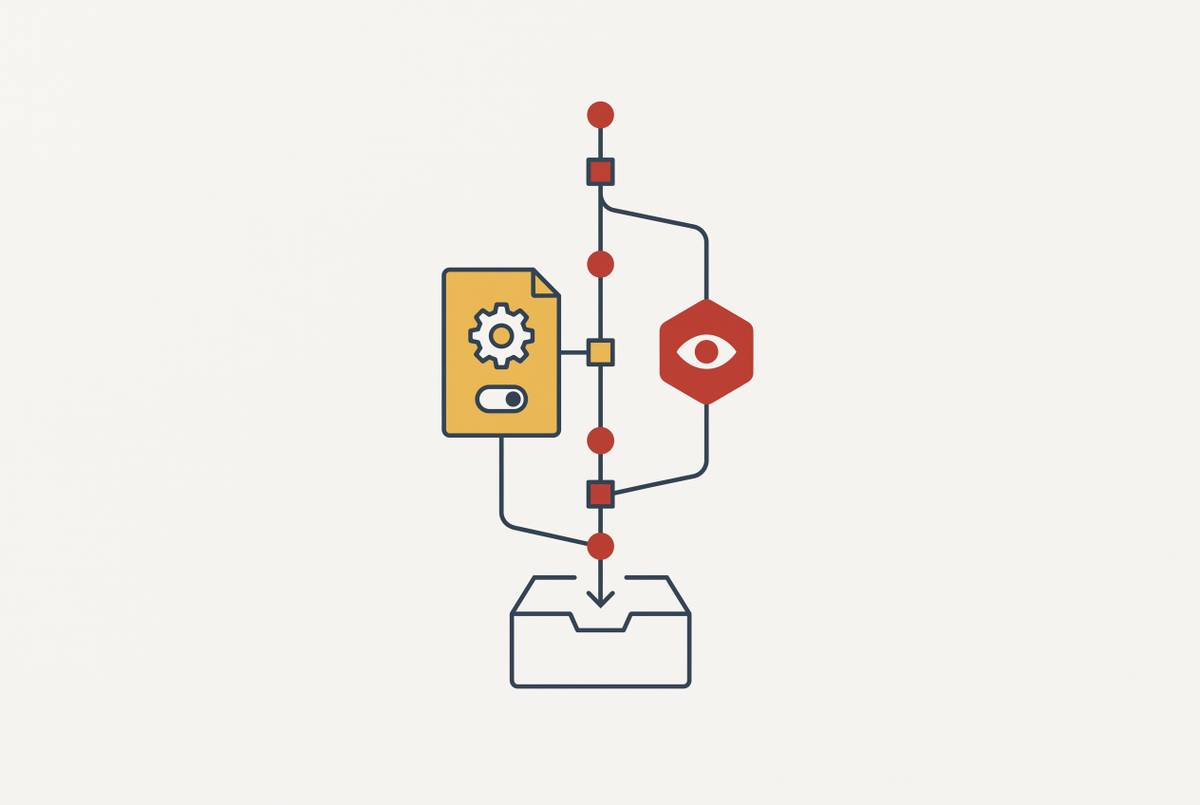
Observability records execution, while governance constrains authorization before execution. A log of every tool call is useful evidence, but it does not establish that the permission enabling the call was reviewed, approved, and unchanged since approval. Those are different claims requiring different records. Intent observability connects an action to why it was permitted and who approved that permission.
A richer dashboard also leaves the enforcement boundary untouched. It does not, by itself, make permissions reviewable in pull requests, supply machine-enforceable semantics, or narrow inherited credentials. Enterprise security reviews ask whether authorization was governed, which takes more than being able to see what happened. The NIST AI Agent Standards Initiative, launched in February 2026, points toward standards and oversight that treat agentic AI as a category of its own. That direction supports explicit, auditable authorization records without establishing that a particular rule already mandates repository-based configuration.
The objection that review adds friction does not change the control required. Distributed systems enforce rate limits at gateways rather than rely on a service’s willingness to comply. Databases use permissions to limit destructive operations. Agents require the same separation of intent and authority. A dashboard can remain a useful interface, but when its changes become versioned policy subject to review and independent enforcement, governance comes from that underlying infrastructure.
How do you define AI agents in YAML so they live in Git?
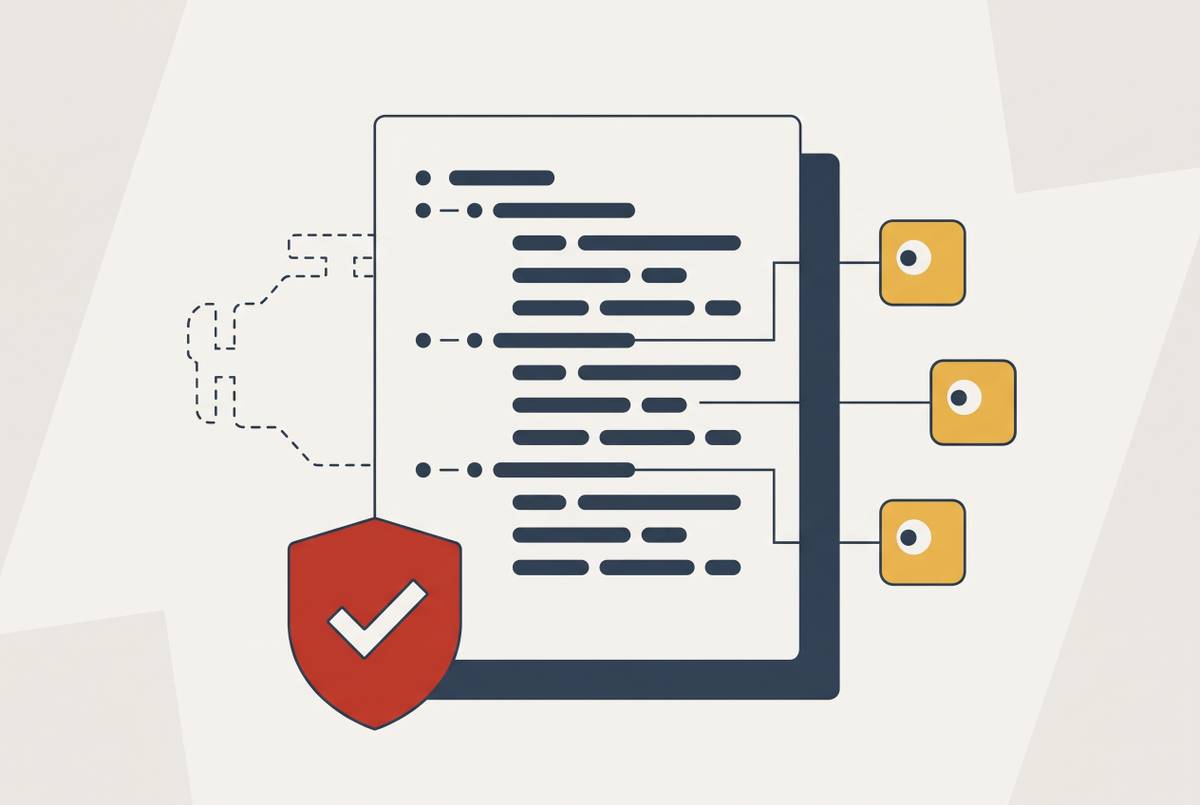
The agents-as-code pattern places tools, credential scope, network rules, and configuration in a YAML or Markdown+YAML definition committed to the repository. The agent boots from that definition consistently, and behavior changes follow the review process used for infrastructure. The file is the authoritative specification. Its value comes from connecting the reviewed definition to what deployment tooling permits.
Model-Based Agentic Software Engineering, or MAGE, formalizes two principles, Modeling and Alignment. Its Alignment Principle gives engineering obligations authority through constraints, sensors, validators, and gates. This provides a useful distinction for agent definitions. Configuration should express obligations that engineering systems can enforce, rather than force each reviewer to reconstruct them from runtime behavior or interface state. The role of AGENTS.md also needs an explicit organizational convention, and the file belongs in source control regardless of how the community resolves that role.
The propose/dispose CI pattern makes the permission boundary concrete. The job that runs the agent gets read-only access to repository contents and nothing else, and deployment secrets are kept out of its environment. CI can thus enforce the declared boundary before the agent starts work. Pull request review governs the proposed change without giving the agent the privileges to carry out everything that could follow from it.
Isolation extends that separation into execution. Anthropic describes decoupling the agent’s reasoning process from its sandbox, with the agent calling the sandbox as a tool. Credentials stay outside the sandbox, and a sandbox crash does not end the session. For production workloads handling proprietary code, microVM isolation with a dedicated kernel per agent workload is the recommended baseline. That boundary is particularly important when agents execute shell commands, install packages, or make network requests.
These patterns give YAML definitions an operational role. The repository holds the reviewed declaration, CI evaluates the boundary before work starts, and runtime controls restrict the session’s actual authority. Each layer has a separate responsibility. Neither a configuration file nor a sandbox replaces the other, because review governs what should be allowed while isolation and credentials govern what can happen.
Where the enforcement boundary sits and what engineering teams should do first
Engineering teams should begin with inventory, before choosing which configurations to standardize. Registry-based discovery misses coding agents that run locally on developer laptops, so teams need telemetry, network-layer analysis, and MCP server monitoring to see which agents they actually have. Discovery comes before policy can be applied consistently. A security team cannot scope an agent it does not know exists, even if its server-side agent registry is complete.
The second move is to commit configuration. Every agent retained after inventory should have a YAML or Markdown+YAML definition in its repository covering tools, permission tier, network rules, and credential scope. Settings that exist only in a GUI should not be authoritative. The third move is to enforce the delivery boundary through branch protection, required reviewers, and CI status checks. Agent-generated pull requests should meet the same owner-review, coverage, secret-scanning, and SAST requirements as human pull requests, with tool and session IDs linking them to the originating SIEM records.
The fourth move is to scope credentials. Read paths should be separated from destructive ones, with credentials minted per session and revoked on completion. No agent should inherit standing developer credentials that can reach both production and backup infrastructure. This control belongs in credential issuance and runtime permissions. A reviewed configuration must set what the session has authority to do, going beyond a description of what its authors hoped it would do.
The fifth move is to enforce session budgets. Token budgets, model-call limits, tool-call limits, and dollar caps must stop execution during the session instead of reporting afterward that it went over a limit. The four-agent LangChain runaway-loop case illustrates the distinction. Without a budget limit, the pipeline ran for an extended period before its billing dashboard displayed a number large enough to stop it.
Branch protection and CI control what gets through, scoped credentials limit what the agent can do, and session budgets stop work that goes over its limits. Choosing a tool does not put those controls in place on its own. The deployment decision is complete only when an agent’s reviewed definition determines the permissions and limits under which it can run.