Least-Privilege Credential Scoping for AI Coding Agents
AI agents need credential scoping that changes with each task, not fixed roles.

Least-privilege, as a working principle, assumes a designer can predict at build time what a program will do with the access it's given. Scoping access is straightforward because the behavior is fixed before the program ever runs, and the rest of this piece explains why that assumption no longer holds for AI coding agents, and what has to replace it.
Why Classical Least-Privilege Breaks
The principle of least privilege has held up for decades because deterministic software makes a narrow, knowable set of moves. The access it needs can be scoped once, during design, because its behavior at runtime matches its behavior on paper. Role-based access control rests on the assumption that the role and the actual action set are the same thing, so granting the role is equivalent to granting what's needed.
AI coding agents break that equivalence. None of that sequence exists in the source code ahead of time. The agent's actual behavior is only knowable by watching it run, not by reading what it was built to do.
The stakes of that shift are concrete. An autonomous agent holding elevated permissions turns the same kind of mistake into an operational action: a file gets deleted, a remediation script runs against the wrong service, a ticket gets closed that shouldn't have been. Errors no longer stop at the editor. They propagate into live systems because the agent, unlike the autocomplete tool before it, has the standing access to act on its own conclusions.
This isn't a matter of someone misconfiguring a policy somewhere. The mismatch is structural: least privilege was built for programs whose behavior is set at deploy time, and agents are software whose behavior is only legible at runtime. Scoping access correctly for a system like that requires rethinking what "least" and "privilege" mean when the actions themselves aren't fixed in advance.
Accumulated Effective Permissions
Agents end up holding more effective access than anyone intended to give them, and two mechanisms account for most of it: scope creep during provisioning, and the combination effect that emerges once an agent touches several systems at once.
Scope creep follows a pattern Microsoft's security team has documented directly. A team sets up an agent with a broad "Reader" role because the first use case looks read-only, nothing more. That incremental broadening rarely gets revisited once the deadline pressure that caused it has passed, and the agent is left running with permissions shaped by its history of ad hoc changes.
Human access-review workflows don't catch this because they weren't built for it. An agent stood up for a six-week migration can still hold its original write access eight months later, long after the migration finished and the justification disappeared.
The combination effect is a separate problem, and it's the one engineering teams tend to underestimate. An agent connected to email, a file store, a ticketing system, and a code repository can look reasonably safe at each individual connection. Microsoft's security team names this risk directly: the danger isn't any one integration, but what the agent can do once it holds all of them at the same time.
Two additional patterns add texture to this picture without changing its shape. Agents that connect to multiple tools through the Model Context Protocol load every tool's schema into the context window on each request. A large inventory of tools is structurally visible to the model even when most of them have nothing to do with the task in front of it. And the scale of the underlying problem isn't theoretical: SkillScope, a framework accepted at ACM CCS 2026, measured over-privileged behavior across 68,312 valid real-world Agent Skills and found that nearly one in ten of them perform actions exceeding what the user's actual request required.
Why over-privilege is task-conditioned, not just role-conditioned
The deeper problem with applying classical role-based thinking to agents is that an action's legitimacy doesn't depend only on who the agent is. It depends on what the agent is doing right now. The same tool call that's perfectly reasonable under one prompt becomes a violation under another, even though the agent's role, credentials, and installed capabilities haven't changed at all between the two moments.
SkillScope's own framing makes this point precisely: existing approaches to detecting over-privileged skills fall short because the problem is inherently tied to the current task, not to the agent's fixed capability set, so the framework models each action against what the user actually asked for rather than against what the agent is generally allowed to do. That's a meaningful departure from how access control has worked for thirty years. A standing role assignment, the basic unit of RBAC, simply can't capture a condition that changes from one request to the next.
A real example from SkillScope's analysis makes the abstraction concrete. A "deep-work" skill advertises a single purpose: generate a local heatmap report. In execution, it also sends that report to an external recipient and collects host identifiers for outbound transmission. Both happen anyway, folded into execution as if they were part of the job, because nothing in the system checked whether each action matched what the user had actually requested.
That example points toward a privilege model with several layers operating at once. Each one has to be evaluated while the task is actually running, which is the structural requirement the next section builds toward.
The structural fix: per-session identity, task-conditioned permission envelopes, and credentials that expire
A working least-privilege model for agents needs three changes operating together, not as separate projects to check off but as a system in which each piece covers a gap the other two leave open. Every agent session needs its own identity. Permissions need to track the active task. And credentials need to be minted fresh when a session starts and revoked the moment it ends.
Per-session identity means treating each agent as a distinct principal with a named owner and a stated purpose, rather than letting a fleet of agents share one service account. They just don't mean anything, because the identity model behind them was never built to answer the question that matters.
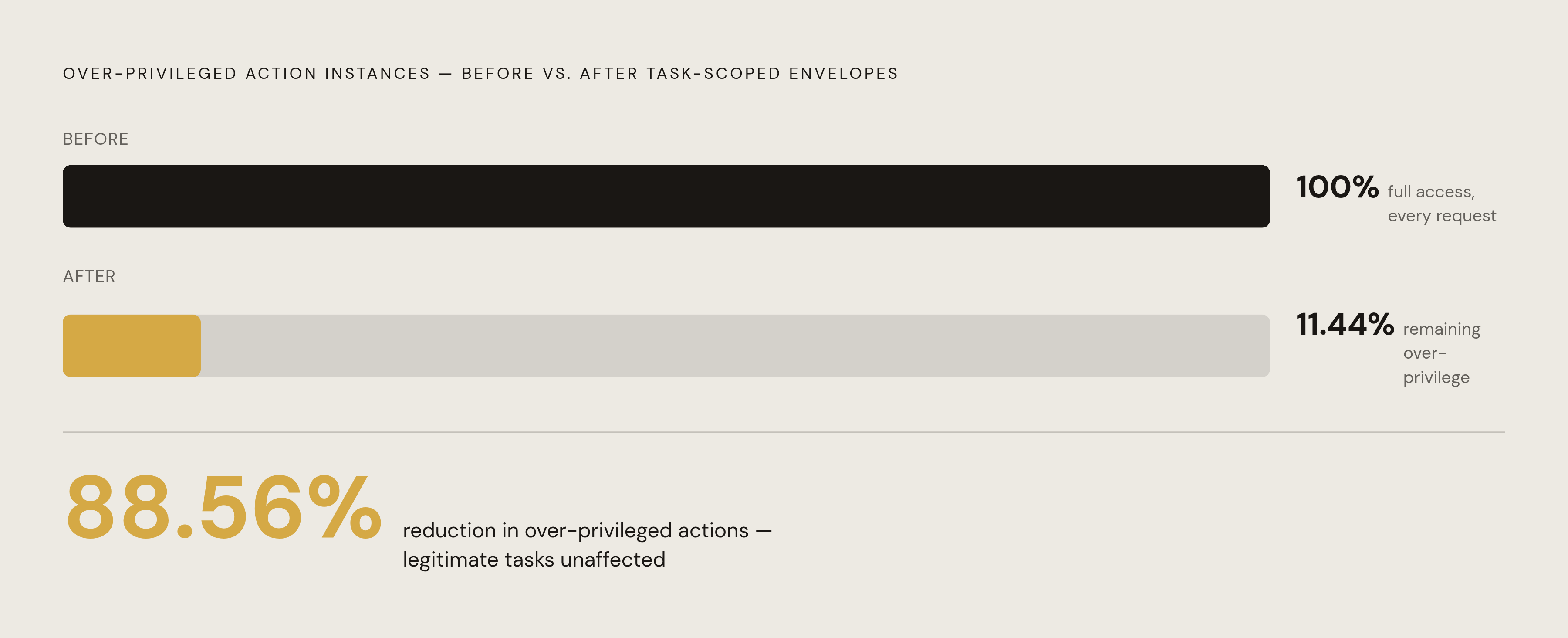
Task-conditioned permission envelopes are the second piece. The envelope is the set of tools, arguments, and data access that's valid for whatever the agent is doing right now, and it should expand or contract as the task context shifts, rather than sitting fixed at whatever the agent's provisioned role happened to be. Instead of loading every connected tool's schema into context on every request, the system exposes a small set of meta-tools relevant to the current step and keeps the rest out of view. Constraining over-privileged actions to task scope through control-flow privilege constraining cut triggered over-privileged action instances by 88.56%, while the agents in the study still completed the legitimate work they were asked to do.
The third piece is ephemeral credentials: access minted at the start of a session and revoked automatically when the session ends, rather than standing access that persists indefinitely. The expiry has to be structural, baked into the system, not a step on a checklist someone is supposed to remember.
A deny-by-default sandbox is the infrastructure expression of that same idea. The agent's file access stays limited to the project folder, with no path into the home directory or SSH keys. Outbound network traffic is blocked except to a named list of hosts. A .gitignore file is not a security boundary.
What a compromised agent can do with standing credentials
When an agent holds broad, standing credentials and that agent is compromised, the attacker inherits the full permission set, not just the narrow slice of access the triggering task happened to use. That's the right way to measure the size of an incident: not by what the attacker was trying to do, but by everything the compromised agent was able to do.
The more common entry point is the data and tools the agent already trusts. Prompt injection through tool responses is the most frequently documented path: a tool call that looks completely routine returns a response carrying instructions hidden inside it, the agent reads that response as part of its legitimate task, and it acts on the hidden instructions using another tool it's already authorized to use. The agent simply did what it was told to do by content it had no reason to distrust.
Memory makes this worse over time. Agents carry state within a task and sometimes across sessions, so a single piece of poisoned input encountered early can keep shaping decisions long after the input itself is gone from view. The signal that would indicate compromise looks identical to the noise a working agent produces every day, which makes detection by behavior alone unreliable.
The concrete consequences follow directly from standing, broad access: sensitive data gets retrieved or summarized for an audience it was never meant to reach, an agent "helpfully" automates a remediation step and ends up modifying or deleting something it had no business touching, and the resulting investigation stalls because the identity model in place can't answer who authorized the action. Every structural fix described in the previous section cuts directly against this. Per-session identity means a compromise is traceable to one session. Task-conditioned envelopes mean the credentials in play at the moment of compromise were already limited to what that task required. Ephemeral credentials mean the window during which stolen access is still valid is short by design, not by luck.
Audit trails require intent observability, not just execution observability
A usable audit trail for agent activity needs two separate layers: execution observability, which records what the agent did, and intent observability, which records why it did it. Most enterprise programs today build the first layer and stop there, which leaves a serious gap once something goes wrong.
Execution-only logging can answer forensic questions after the fact. It can tell an investigator which tool was called and when. What it can't do is support real-time intervention, and it can't satisfy a regulator asking whether a given action fell inside the scope the agent was actually meant to operate in, because the log alone has no record of what that scope was at the time. Microsoft's security team describes the failure mode in direct terms: the system captures which tool got called, but it can't say whether the call was within the intended scope for the task underway. The record exists. It just can't answer the question anyone would actually ask about it.
The 2026 Singapore Consensus on Global AI Safety Research Priorities treats this as a governance fundamental.
Intent observability, in practice, means logging the task context and the active permission envelope at the moment of each tool call, not just the call itself, so a reviewer afterward can check whether the action matched what the task actually called for. LangGraph 1.0 illustrates one way to build toward this, modeling agent logic as a graph of nodes and edges so it keeps complex state transitions manageable and provides a traceable execution history through checkpointed state, with LangSmith handling the observability layer on top of it. The graph structure doesn't replace intent logging, but it gives a system the scaffolding needed to record not just what happened, but the state the agent was in when it happened.
Configuration as the enforcement layer: agent permissions belong in version-controlled YAML, not web forms
Permission scoping that lives in a web console or gets granted by hand at deployment time can't be peer-reviewed, can't be diffed against a prior version, and can't be rolled back cleanly if something goes wrong. That's the same scope-creep dynamic described earlier, just moved into the tooling layer: access changes happen informally, nobody circles back to check them, and the record of why a given permission exists eventually disappears.
The agents-as-code pattern addresses this directly by storing agent definitions, tool configurations, and credential scopes together in a source-controlled repository, written as declarative manifests in YAML, HCL, or custom resource definitions, peer-reviewed like any other code change, and applied through automation. Git becomes the record of what changed and who signed off on it, and the platform pulls the versioned configuration at deploy time rather than running on whatever someone last clicked into a form.
Microsoft Foundry's CI/CD architecture is built around this same pattern: agent definitions live in version control, and each deployed version gets its own dedicated Microsoft Entra Agent Identity, with role assignments and policy enforcement applied per project. The effect is to hold agent governance to the same standard long applied to application software, where a change without a reviewed commit simply doesn't ship.
The Microsoft Agent Governance Toolkit pushes this further by moving enforcement ahead of execution rather than layering it on top of model output after the fact. Governance decisions get applied deterministically before an action reaches the wire, so a blocked action is structurally impossible. That's a meaningful distinction: a soft guardrail can be talked past by a sufficiently persistent chain of reasoning, but a pre-execution interceptor that refuses to pass a disallowed call through doesn't care how the model justified it.
Budget controls belong in this same configuration layer, and LiteLLM's hierarchical approach shows why. Declarative, version-controlled configuration is what turns least-privilege and cost control from policies people intend to enforce into limits a system actually can't cross.
Sources
- Least privilege for AI agents: Identity, access, and tool binding
- SkillScope: Toward Fine-Grained Least-Privilege Enforcement for Agent Skills
- The 2026 Singapore Consensus on Global AI Safety Research Priorities
- Task-Conditioned Least-Privilege Learning for Executable Terminal and MCP Agents
- Authorization Architectures for Tool-Using AI Agents