Operational Accountability Gaps That Appear When Agentic Coding Assistants Scale Beyond One Developer
Scaled agentic coding requires explicit governance controls sitting outside the agents themselves.
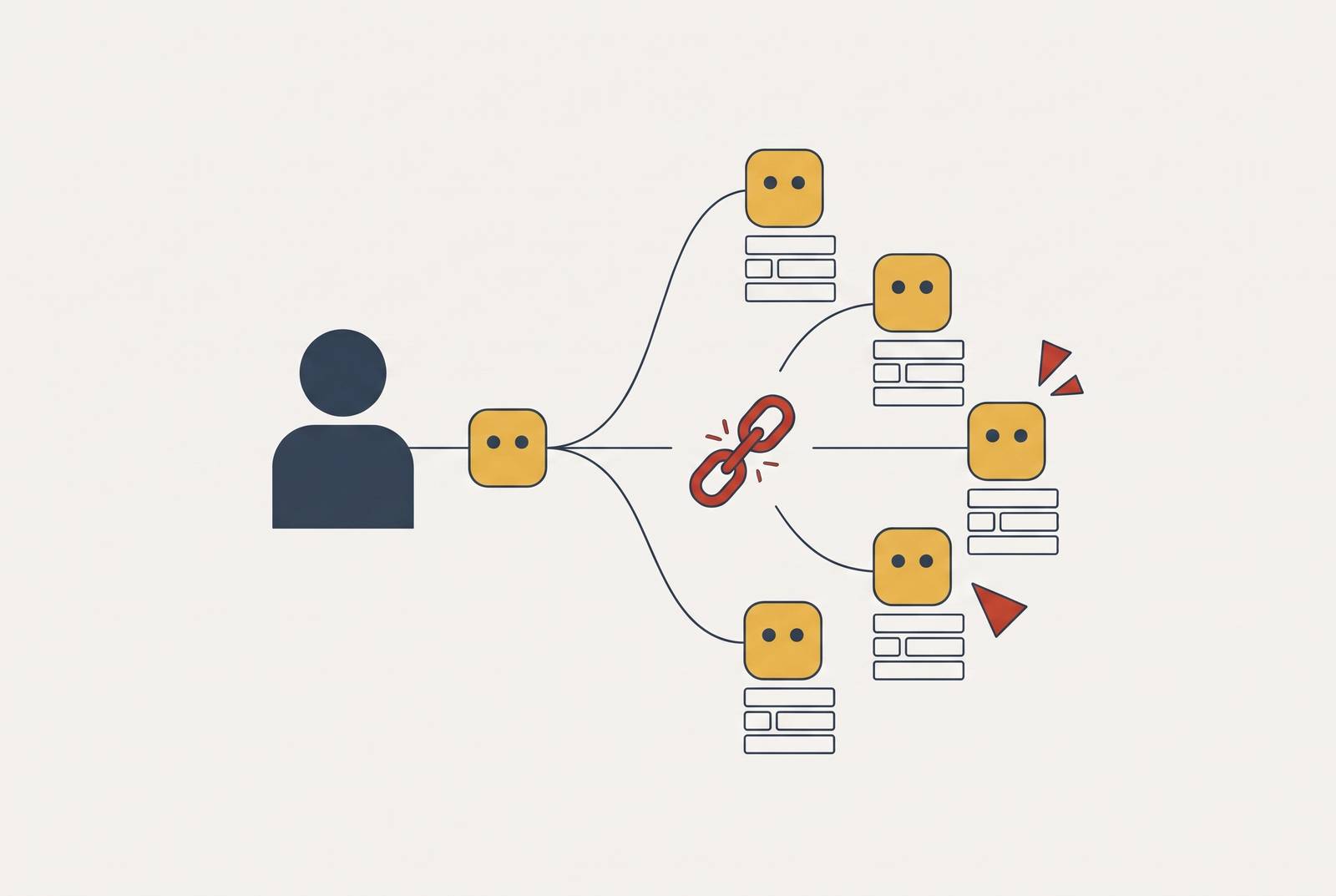
Running coding agents at team scale requires an operational governance layer. A managed cloud platform for that work must bind sessions to people, restrict credentials, preserve audit evidence, enforce review, and control spend. Those controls must sit outside the agents, with a named owner in the organization who remains responsible for governing them.
Why accountability breaks when an agentic coding assistant moves from one developer to an organization
A developer running an agent on a laptop owns the session, reviews the output, and decides whether to merge the PR. Across an engineering organization, that work is split across sessions, tools, and teams. Responsibility does not distribute automatically with the work. The person requesting a change may no longer be the person reviewing its output, and neither may be watching its intermediate actions.
Forrester’s 2026 report describes agents receiving intent across the software development lifecycle, such as “build this feature,” then decomposing work, generating artifacts, running tests, and preparing releases. One person’s memory can no longer serve as the record of authorization, execution, and acceptance. The shift is qualitative.
How terms of service already place organizational accountability on engineering teams, not on the tool providers
Christoph Treude’s 2026 comparative terms-of-service analysis finds a consistent tendency to assign responsibility for correctness, safety, and legal compliance to users. Across the nine providers analyzed, developers own what agents produce and bear obligations around verification, licensing, and indemnification, although the terms differ. Delegating execution does not transfer these obligations to the provider. The organization needs to assess whether it can discharge responsibilities it has already accepted.
The analysis looks at ownership and intellectual property rights, responsibility and liability, data governance, and acceptable use constraints. Training and retention terms set rules for how data is handled, while licensing and compliance obligations call for controls that a team cannot reliably replace with each person’s judgment. Many teams take on those obligations when individuals start using agents, before the organization has governance in place. The contractual assignment therefore precedes the infrastructure needed to support it.
The attribution gap — when an agent acts, the record rarely shows who authorized it
A developer enables an agent with a personal API key, then leaves the organization while the key persists. The agent continues acting under credentials no longer associated with an active identity. Offboarding never reached the agent’s access. This failure can remain silent because disabling the developer’s accounts does not, by itself, establish that every delegated session has lost its authority.
Northflank’s enterprise deployment guide requires every agent request to be attributable to a specific person and recommends configuring SSO before anything else. The requirement is stronger than recording an account name. Every session must bind to a named human identity so that access reviews, offboarding, and investigations can follow the delegation. Without that binding, a record of activity does not establish who authorized it.
Attribution is therefore a design decision. Searching logs later cannot recover a link to an identity that was never made. At team scale, the authorization record must start with the session so the team has a record of why it ran without relying on someone’s memory.
The credential scope gap — agents inherit access designed for humans and hold it longer than any session should
Once a session has an accountable identity, the next question is what it can reach. Human developers accumulate broad permissions over time, and agents that inherit those permissions inherit the same reach. Shared credentials spread that exposure across sessions. An agent working on a narrow task can therefore have far more access than it needs for that task.
The deployment guide identifies sandbox isolation as a non-negotiable control and specifies microVM isolation with a dedicated kernel per agent workload as the baseline. Without isolation, a misconfigured agent can reach the host system, other teams’ infrastructure, or sensitive data stores. The dangerous combination is access to private data, exposure to untrusted content, and external communication within a persistent session. Each capability is manageable on its own, but they need stronger boundaries when used together.
The recommended credential architecture mints credentials at session start, limits them to the task, and revokes them at session end. Privileged access that stays in place and API keys that are shared break that boundary. Secret scanning before merge adds a separate safeguard because evidence from deployments shows that agents commit credentials more often than human developers. That check must be enforced independently of agent behavior.
The audit trail gap — activity logs that satisfy one developer satisfy no compliance framework
A terminal history, PR description, or local log can help a developer understand a session without providing an organizational audit trail. Enterprise deployment requirements say that a record of every file access, shell command, PR creation, and API call must go into the enterprise SIEM. Retention must meet the applicable compliance framework’s requirements. The evidence needs to survive beyond the person and environment that produced it.
SOC 2 Type II, PCI-DSS, and HIPAA impose access-control, audit-logging, and data-handling requirements that extend to AI tooling touching in-scope code or data. A compliant result does not excuse a non-compliant path. Governed AI-Assisted Engineering, or GAIE, distinguishes human-in-the-loop oversight for strategic functions, human-over-the-loop oversight for customer-impacting work, and automated-with-monitoring oversight for internal work. Each tier requires evidence artifacts, but the requirements differ with risk.
Those artifacts must be designed into the workflow. A post-hoc activity log cannot reconstruct evidence that the relevant oversight tier required during execution. Labeling agent PRs with the tool and session ID lets security operations connect a change to its originating session in the SIEM.
The oversight assignment gap — when agents act across a team, “someone should review this” is not a policy
An agent PR enters the same review queue as human-written changes, but its reviewer does not know it is agent-generated, which session produced it, or what that session was authorized to do. No malicious actor is required for this failure. Responsibility remains ambiguous because generating a candidate change and accepting it are treated as though they were the same assignment.
Zhongjie Wang and Mingyi Liu’s 2026 framework separates these functions through the Human–Agent Cell, which produces candidates, proposals, and evidence but gains no right to accept them just by doing the work. Each domain with its own governance remains responsible for accepting residual risk. When a change crosses those domains, it needs joint acceptance and explicit responsibility closure. An ad-hoc review cannot establish that every required owner accepted the risk.
The deployment framework translates that distinction into PR policy gates requiring owner review, coverage thresholds, lint, SAST, and secret detection. It allows no pilot exemptions, and every bypass must be logged and tied to a named role. In GAIE, work on authority levels, approval gates, and human–agent responsibility mapping runs throughout the lifecycle. Its application of the Bank of Thailand’s 2025 AI risk-management policy also connects oversight of strategic functions to the engineering pipeline when agents write the code governing those functions.
The cost governance gap — agent spend is uncapped by default and compounds across a team
A developer can notice an expensive session while operating it, but a team’s cumulative token expenditure spans people, sessions, and time periods. Without clear limits, much of that spend can go unmeasured until tasks end. The failure can be sudden. An agent running without a budget boundary also lacks one of the constraints that defines its authorized scope.
Enterprise deployment guidance accordingly treats hard budget caps as a non-negotiable control with identity, logging, and sandboxing. Separate limits are required for tokens, model calls, tool calls, retries, and dollars, with checks at the run, step, and tool level. A single aggregate cap cannot catch every session-level runaway. Cost control must be part of how the team assigns and tracks responsibility, as well as its later billing review.
Dynamic degradation provides another response at defined thresholds. Routine planning can move to a fallback model, context compression can reduce consumption, and non-critical tools can be gated. This approach keeps required operations running while constraining runaway cost.
Why the controls that close these gaps cannot be agent-level settings
An agent’s own guardrails are not a reliable enforcement boundary for organizational accountability. The controls must operate where the agent cannot influence or bypass them. Secret detection makes the distinction concrete. Asking an agent not to commit credentials governs its intended behavior, while pre-receive hooks or required status checks enforce the restriction independently.
Coding tools govern what happens within their own perimeter, but an organization running more than one agent needs the same controls across those perimeters. The deployment requirements identify seven infrastructure-level controls, including SSO integration, SIEM-connected audit logging, secret scanning on agent PRs, PR policy gates, license governance, sandbox isolation, and incident response runbooks. These controls govern the surrounding workflow rather than rely on each tool interpreting a policy correctly.
Generated code may contain snippets matching open-source licensed material, so enterprise legal teams require scanning before merge and a remediation process. The agent cannot supply that governance by itself. GAIE also adds governance to the SDLC controls already in place and keeps those controls as the infrastructure that enforces rules on how each agent behaves.
What an operational governance layer looks like when running Claude Code and Codex for a whole team
For a team seeking a managed cloud platform without managing virtual machines, the relevant assessment is whether the platform enforces a common governance boundary across both tools. Hosting alone does not establish operational accountability. The architecture needs four connected components, namely identity binding, session-scoped credentials, SIEM-connected logging, and explicit approval gates. Budget controls add the cost boundary to that same structure.
In practice, identity binding begins with SSO, links each session to a named person, and extends offboarding to the agent layer. Session credentials follow the propose/dispose pattern, with access created for the task and revoked when the session ends. Logs connect execution to the originating session, while approval gates identify who can accept the resulting change. Each component preserves a different part of the delegation.
Oversight can be lighter for some tasks than for others. GAIE’s Oversight Classification Model routes work based on its regulatory impact, customer proximity, reversibility, and data sensitivity. That graduated approach preserves agentic velocity while maintaining the evidence coverage required for more sensitive functions. A shared platform can enforce those routes, but the organization must define the responsibility assignments behind them.
The organizational design question that infrastructure alone cannot answer
Ownership of agent governance remains unresolved as capabilities and team responsibilities change. Infrastructure can enforce an assignment without deciding whether that assignment remains appropriate. Governance therefore needs an ongoing organizational owner. A configuration that matched one distribution of responsibilities may need revision when code or delegated work crosses into another domain.
In Wang and Liu’s multi-anchor governance model, domains with their own governance must keep addressing joint acceptance and responsibility closure. GAIE likewise calls for continuous governance throughout the lifecycle, with oversight classification done again when the code’s regulatory impact changes. For engineering leaders, the practical implication is a named owner, a process for updating classifications, and a feedback loop from incidents into configuration. Deploying a platform does not discharge that work.
The standard is that the team can explain agents’ actions in minutes from the record. GAIE’s four questions provide the practical test. Who authorized this? What context did the agent have? What did it decide? Was that consistent with policy?
Sources
- Governed AI-Assisted Engineering: Graduated Human Oversight for Agentic Code Generation in Regulated Domains
- Software Engineering in the Agent Era From Trustworthy Change to Human Agent Software Organizations
- Agentic Software Development Takes The Lead: From Code Assistants To Orchestrated SDLC Agents
- Accountable Agents in Software Engineering: An Analysis of Terms of Service and a Research Roadmap
- Where Accountability Lives: Mapping Human Responsibility to Workflow Artifacts in Agentic Software Development