Self-Hosted vs Managed Platforms for AI Coding Agent Governance
Where you run AI coding agents determines what governance you can actually enforce.
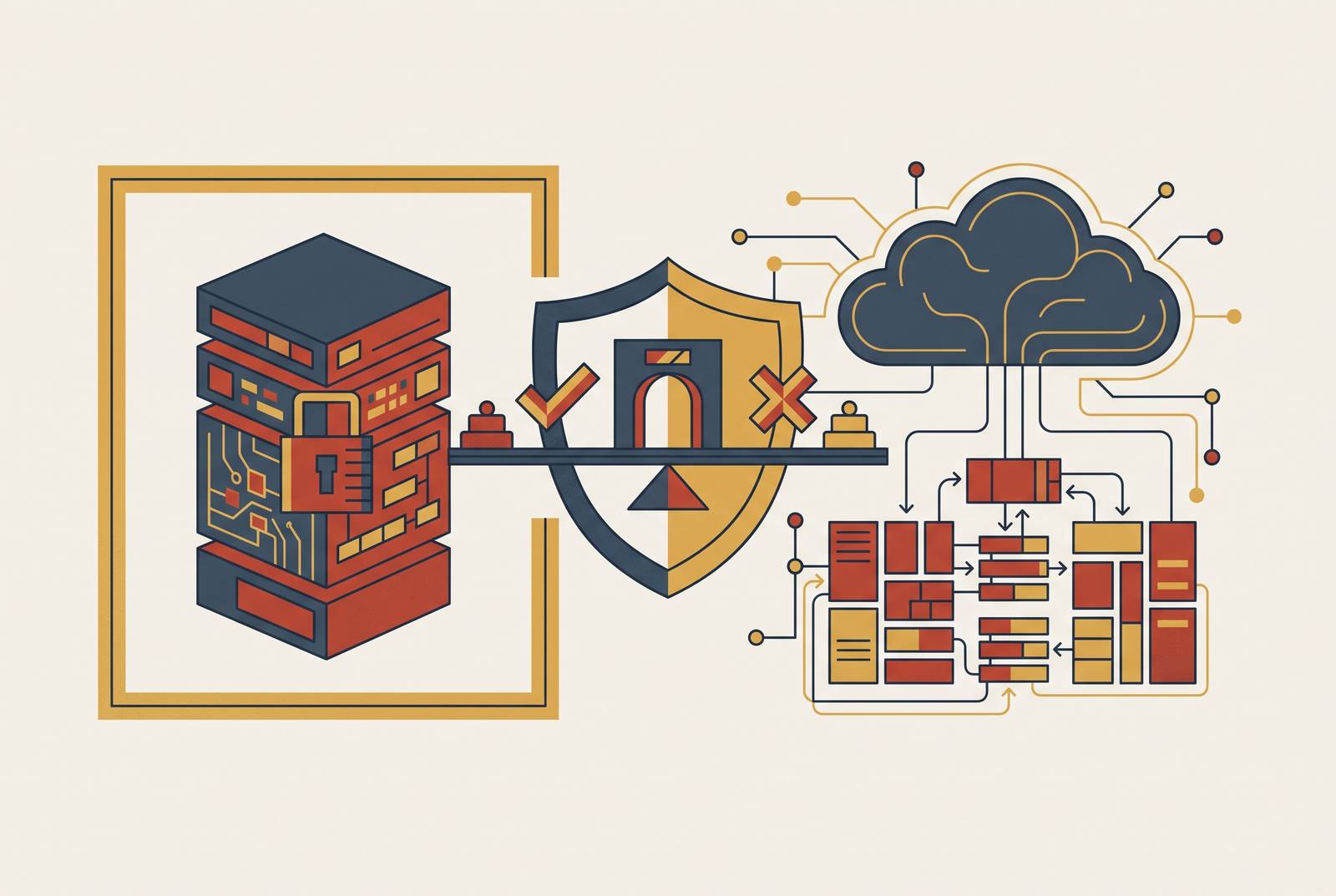
Production AI coding agents no longer just autocomplete a function. Teams now hand them entire GitHub issues, database migrations, and test suites, and that shift in delegation is what makes governance urgent rather than academic. Choosing where to run these agents, self-hosted or through a managed platform, is not an infrastructure decision anyone should treat as an afterthought. It's a governance decision, whether the team building the system realizes it or not.
The scope of change matters here. Earlier AI coding tools completed a line, or maybe a file. CIO.com reports that what makes today's agents structurally different isn't smarter prompting but sustained execution across long, multi-step workflows: an agent that opens a branch, writes code across a dozen files, runs the test suite, and opens a pull request without a human touching the keyboard in between. That's a different category of software, and it needs a different category of oversight.
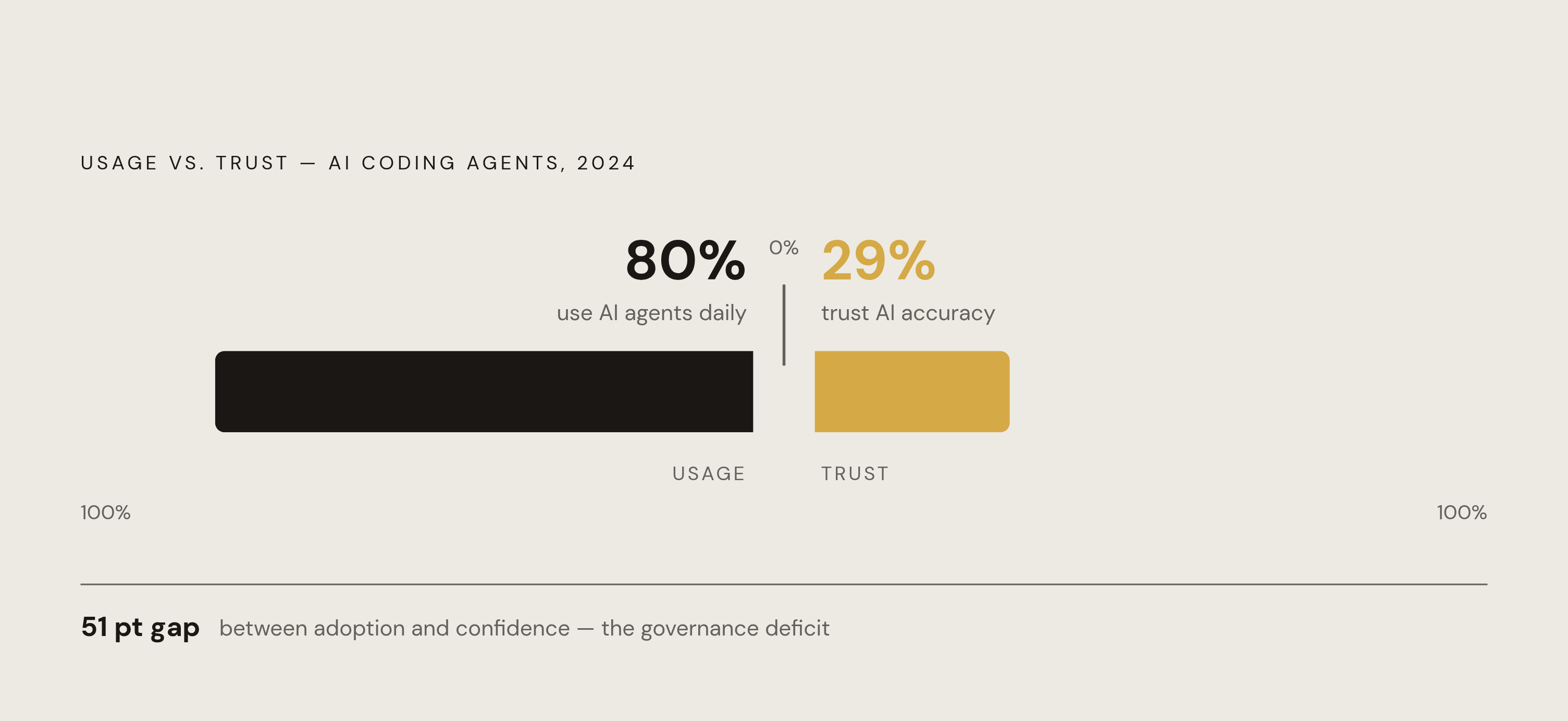
Adoption has outpaced trust in a way that should make any engineering leader uneasy. Eighty percent of developers now use AI coding agents day to day, yet trust in AI accuracy has dropped to just 29% year over year. Those two numbers moving in opposite directions at the same time tell you something plain: usage isn't waiting for confidence to catch up. Agents already have write access to repositories, secrets, CI pipelines, and outside APIs across a growing share of engineering orgs. The governance surface people used to argue about in hypothetical terms is now just the surface, full stop.
Which agents can touch which repos. Which secrets can they read. What's the ceiling on what they're allowed to spend, and who answers for it when something breaks at 2 a.m. Those questions used to sit at the edge of the conversation. Gartner's prediction that 40% of enterprise applications will embed AI agents by the end of 2026 moves them to the center. Whatever deployment model a team picks now is the governance architecture it will be living inside once agents run at that scale, and unwinding a bad choice later costs far more than getting it right at the start. Self-hosting looks like the disciplined choice on paper. In practice, it's the choice that quietly assumes an engineering team has spare capacity to build a security function it doesn't yet have.
What production AI coding agents need to be governed
Governance used to mean deciding which AI tools employees were allowed to open. That's a much smaller problem than the one facing teams today, where governance has to reach into identity, permissions, tool access, memory, orchestration, delegation chains, and autonomy itself, all at the point where an agent actually does something.
The gap sits in a specific place. Security teams spent the last several years building policy around the model layer: procurement reviews, data access rules, approved-vendor lists. Fine, as far as it goes. But the tool invocation layer, the actual API calls, database writes, and workflow triggers an agent fires off mid-task, has mostly been trusted by default. That's the layer where damage actually happens, and it's the layer almost nobody built controls for.
The industry has started to respond. The OWASP Agentic Top 10, released in late 2025, is a standard-setting framework scoped specifically to autonomous AI systems, and it names tool misuse, privilege abuse, and supply chain weaknesses as the dominant risks in poorly configured agent infrastructure, not model hallucination. The EU AI Act's high-risk provisions under Annex III become enforceable on December 2, 2027, covering a broad set of requirements for high-risk AI systems, with penalties for noncompliance established under the Act's enforcement provisions. The Act doesn't spell out how multi-agent chains should be treated, so the compliance boundary has to stretch to cover every agent performing a high-risk function. NIST launched its AI Agent Standards Initiative in February 2026, the first formal government effort aimed squarely at interoperability and security for autonomous agent systems.
Enterprise leaders already feel the pressure, and the numbers show a gap between what they say and what they do. A KPMG survey found 75% of large-enterprise leaders naming security, compliance, and auditability as the most critical requirements for deploying agents. The EY/AIUC-1 Consortium survey found only 38% of organizations monitor AI traffic end to end, across prompts, tool calls, and outputs, and just 17% keep continuous watch over agent-to-agent interactions. Most companies say governance matters and aren't actually watching the thing that needs governing.
Adequate governance requires scoped credentials issued per session rather than standing access, plus audit trails that capture every tool call and every diff. Budget caps need to sit at the session, team, and period level. Sandboxed execution has to limit how far a bad action can spread, with human-in-the-loop checkpoints for anything high-risk. Production readiness guidance for agents consistently treats structured audit logging, a review against the OWASP framework, and real human oversight interfaces as non-negotiable. Skipping them early compounds the debt, because retrofitting audit logging onto a system already running in production is a much bigger project than building it in from day one.
What self-hosted deployment requires teams to build and maintain
Self-hosting has an obvious pull. A team controls the data path, the exact model version running, where credentials live, and the execution environment end to end. For regulated industries, for anyone with data-residency obligations, for teams that have to pass a strict internal security review, that control is essential. It's often the whole point, and nobody should talk them out of it.
The open-source options available as of 2026 are genuinely capable, and that capability makes the gap around them easy to miss. Goose, an Apache 2.0 agent runtime originally built by Block, became a founding project of the Linux Foundation's AAIF on December 9, 2025, with its repository transferred over on April 7, 2026. It's written in Rust, ships as a desktop app, a full CLI, and an embeddable API, and runs its agent logic on-machine, though inference defaults to external cloud providers unless a team wires up fully local inference through something like Ollama. Goose supports a wide range of model providers. Tabby, also Apache 2.0 and with 33,600 GitHub stars as of June 2026, is primarily a code-completion server built for air-gapped environments, self-contained with no outside dependencies, though it now ships a Pochi agent in preview for some agentic workflows. OpenHands, formerly OpenDevin, is a self-hostable autonomous software engineer that spins up sandboxed environments, browses the web, writes and tests code, and submits pull requests, letting teams bring their own model and keep source code off third-party servers. A dev.to piece from April 2026 calls it the right fit for security-conscious organizations that can't send code to external APIs. Kilo Code, MIT-licensed and model-agnostic with no forced subscription, covers VS Code, JetBrains, and the terminal. All four support local models through Ollama for teams that want zero data leaving the building.
None of that gives a team credential lifecycle management, per-session sandboxing, an audit trail that spans multiple agents, or budget enforcement. Every one of those has to get built on top, by hand, by an engineering team that already has other things to do.
The infrastructure cost is often the smaller number, and this is where the framing usually goes wrong. A basic VPS to run the orchestration layer runs $5 to $40 a month. Cloud GPU for local inference costs somewhere between $200 and $1,000 a month, and dedicated hardware runs $5,000 to $30,000 up front if a team wants to own it. Add storage, networking, backups, and monitoring: another $20 to $200 a month. All told, self-hosting can cost as little as $25 a month leaning entirely on external APIs with no local inference, or climb past $1,200 a month with dedicated GPU hardware in the mix. Layer on top of that 2 to 4 hours a month of engineering time just for routine patching and upkeep, before anyone starts building governance controls.
That last part is the real cost, and it's the one nobody puts in the spreadsheet. Every control a managed platform hands over by default, session isolation, secrets rotation, audit logs, spend caps, becomes its own engineering project when self-hosted. That build cost gets left out of the initial infrastructure comparison almost every time, so self-hosted total cost of ownership tends to run well past what the server bill suggests.
The security gap self-hosting operators face at patching time
A real incident from 2026 makes the risk concrete. When critical vulnerabilities surfaced in popular open-source agent frameworks, managed providers had patches out within hours. Researchers scanning the internet weeks later still found thousands of unpatched, internet-exposed self-hosted instances spread across dozens of countries.
That gap wasn't a code quality failure. The open-source maintainers did their job and shipped fixes fast. What failed was operational: the people running those instances didn't have the process, tooling, or plain awareness to apply a patch that already existed. Software being fixed and software being safe are two different things, and the distance between them is entirely a function of who's watching the disclosure feeds. Self-hosting doesn't just move the cost of patching onto the team, it moves the responsibility for even knowing a patch exists.
Shadow AI makes the problem worse. Teams stand up agent tools on their own, ahead of any formal governance policy, and the pattern tends to include environments that were never properly isolated from production. Nobody signed off on that exposure. It just happened, because moving fast felt more urgent than asking permission.
The OWASP Agentic Top 10's supply chain category maps directly onto this failure mode. The plugin and skill execution layer, not the underlying language model, is where most runtime risk clusters. Operationally, a self-hosted team is on the hook for tracking the vulnerability disclosures of every framework in its stack, and for having a tested incident response plan ready before it's needed. Most engineering teams, honestly, don't have that today.
Boards lack visibility into AI governance, and that absence sets the tone for everything below it. Kiteworks' 2026 Data Security, Compliance and Risk Forecast Report found that 54% of boards don't have AI governance anywhere in their top five agenda items, even though board engagement is the single strongest predictor of how mature an organization's AI governance actually is. Without that pressure from above, the urgency to patch fast, or to patch at all, tends to stay absent.
How managed and hybrid platforms handle the governance surface
The pitch behind managed platforms is straightforward: sandboxing, credential lifecycle, audit logging, and budget enforcement become the platform's job instead of an internal build.
Warp's Oz platform offers two deployment shapes: one where Warp manages the worker, and one where the team's own CI invokes the agent directly. Either way, repository clones, source files, build artifacts, and runtime secrets stay on the customer's own infrastructure. Orchestration metadata, session transcripts, and the LLM inference calls themselves route through Warp's control plane, governed by Zero Data Retention agreements. It's a split model: the code stays home, the coordination layer runs through the vendor.
Microsoft's Agent Governance Toolkit, introduced in April 2026, takes a different angle, framed as open-source runtime security for agents. Published documentation on the toolkit states that it addresses all ten OWASP agentic risks at the runtime level, enforcing policy deterministically with sub-millisecond latency. The distinction that matters here: governance decisions get enforced before an action ever reaches the wire, so a blocked action is structurally impossible rather than just statistically unlikely. That's a meaningfully different guarantee than a monitoring system that flags bad behavior after the fact.
What managed platforms tend to offer as a baseline, and self-hosted setups don't get for free: automated patching, credentials that get minted and revoked per session automatically, structured logs of every tool call without anyone having to build the logger, and budget caps enforced at the infrastructure level before money gets spent, not discovered afterward on an invoice.
Token costs and budget control (why agentic workloads break standard LLM cost management)
Agentic workloads eat tokens at a completely different scale than a chatbot ever did, somewhere between 5 and 30 times more per task. Falling per-token inference prices don't offset this. They just get reinvested into agents doing far more per task, so the bill doesn't shrink the way anyone expects it to.
Code generation itself accounts for only a small fraction of the tokens an agent burns through on a given task. The rest is context: re-reading files, holding state across steps, reasoning about what to do next. That's why optimizing a single prompt does nothing for agentic cost control. The spend is in everything the agent does around the prompt. It's in everything the agent does around it.
Tool calls are eating an increasing share of that spend. Across major AI gateway networks, the share of tokens consumed by tool-call requests has grown substantially, and tool-using requests run roughly 2.6 times heavier per call than the rest of traffic. Agents aren't just generating text anymore. They're calling functions, and each call carries its own token weight.
In November 2025, four LangChain agents running a market research pipeline over the A2A protocol got stuck in an infinite loop and kept running for 11 days straight, racking up a $47,000 bill that nobody caught until it was already over. At a smaller but still painful scale, Claude Code running inside CI/CD pipelines can drive costs to unexpected heights with zero visibility into which team, or which pipeline, actually caused it.
The fix isn't optional, and it isn't complicated in concept: caps for each session, developer, team, and period, plus real-time cost attribution instead of a report that shows up after the money's gone. The strongest AI gateway setups combine semantic caching, layered budget controls, and per-consumer rate limits behind a single API. Self-hosted teams have to build that entire layer themselves. Managed platforms can enforce it at the infrastructure level before spend happens at all, and that's a structural difference in what's possible, not a cosmetic one.
LLM inference costs are broadly expected to continue falling. That sounds like relief, except agentic workloads are positioned to absorb every bit of those savings by simply doing more, running longer, calling more tools. Cost discipline doesn't get easier as models get cheaper. It gets more urgent.
How the deployment choice interacts with multi-agent architectures and mixed-model stacks
The 2026 KPMG survey cited earlier found that multi-agent orchestration is now the main thing slowing organizations down as they move past pilots into production. Not model quality. Not adoption. Coordination.
The mixed-model pattern has become the dominant one in practice: orchestrating different frontier models across vendor lines, with cheaper models absorbing the routine volume and pricier ones reserved for harder steps, produces stronger engineering output than sticking with a single vendor end to end. That's arguably the most consequential shift in how these tools get used in 2026, and it changes the governance math considerably.
Every multi-agent stack adds agent-to-agent delegation, shared memory, cross-agent tool access, and accountability chains that now span multiple model providers and multiple execution environments at once. The EU AI Act's Recitals 99 and 100 speak to this directly: in a chain of agents, the compliance boundary follows every agent performing a high-risk function, not just the orchestrator sitting at the top. An EY survey cited by the AIUC-1 Consortium found that only 17% of organizations continuously monitor agent-to-agent interactions, so the compliance gap is widest exactly where the architecture has gotten most complicated.
Self-hosting a multi-agent stack means stitching together frameworks like LangGraph, CrewAI, and AutoGen (also known as AG2), each with its own logging format, its own credential model, its own idea of session state. Turning that patchwork into one unified audit trail and one budget control system is a serious engineering undertaking on its own, separate from the agents doing actual work.
Protocol choice matters here too. MLflow's guide notes that adopting MCP and A2A standards at the architecture stage is far less painful than retrofitting them onto a system already in production. The deployment model chosen early effectively decides whether a team adopts those standards from the start or bolts them on later under pressure. Managed platforms that enforce governance at the infrastructure layer, rather than inside each individual agent framework, tend to produce consistent audit trails and credential controls across a mixed agent stack simply by design, not by extra effort.
Making the deployment decision deliberately: a framework for matching governance requirements to deployment model
Most teams don't actually choose based on governance. They pick self-hosted because it feels like control, or managed because it feels convenient, and neither instinct is wrong exactly, but neither one is a governance decision either. Governance requirements should drive this choice, not trail behind it, and for most teams outside a narrow set of conditions, the honest answer is that self-hosting is a bigger commitment than the pitch for it lets on.
Self-hosting genuinely makes sense under a specific set of conditions: strict data-residency rules that forbid any code or context from leaving the organization's own infrastructure, air-gapped environments where outbound HTTPS to a vendor's control plane simply isn't allowed, full stop, teams that already have platform engineering capacity on hand to build and maintain credential lifecycle management, cross-agent audit logging, budget enforcement, and sandboxing as internal systems rather than side projects, and regulatory regimes that demand full ownership of the entire execution stack, orchestration metadata included, not just the code.
Outside those conditions, the calculus runs the other way. A team without spare platform engineering capacity, facing the KPMG survey's finding that most enterprise leaders now rank security, compliance, and auditability as the top requirement for agent deployment, is choosing to build from scratch what a managed platform already ships by default. That's a significant tradeoff to take on without naming it first. Governance as a feature and governance as a multi-quarter engineering roadmap are two different paths, and that distinction needs deciding before the infrastructure choice gets made, not after.