AI Coding Agents for Automated Pull Request Review
Agent reviewers need codebase context and strict access controls to catch what diffs alone cannot.
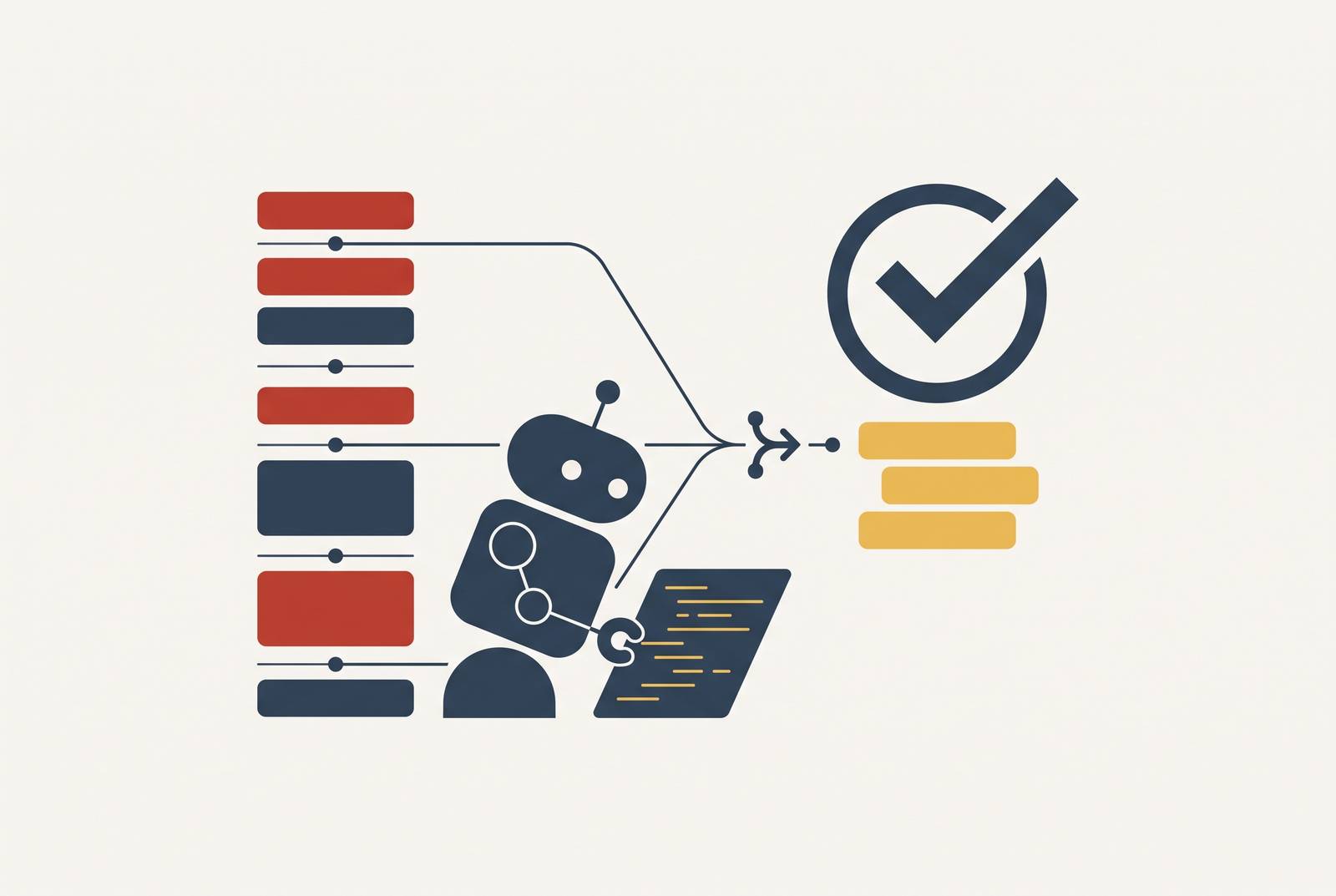
AI coding agents can help close the verification gap created by AI-generated code, but automated pull request review is a production workflow. Its value depends on codebase-wide reasoning and the controls around that reasoning. Scoped credentials, controlled configuration, audit trails, and spending limits are prerequisites for dependable agent review.
Why AI-generated code has made PR review the engineering bottleneck
More code is reaching pull requests, but the amount that people can review has not kept pace. AI coding agents have changed the authorship balance faster than review practices have adapted, leaving manual verification to absorb the difference. Duma et al. (2026), cited by Takerngsaksiri et al. (2026), found that 61.4% of agent PRs receive no recorded human review, completing within minutes to hours. With no recorded human review, fast completion cannot be treated as evidence of scrutiny.
The consequences extend beyond the merge. The same study found that merged agent PRs attract verified follow-up fixes at higher odds than human-authored PRs in the same repositories. Yet practitioners disagree about whether review is becoming the bottleneck, whether human review remains necessary, and whether automation erodes the understanding that review once built. Agarwal et al. (2026) document those disagreements in a synthesis of discourse from thousands of engineering practitioners. Their central framing explains why review remains decisive, stating that “review is the control point through which a coding agent's effect on software is decided”.
What agents can actually do in a PR review that diff-only tools cannot
The distinguishing capability of an agent reviewer is codebase-wide context. A diff shows what changed, but it does not necessarily show the assumptions that change affects. Shared libraries change on their own, services depend on one another in ways that are hard to see, and generated code can pass tests while breaking what other code expects.
Qodo defines this work as rebuilding architectural context across repositories, tracking dependency movement, validating test behavior, linking changes to underlying issues, and finding risks invisible in an isolated diff. Agent reviewers can also scan related files and apply defined rules autonomously on every PR. Those rules can set out how to handle security, retry logic, and rate limits. This makes the mechanism different from a tool that only comments on the patch presented to it. The agent gathers context as part of the review itself.
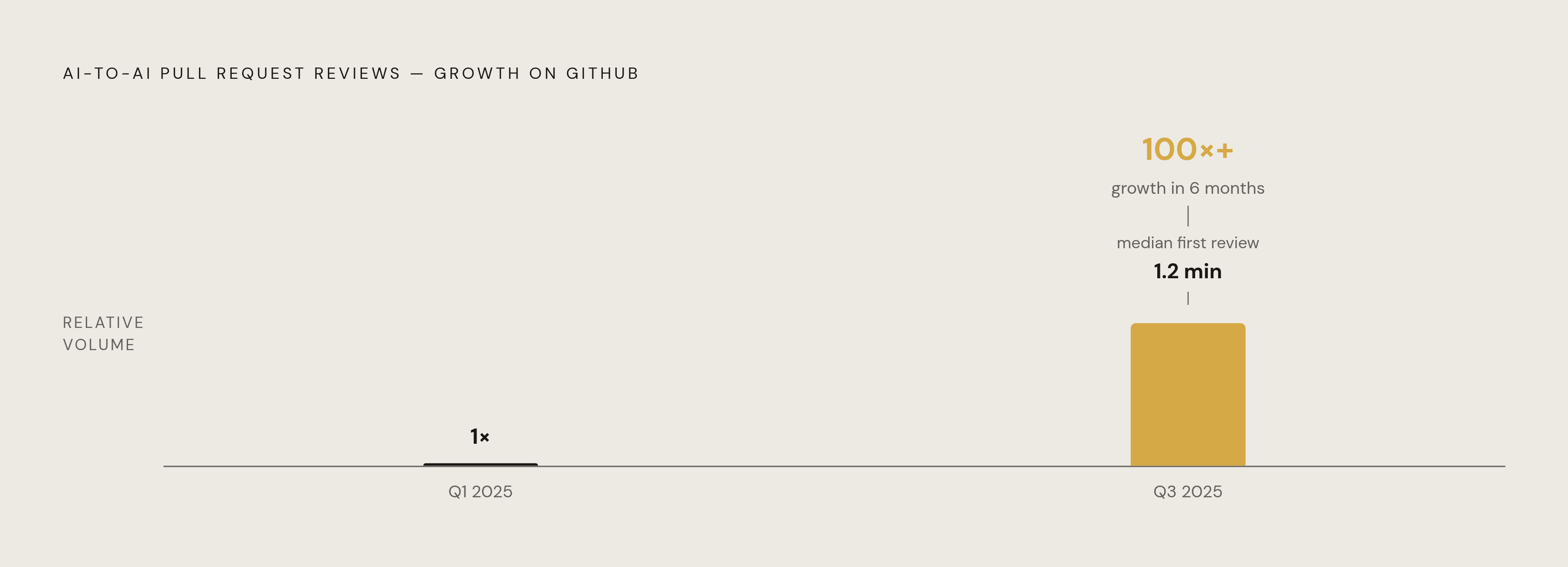
That mechanism is already producing an emerging structural change in software review. Selvanayagam and Ghaleb (2026) document closed-loop AI-to-AI review across hundreds of thousands of unique AI-attributed PRs on GitHub. Cross-product AI-to-AI review grew by more than two orders of magnitude from 2025-Q1 to 2025-Q3. The median time from PR creation to first AI review was 1.2 minutes for cross-product pairs.
How the current generation of PR review agents differ from one another
Review tools differ most usefully on context depth, noise control, and workflow fit. Graphite Agent works with users on the PR page to build test plans, explain complex logic, and give summaries right away. Its stacked-PR approach keeps individual diffs small, improving the conditions for AI-assisted analysis. SonarQube Cloud addresses a different requirement through deterministic quality gates. Pairing deterministic enforcement with an AI reviewer can serve teams that need both repeatable rules and checks of the change's intent.
Replay merged PRs, including one with a change whose behavior depends on a caller or shared type that has not changed. Link a ticket with one acceptance criterion intentionally omitted to test whether the reviewer connects implementation to requirements. Keep separate counts of accurate findings and false positives, because they show how much the review catches and how much noise it adds. A tool that produces more comments has not necessarily performed a better review.
Noise control deserves particular attention because false positives weaken developer trust. Path exclusions, severity thresholds, and feedback learning are therefore practical procurement criteria. Graphite Agent's reported sub-5% negative feedback rate illustrates the kind of low-noise performance available for evaluation. The procurement decision still turns on performance against the repository and workflow where the reviewer will operate.
What the research shows about where agent review still fails
Research on follow-up fixes provides an important counterweight to the speed and capability case. Takerngsaksiri et al. (2026) found that the odds of verified fixes for merged agent PRs are 1.62 times those for merged human PRs. Most of those fixes are authored by the same agent that wrote the original PR. Agents therefore largely finish their own work, but their merged contributions still need fixing more often. This finding concerns agent-authored PRs and should not be treated as a controlled comparison of every reviewer product.
The study also identifies a signal available before the work is considered complete. Within repositories, a merge with far more commits carries substantially higher odds of a verified follow-up fix. Commit count records the work done and gives reviewers a warning signal they can check. Without cross-session memory, multiple agents can independently build near-identical utility functions because they lack memory of what was already built.
These problems are about how changes accumulate, how repository knowledge persists, and how teams decide that work is ready. Agarwal et al. (2026) express the organizational dependency directly. Their synthesis states that “AI does not fix the sign of that effect — the team sets it, through the expertise its humans bring and how it structures the review process”. If review quality is an organizational outcome, governance is the lever for shaping it.
Why the governance gap around agent reviewers is widening faster than security controls are closing it
Coding agents can connect to source-control platforms, CI/CD pipelines, and cloud APIs and have read/write access to sensitive repositories and deployment keys. That authority creates a risk profile categorically different from a passive linter. OWASP published the Top 10 for Agentic Applications in December 2025 as the first formal taxonomy of risks specific to autonomous AI agents. Its categories include goal hijacking, tool misuse, identity & privilege abuse, memory & context poisoning, and cascading failures. The common concern is not simply a wrong answer, but what an agent can do with its access.
Regulatory developments make governance planning more concrete without establishing that every PR reviewer falls into the same legal category. The EU AI Act high-risk obligations under Annex III are set to take effect in December 2027, after the AI Omnibus (Reg (EU) 2026/1744) pushed back the original August 2026 deadline. Colorado's AI Act (SB 26-189) is scheduled to become enforceable on January 1, 2027. These dates place agent controls within a broader compliance timetable. They do not replace the need to determine the obligations applicable to a particular deployment.
Cloudsmith's 2026 guidance calls for every AI agent to have a non-human identity, with package pulls and MCP queries audited like a human developer's access. Microsoft open-sourced the Agent Governance Toolkit in April 2026, with tools for policy enforcement, zero-trust agent identity, and execution sandboxing. It includes a Merkle-chained audit trail and a Decision BOM, with mappings to the OWASP Agentic Top 10, NIST AI RMF 1.0, the EU AI Act, and SOC 2. Such controls address authority and accountability, which review accuracy alone cannot provide.
What production-grade governance of agent PR review actually requires
Production governance is an infrastructure problem. Every agent session should run with credentials minted for that session and revoked on completion. Session isolation and scoped permissions limit the authority available during execution. Persistent broad credentials are a primary attack surface when agents have source-control and CI/CD access.
The same discipline applies to the instructions that govern behavior. Agent configuration should live in repository files, reviewed and approved like any other code change. A UI setting that bypasses normal change management leaves a different control path for changing how review operates. Version-controlled configuration puts that behavior inside the team's established approval process.
Audit records must also identify both the agent and the authority behind its actions. LoginRadius specifies a minimum schema including agent ID with model instance and version, parent identity, delegation scope, tool name, tool-parameter hash, and guardrail result. These fields connect an action to the human or system that authorized it and the permissions granted for the session. OpenTelemetry deprecated every gen_ai.* attribute, metric, event, and span from its main semantic-conventions repository on 12 June 2026, moving them to a dedicated repository with zero tagged releases. Teams therefore need to instrument their audit trails now rather than assume that cross-layer agent tracing is a settled off-the-shelf capability.
How to control agent review costs before they become a budget problem
An agentic review can trigger dozens of model and tool calls for a single PR. Spending grows with both the number of PRs opened and the amount of work done in each review. Gartner's June 2026 forecast predicts that by 2028, AI coding costs will overtake the average developer's salary because of rising LLM token consumption and consumption-based licensing. Gartner also identifies limited transparency in how many vendors calculate and bill token consumption. That combination makes cost control an architectural requirement rather than an accounting exercise after usage occurs.
An AI gateway places that control in the request path. It can enforce budgets, rate limits, and virtual keys on LLM requests while logging the cost of each call. Gateway options as of October 2026 include Bifrost, LiteLLM, Kong AI Gateway, Cloudflare AI Gateway, and Azure API Management. Bifrost is open-source and written in Go, while LiteLLM is a Python proxy supporting 140+ providers. These options differ in budget depth and operational trade-offs, so the relevant comparison is the control required.
One LiteLLM pattern uses a virtual-key policy to set a cap on how much a PR-review bot can spend each month. A separate feature tag can carry its own limit, with explicit rate limits per CI key. Model cascading addresses another part of the cost equation by routing simpler tasks to smaller models and reserving frontier models for complex reasoning. This is the primary architectural lever for reducing per-PR cost without reducing coverage.
What to put in place before treating agent PR review as a production process
Start agents in assisted mode and establish precision and false-positive baselines from logs. Give them more autonomy only when those records show stable precision, low false-positive rates, and behavior the team can control. Performance gates should make each autonomy level auditable.
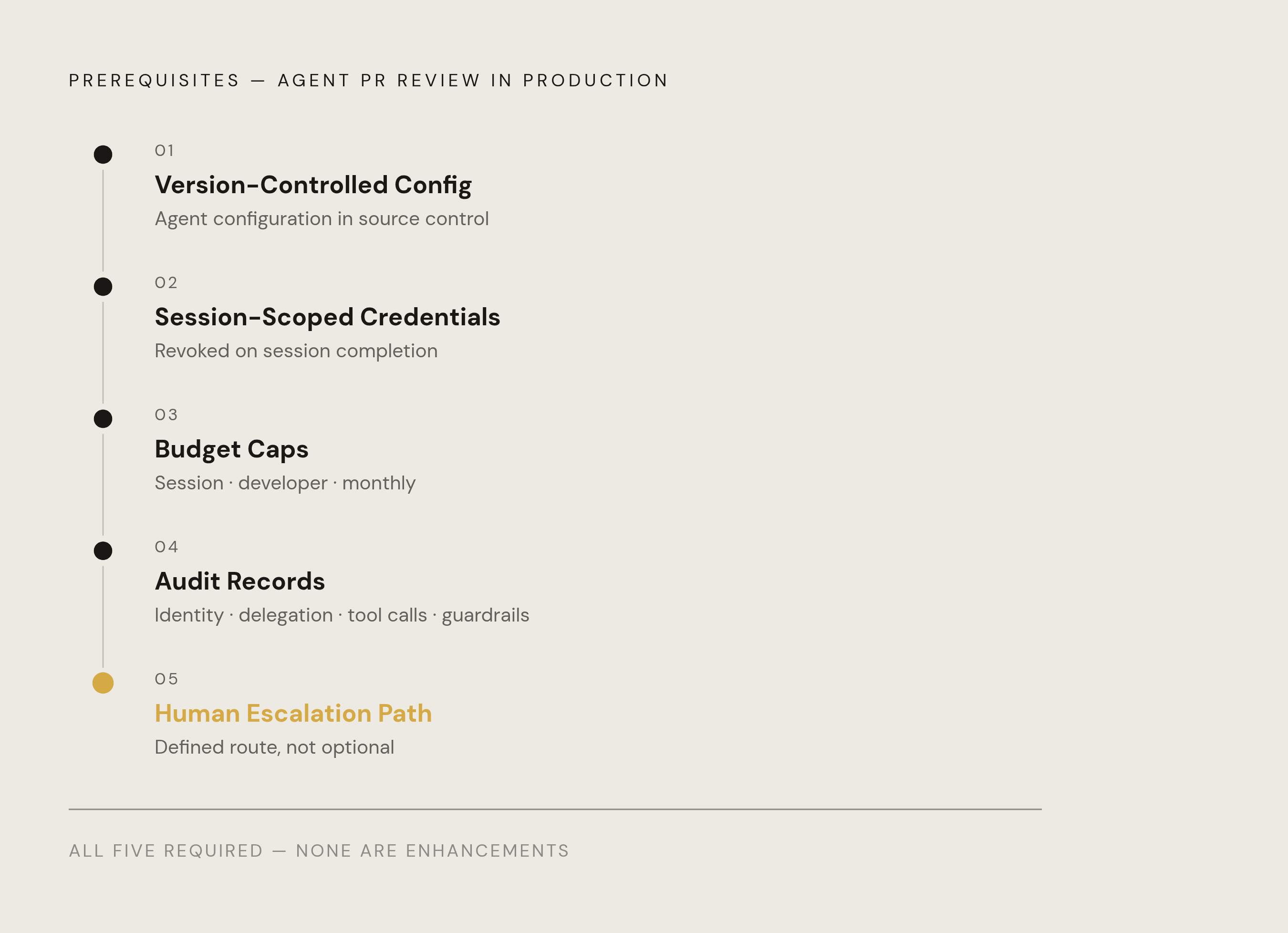
Before that promotion, the operating controls need to be complete. Agent behavior must be defined in reviewed, version-controlled configuration, with session-scoped credentials revoked when execution ends. Budget caps must exist at session, developer, and monthly levels, and audit records must capture identity, delegation, tool calls, and guardrail decisions. Teams must have a clear human escalation path so they can act on warning signals, including unusually high commit counts at merge time.
Sources
- Who Finishes the Job? A Study of Follow-Up Fixes and Commit Authorship on AI Coding Agent Pull Requests
- AI-to-AI Code Reviews of GitHub Pull Requests
- 3100 Opinions on Code Review in an AI World: Building Causal Theory from Practitioner Discourse
- Humans Integrate, Agents Fix: How Agent-Authored Pull Requests Are Referenced in Practice