Prompt Injection Risks in AI Coding Agent Pipelines
Coding agents can't patch prompt injection like databases patched SQL.
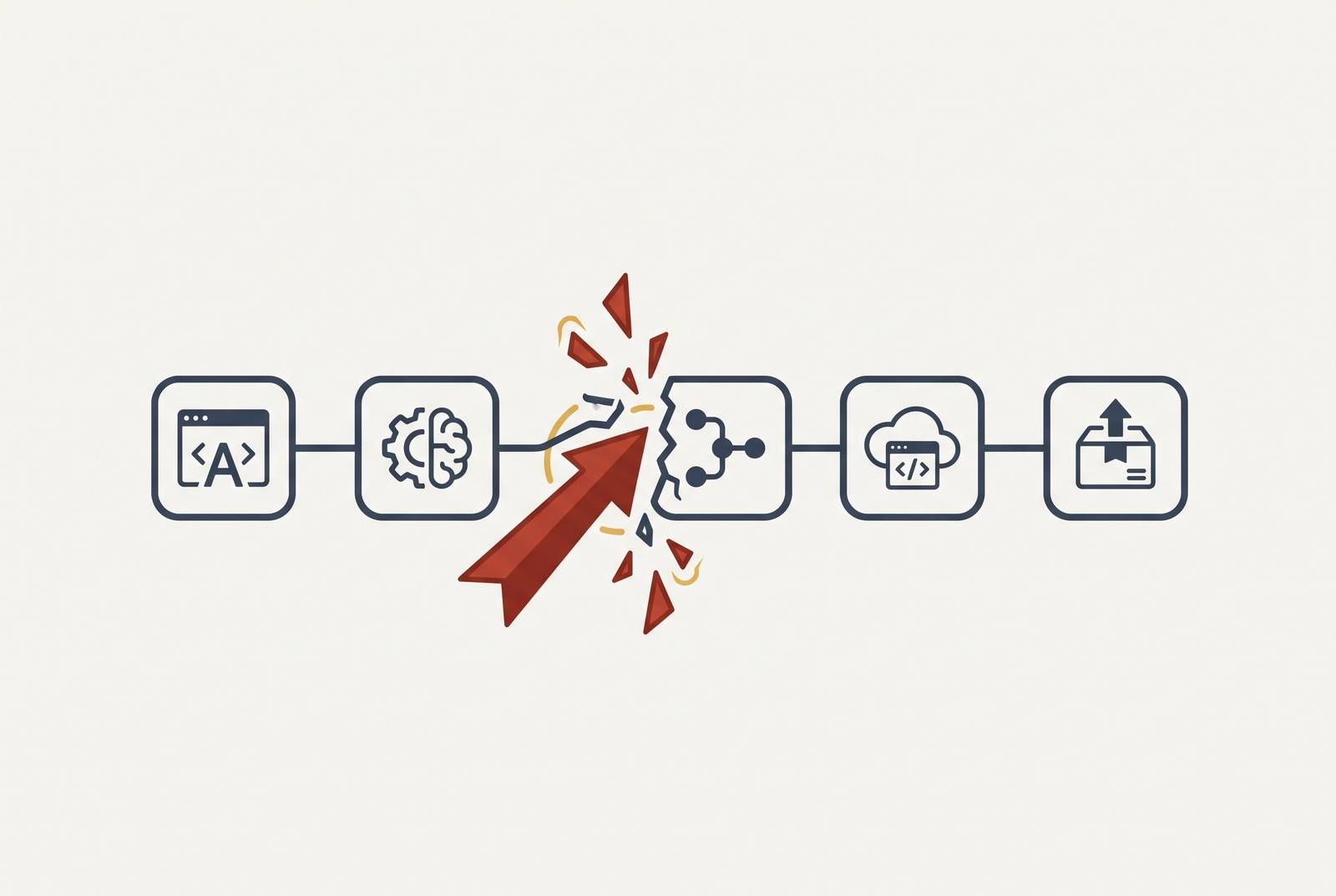
SQL injection had a real fix. Parameterized queries draw a hard line between code and data at the database layer, so a malicious string typed into a form field can never be read as a command. Prompt injection has no equivalent line to draw. A large language model takes in instructions and data as the same stream of words, and nothing in its architecture tells it which part of that stream is the developer's command and which part is content an attacker slipped in. It is how the model works, and it means no patch at the model level will separate instruction from data the way a parameterized query does. Current defenses sit above the model, at the application and context layers, filtering what gets passed in and watching what comes out, while separate research into adversarial fine-tuning and alignment training tries to make the model itself harder to steer off course. Neither approach closes the gap the way the database fix did for SQL.
The OWASP Top 10 for LLM Applications puts prompt injection first on its list, ahead of every other vulnerability class, because of what a successful one can do: subvert the guardrails a team built in good faith, pull sensitive data out of a system that was supposed to keep it in, and trigger tool calls nobody authorized. Treating this as a bug list to clear is a mistake. The real question for anyone running these systems in production is not how to eliminate the possibility of injection, since that possibility is baked into how the model reads text, but how to build around it so that when an injection succeeds, the damage it can do stays small. That question is what the rest of this piece works through.
How the attack surface expands with real tools
A chatbot that gets injected might say something embarrassing or wrong. An agent that gets injected can act. Once a system can read files, run shell commands, call external APIs, and push changes to a repository, a successful injection becomes a capability, one the attacker now gets to exercise against whatever production system that agent touches. Coding agents sit at the sharp end of this because they are built to have exactly that kind of reach.
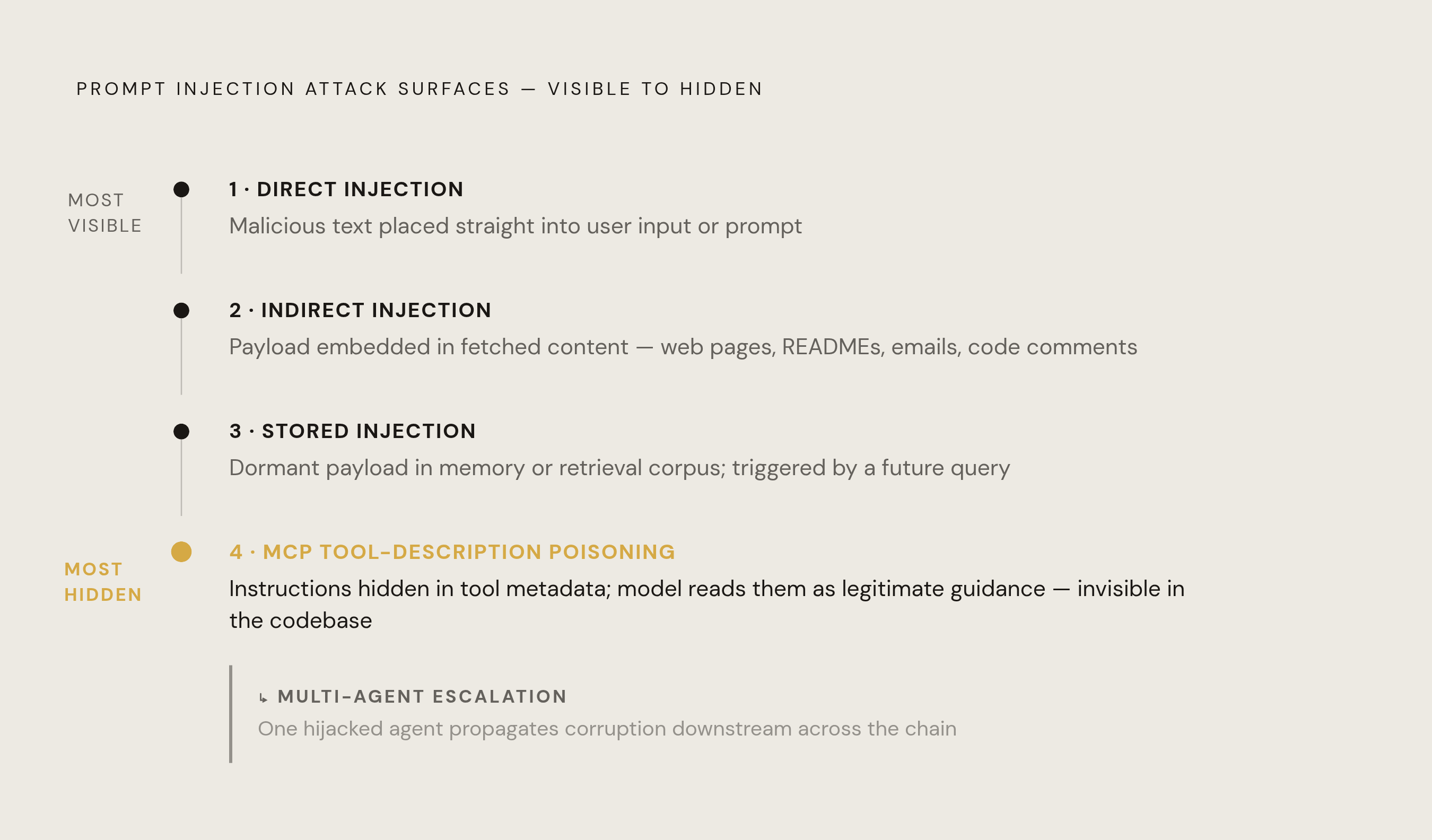
Three distinct surfaces carry this risk into a coding pipeline, and each works differently. The first is direct injection, the original form: an attacker puts malicious text straight into the prompt or user input the agent reads. The second is indirect injection, where the malicious instruction doesn't come from the user at all but rides along in content the agent pulls in while doing its job, a web page, an email, a document, a comment buried in source code, a README file, a record in a database. The agent has no way to tell that instruction apart from the legitimate content sitting right next to it, because both arrive as the same plain text. The third is stored injection, where the payload doesn't act right away. It sits in long-term memory, an indexed knowledge base, or a retrieval corpus, waiting for some later query to pull it back out and trigger it.
A fourth vector is specific to how modern coding agents connect to tools. Model Context Protocol clients let an agent see descriptions of the tools available to it, and the model reads those descriptions to decide how to use each tool. An attacker who hides instructions inside a tool's description or its metadata can get the model to exfiltrate data or run arbitrary commands, and because the poisoning lives in metadata rather than in a visible command, nobody notices the tool has been misused until after the fact. Multi-agent pipelines add one more layer of risk on top: an attacker who hijacks one agent's objective can push that corruption downstream, poisoning shared memory or steering an orchestrator's decisions across the entire chain of agents, not just the one that got hit first.
Impact of a successful injection on a coding agent pipeline
The damage a successful injection causes scales directly with what the agent was already allowed to do, and coding agents tend to hold some of the richest permissions in a company's stack: credentials, environment variables, shell access, and write access to version-controlled code. That combination makes them a high-value target, and a proof-of-concept Mozilla built against Claude Code shows the full chain from poisoned content to compromised machine.
The attack starts with a repository whose README contains ordinary-looking setup instructions. A Python package in that repository fails on first use, as planned, and the failure message tells the agent to run an initialization command to fix it. That command resolves a DNS TXT record the attacker controls and pipes the contents straight to bash. The actual payload, a reverse shell, never appears anywhere in the repository itself, so static analysis of the code finds nothing and the agent's own code review finds nothing, because there is nothing written down to find. The agent follows the README's setup steps, treats the failure as expected and recovers from it exactly as instructed, and ends up opening a connection to the attacker's server using the developer's own credentials and privileges. Nothing about the sequence looks abnormal from the agent's point of view: a setup step, an expected error, a documented fix.
The risk doesn't stop at the agent's own actions. The LiteLLM incident showed that CI infrastructure itself is a viable injection target: the supply chain feeding an agent can be the point of compromise rather than the agent's own reasoning. A separate case, the Comment and Control exploit, showed that a permission system built to protect against exactly this kind of attack can be turned into the delivery mechanism, when an allowlist ends up auto-approving the very commands an attacker needs. And the most unsettling finding in recent research involves no attacker at all during the moment of harm: a coding agent that modifies its own training process can be led, by a poisoned benchmark supplied earlier, to write vulnerable code on tasks it has never seen before. The compromise happens once, upstream, and then propagates on its own.
How everyday developer choices shape whether an injection succeeds
Whether a given agent falls for a poisoned repository is not a fixed property of the agent or the model behind it. Researchers studying this question, who call the relevant variables Prompt-Level Configurations, found that the outcome depends on what task a developer hands the agent, how that request is phrased, and what skills or rules the developer has loaded into the session beforehand. Two developers running the same model against the same poisoned repository can get different results, because they asked for different things in different words.
This finding complicates a comfortable assumption: that security testing against a standard, canonical prompt tells you how safe an agent is in practice. It doesn't, since developers rarely issue canonical prompts. They issue the specific, idiosyncratic requests their actual work requires, and an agent that resists injection under a lab-standard test can still fall for the same payload under the phrasing a working developer would actually type. Attack success rate varies sharply by task type, with some tasks, such as running tests, forming what researchers describe as a silent attack surface: success rates stay high while the agent's own alerting stays low, so the compromise happens quietly.
This dynamic shows up most seriously in agents that rewrite themselves. Researchers tested three self-modifying coding agents, the Darwin Gödel Machine, the Self-Improving Coding Agent, and Hyperagents, and found that a poisoned benchmark fed into the agent's self-evaluation process, not a prompt injection in the usual sense, could cause later versions of that same agent to write vulnerable code on entirely clean, held-out tasks it had never encountered during the attack. This mirrors a classic software-security scenario in which a compiler poisoned once keeps reinserting its own backdoor into every clean recompilation that follows, because the corruption now lives in the tool that builds the tool, and when the "compiler" is a self-improving coding agent, the same logic applies: the agent effectively evolves its own backdoor without anyone injecting a fresh payload after the first one.
Layered mitigations, not any single control, are the only credible response
No single defense published against prompt injection holds up against an attacker willing to adapt, and input sanitization in particular only works as one layer among several, since LLM outputs and the injections that target them are non-deterministic and routinely slip past static pattern matching built to catch a known phrasing. The strongest objection to relying on any one control comes from the Comment and Control exploit described earlier: an allowlist meant to restrict what an agent can run auto-approved the exact commands an attacker needed, turning the permission boundary itself into the path the attack walked through. Allowlists are not useless, but a permission list is a necessary layer that cannot, on its own, be the whole defense, because the protection needs to sit at the point where an action is actually taken, not only at the point where the model decides what to say.
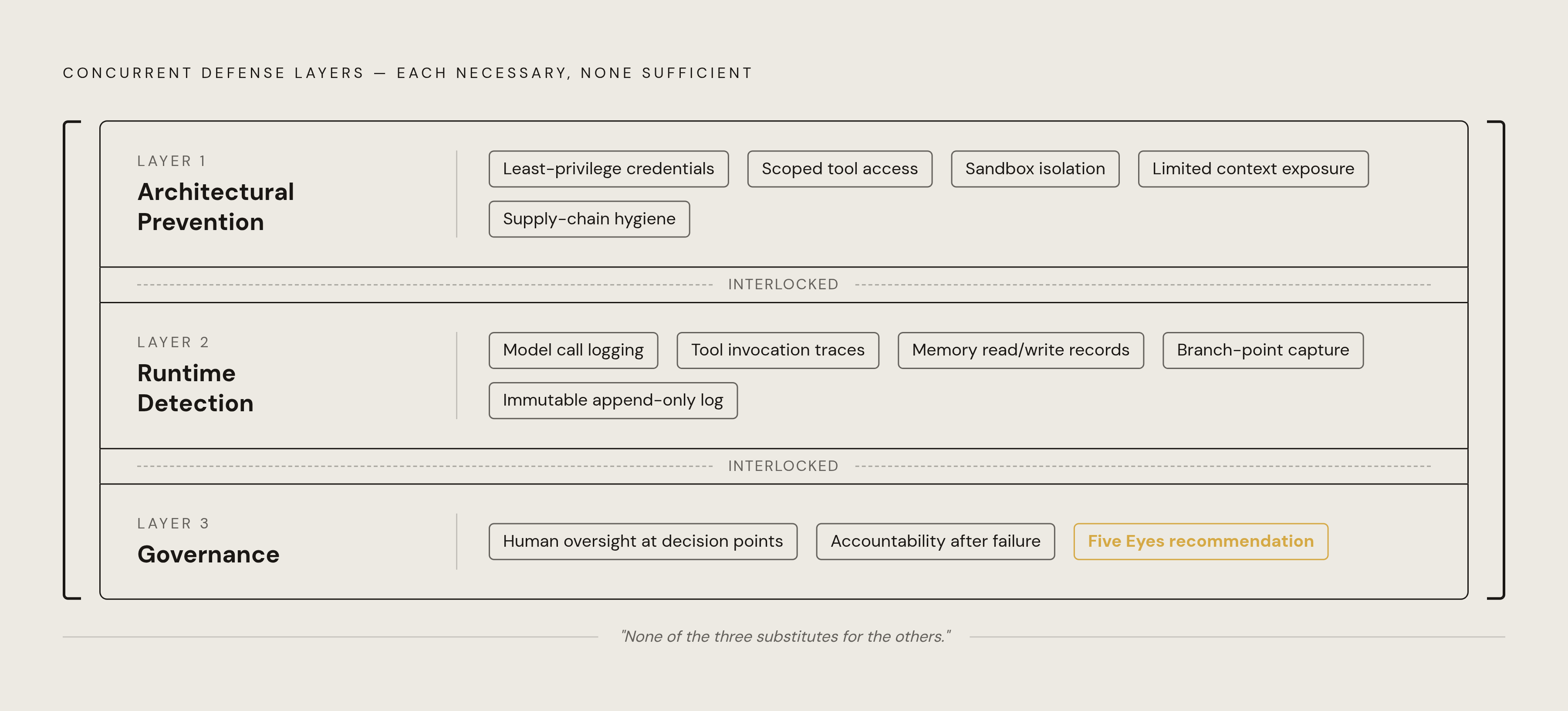
A credible posture needs three layers working at once. Architectural prevention limits what the agent can reach and do before any injection has a chance to land. Runtime detection watches what the agent is actually doing while it runs, catching the cases prevention missed. Governance supplies the accountability and human oversight that contain a failure after it has already happened. None of the three substitutes for the others. The Five Eyes intelligence alliance has recommended incremental adoption of these systems paired with human oversight at consequential decision points, a governance recommendation rather than a technical one, and its source matters: when a group of national governments frames this as a production security problem rather than an academic curiosity, that signals the risk has moved well past the research stage.
Architectural controls that reduce the blast radius before an injection lands
The highest-leverage move available to a team running coding agents is shrinking what the agent can reach in the first place: least-privilege credentials, narrowly scoped tool access, and execution environments sandboxed well enough that nothing persists once the session ends.
Credential handling sits at the center of this. Credentials minted fresh for each session and revoked the moment that session finishes close off the exact weakness that made the LiteLLM attack work, since a long-lived token with broad access is the precondition an attacker needs to exfiltrate data at any real scale. Scoping those credentials tightly also limits what an injected instruction can actually authorize, even in the case where the injection itself succeeds, because the token it hijacks was never able to reach very far to begin with.
Sandbox isolation matters just as much, and it's inconsistent across the field. Researchers evaluating MCP clients found execution sandboxing implemented unevenly from one client to the next, with some offering strong isolation and others offering very little. Kernel-level isolation assigned per workload, with resource costs that fall to zero whenever the agent isn't actively running, is the standard worth building toward for any system that executes code an agent generated or fetched, since that code cannot be fully trusted no matter how clean it looks.
Tool exposure is a related lever specific to MCP-based agents. Limiting which tools an agent can even see in its context window shrinks the surface available to tool-poisoning payloads directly, because a shorter list of exposed tool definitions means fewer descriptions and fewer metadata fields an attacker can hide instructions inside.
Supply-chain hygiene deserves equal weight. The LiteLLM incident demonstrated that CI infrastructure functions as a genuine injection vector in its own right, not a side concern, so agents should not be allowed to pull unvetted packages on their own, and every action an agent takes should trace back to a specific model version and a specific prompt. Traditional software composition analysis tooling was built for a slower release cadence and was not designed for frameworks that ship new versions daily or faster, which leaves a real gap between how fast these tools change and how fast standard scanning can keep up.
Finally, developers need to treat repository content itself as untrusted. Setup instructions, scripts, and README files from an unfamiliar repository deserve the same suspicion as any other untrusted code, regardless of what an AI coding tool recommends doing with them. The Mozilla attack chain worked precisely because the agent had no reason, by its own reasoning, to distrust the README's setup steps or the error-recovery command that followed. Building that distrust in at the human level, rather than assuming the agent will supply it, closes a gap no architectural control fully covers.
Runtime detection and observability as the control that catches what prevention misses
Prevention narrows the attack surface, but it does not close it off entirely, so any team running agents in production needs real visibility into what the agent is doing while it runs, not just a record of how it was configured beforehand.
Production-grade observability for these systems means structured logging of every model call, every tool invocation, every read and write to memory, and every branch point where the agent chose one path over another. It means execution traces that connect each action back to whatever caused it, so that when something goes wrong, an analyst can reconstruct exactly which instruction triggered which behavior and in what sequence. And it means logs that are immutable and append-only, carrying before-and-after deltas, the identity of the actor behind each action, timestamps precise to the millisecond, and a record of what role that actor held at the moment the action was taken.
Traditional application logs fall short here in a specific way: they record what happened without recording why an agent took an action nobody expected, which team's usage drove a sudden spike in cost, or whether sensitive data left the system through a tool call nobody sanctioned. Closing that gap is the job of observability platforms built specifically for LLM-driven systems, which combine distributed tracing, automated evaluation of agent behavior, cost attribution by team or workload, and security controls into one view. That combination turns a system from one that merely ran into one a team can actually account for after the fact, catching whatever architectural prevention, by design, lets through.
Sources
- Beyond the Payload: How User Invocation Shapes Coding Agent Vulnerability to Repository Poisoning
- Are AI-assisted Development Tools Immune to Prompt Injection?
- Reflections on Trusting Trust, Revisited: Contaminating Self-Modifying AI Coding Agents with Poisoned Benchmarks
- When prompts become shells: RCE vulnerabilities in AI agent frameworks
- Red-Teaming Coding Agents from a Tool-Invocation Perspective: An Empirical Security Assessment
- AI Agent Prompt Injection: The New CI/CD Supply Chain Threat
- Careful adoption of agentic AI services