AI Code Governance Policies for Engineering Organizations
Closes the gap between AI agent adoption and the governance frameworks needed to control them.

2023 brought code completion. By 2026, that had turned into fully autonomous development environments, a phase analysts have started calling agent engineering. The label marks a real shift in what these systems do. An autocomplete tool finishes a line. An agent runs a loop: it plans, calls tools, retries when something breaks, and keeps going until the task closes out or a limit stops it.
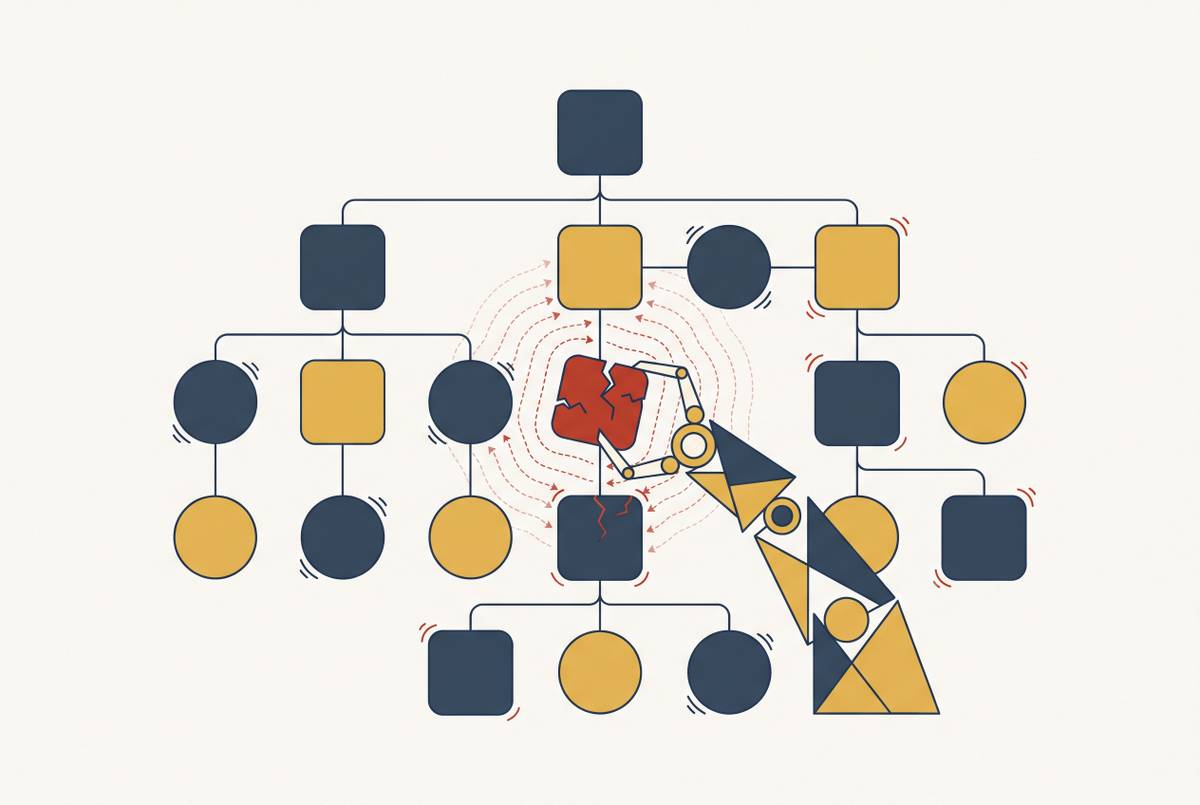
Agents run sustained execution loops instead of answering one prompt and stopping. They call tools with real side effects: bash commands, file writes, API calls that reach systems well outside the chat window. A single agent session can touch the source repo, the CI pipeline, the secrets manager, and the deployment tooling, all without a human clicking anything in between. Stack a few agents together, Planner handing off to Implementer, Implementer to Tester and Reviewer, and a small error in step one grows. It compounds through every role downstream.
Gartner expects task-specific AI agents inside 40% of enterprise applications by 2026, up from under 5% the year before. Adoption is outrunning governance, and the gap is not close. The engineer's job is already sliding from builder to orchestrator, CIO.com reports: routine, reversible work goes to the agent, while architecture calls, security decisions, and anything consequential stay with a human who owns the outcome.
Governance models built for deterministic scripts, the kind that do exactly one thing every time, don't map onto systems that reason, retry, request credentials mid-task, and touch production. Most engineering organizations are still running access policies from an earlier era against agents built for 2026. Closing that gap is the actual job now. It's the actual job now.
What a formal AI coding governance framework needs to cover
Governance, done right, rests on four load-bearing pillars: identity and credential scoping (who or what the agent is, and what it's allowed to touch), configuration management (how its behavior gets defined, reviewed, and rolled back), cost controls (spend capped before it happens, not tallied afterward), and audit trails (a record of what happened, why, and who's accountable for it). Each pillar depends on the others. A budget cap means nothing without session-level logging to enforce it, and a credential scope means nothing without a versioned config that spells out what that scope should be.
The regulatory clock is running faster than most engineering teams have registered. The EU AI Act's Phase Two high-risk deadline has already arrived, with August 2, 2026 confirmed as a key compliance date for covered systems. NIST's AI Risk Management Framework is being extended to cover agentic systems specifically. ISO/IEC 42001 has turned into something procurement teams ask for by name. State-level AI legislation in the U.S. is also moving toward requiring governance evidence for high-risk systems.
None of this works without someone owning it. A workable framework assigns a Chief AI Officer for strategy, Agent Owners accountable for specific tools, Security Champions who run the risk assessments, and Engineering Managers handling day-to-day oversight, and it assigns these roles before anyone picks a vendor. Most teams do it backwards: they pick the tooling first, and the roles get built around whatever the tool happens to log. That order guarantees governance chasing a product roadmap instead of setting one.
The arXiv Five-Plane Reference Architecture, published in June 2026, centers on a core distinction: there's a boundary between a development action and a production-altering one, and governance exists to enforce that exact boundary. Everything below is a variation on that idea. Compliance should fall out of the engineering process as a side effect, not get bolted on afterward as its own project with its own meetings.
Credential scoping and agent identity: treating every agent session as a non-human principal
Every AI agent needs its own non-human identity, and every package it pulls or MCP query it makes needs the same scrutiny a human developer's access would get in a security review. That's the whole principle. Ignoring it means the failure is not random. It follows a pattern, and that pattern already has a name.
The Cline incident, sometimes called "Clinejection," is the case study to know cold. An attacker opened a GitHub issue on the Cline repository with a hidden prompt injection payload buried inside it. That payload hijacked Cline's AI-powered triage bot, which then ran malicious code on a GitHub Actions runner and pulled out npm publishing credentials. Eight days later, an unauthorized version of Cline sat live on npm for roughly eight hours, in a position to compromise any developer running auto-updates. Trace the root cause back to one configuration line: the CI workflow had allowed_non_write_users: "*", so any GitHub user on the planet could trigger the bot, and the bot itself carried Bash, Read, Write, and Edit access on the runner. The model didn't fail here. The permissions design did, and no patch to the model fixes that.
Scoped credentials, done right, get minted fresh per session, scoped tightly to what that session's task actually needs, and revoked the moment the session ends. No long-lived shared tokens carried across runs. Access sits in privilege rings: read is the default, write gets granted explicitly per task, and anything touching deployment or production sits behind a human approval gate or a hard policy block.
The MCP specification update from July 28, 2026 introduced stateless operation along with tighter authorization requirements, and stateless design makes per-session credential scoping far easier to enforce, since there's no lingering session state to leak between runs. The principle is straightforward: governance decisions should be enforced deterministically before an action ever reaches the wire, so a blocked action is structurally impossible, not just unlikely given the current prompt. Credential gates should work the same way.
In a Dark Reading poll, 48% of cybersecurity professionals named agentic AI the number-one attack vector heading into 2026. Set against that, only 21% of executives report full visibility into what permissions their agents hold, what tools they call, or what data they touch. Almost half the industry can name the threat by heart while barely a fifth can see into their own systems. That gap, not the threat itself, is the actual state of play right now.
A workable design checklist starts with enumerating every tool an agent can call, things like read_code, propose_change, run_tests, open_pull_request, trigger_deployment, and gating each one individually rather than granting a blanket toolset. Each agent session should run sandboxed in isolation, so a failure or a credential leak stays contained to that one session. And there needs to be a kill switch, a runtime way to shut down one agent session without taking down every other session running alongside it.
Configuration management: defining agent behavior in version-controlled YAML, not ad hoc prompts
Ad hoc prompting fails as a governance model for a simple reason: agent behavior defined in a UI field or buried in a chat history is invisible to code review. It can't be reproduced reliably across runs, and when something breaks, there's no clean way to roll it back.
Treat agent configuration as code, full stop. Which tools the agent can call, which model version it runs on, retry limits, approval gates, output constraints: all of it should live in version-controlled files, reviewed through the same pull request process application code goes through. This isn't tidiness for its own sake. In a multi-agent pipeline, Planner, Architect, Implementer, Tester, Reviewer, each agent's scope needs to be specified and auditable on its own terms. When something goes wrong, the first thing an investigator wants is the config file that defined the agent's behavior at the time. If that behavior only ever existed inside a UI session, the investigation stalls before it starts. Regulators are pointing this direction too: both the EU AI Act and ISO/IEC 42001 push organizations toward documented, auditable AI system behavior, and git history is evidence in a way a chat transcript never will be.
A trustworthy config pins the model and version, lists tools explicitly rather than using a wildcard, sets retry and loop limits, caps the budget per session, defines what triggers a run (a PR opening, an issue getting labeled, a schedule firing), gates specific action classes like trigger_deployment behind human approval, and routes output to a PR comment, a Slack channel, a log, or a human review queue.
MLflow's production agent guide, published in May 2026, makes the case for modular sub-agent design: individual agents can get swapped out or upgraded without touching the rest of the pipeline, but only if each one's configuration is specified and versioned independently. That modularity is the actual payoff of building configuration this way instead of treating the pipeline as one giant, unversioned prompt.
Shadow AI is the failure mode configuration management actually catches. Industry benchmarks put a healthy target for unauthorized AI usage around 3 to 4% of total usage, and version-controlled config gives an organization a real baseline to measure against. Without that baseline, nothing was ever written down, so there's no way to tell unauthorized behavior from expected behavior. Config review belongs inside the normal PR process, not off in a separate governance meeting that meets once a quarter. Governance built as engineering holds up under pressure. Governance built as theater doesn't survive contact with the first incident.
Cost controls: why monitoring spend after the fact is not governance
Agentic workflows burn tokens at a rate that catches most budget planning flat-footed. Gartner's analysis puts agentic token consumption at 5 to 30 times a standard chat interaction per task. Those numbers are wide because agent behavior itself is unpredictable in a way a single chat completion never was, and the range is the point: nobody can forecast this off last quarter's chat usage.
The real numbers make the abstraction land hard. Uber rolled Claude Code out to roughly 5,000 engineers in December 2025, and by early 2026, 84% of its developers counted as agentic coding users. The company's entire 2026 AI budget was gone by April, four months in, and its CTO said the company was "back to the drawing board" on budget assumptions. A documented production incident tracked an agentic workflow that ran up $47,000 in compute cost before a budget alert ever fired, simply because no real-time enforcement layer existed to catch it sooner. The fix that followed enforces limits before the spend happens, not after.
Some of this comes down to mechanics that are easy to miss. A failed attempt that retries three times pays for three attempts, not one. Multi-step loop patterns can add additional model calls at each stage of a generation sequence. Without a hard loop limit, one stuck workflow can burn through a full day's budget retrying against a problem it was never going to solve on its own. Inference costs alone eat 85% of enterprise AI budgets industry-wide, and that number should drive where the governance attention actually goes: not toward token pricing negotiations, but toward stopping the retries before they start.
Real pre-execution cost governance means hard budget caps enforced at the session level, the developer level, and the time-period level, not dashboards that show the damage after it's done. It means loop limits set inside the agent's config file, tying straight back to the configuration pillar above. It means routing everything through an LLM gateway that sits between the applications and the model providers, enforcing budget limits, rate limits, and caching policy centrally instead of scattering those controls across a dozen codebases where nobody's watching all of them at once. And it means using prompt caching aggressively: Anthropic's cache_control feature can cut repeat-context costs by up to 90% on cached tokens inside agentic loops, which matters enormously when an agent rereads the same file or the same system prompt dozens of times in one session.
The number that actually matters is cost per successful outcome, not cost per call. A cheap loop that fails twice before succeeding once can cost more than an expensive one that succeeds on the first try, and most teams are still measuring the wrong thing. Compliance requirements complicate the picture further: Compliance constraints shape which tasks and workflows an organization can legally run, and those decisions carry direct cost consequences. Without a governance layer connecting compliance requirements to operational decisions, an organization ends up paying twice, once in compliance risk and once in wasted spend.
Audit trails and observability: what you need to log when an agent takes 27 steps to answer one prompt
A standard log records what a user typed and what the system replied. That model breaks completely once a single prompt can trigger a dozen internal tool calls, several vector database queries, and a handful of self-reflection steps before the agent produces anything a human sees. Logging "user said X, agent said Y" throws away the entire causal chain in between, and that chain is what an investigation needs.
A complete agent audit trail captures the input and trigger condition that kicked off the session, the internal chain-of-thought steps the model produced along the way, every individual LLM call along with its model, version, and token count, every tool call and what it returned (the diff a read_code call pulled back, the result of a test run, the contents of a PR), every data access including exactly which secret got pulled from where, the final output and where it got routed, and attribution identifying which person or automated trigger started the session. That list runs long because the failure modes spread across all of it. None of it clusters conveniently in one spot.
This record serves two purposes that shouldn't get conflated. Debuggability means every failure traces back to the specific decision, tool call, or data access that caused it, so an engineer isn't guessing at 2am. Auditability means every action is logged with the context, the policy, and the data assets that governed it at the time, which is what turns the log into evidence a regulator or an internal compliance review can actually use. The question used to be simple: what did the agent say? Now it's what did the agent network do across the 27 internal steps that produced that answer?
Every entry in that log needs to be immutable and queryable. A log that can be edited after the fact is a liability wearing a compliance badge. Observability also makes cost governance enforceable in the first place: token-level logging broken down by session, by developer, and by trigger is the actual data feeding the session-level budget caps described earlier. None of these four pillars stands alone. MLflow's May 2026 production guide recommends structured logging and model version pinning from day one, rather than retrofitting it once something's already gone wrong. Evaluation probes embedded directly inside the agentic workflow, not run separately in an offline batch job, give teams real-time auditability instead of a report that arrives after the incident has already resolved itself one way or another. And monitoring faithfulness, drift, and hallucination rates over time builds the feedback loop that keeps an agent's behavior from quietly degrading months after it first shipped.
Set against all of this, only about a fifth of executives report full visibility into their agents' permissions, tool use, and data access. Observability, for most organizations, remains an open problem, not a solved one, and pretending otherwise is how the next Cline incident happens.
How to run this framework in production: infrastructure patterns and tooling choices
The distance between a notebook prototype and a production agent system is bigger than most teams expect going in. MLflow's May 2026 production guide describes the pattern bluntly: a prototype dazzles the stakeholders in a demo, gets approved, and then starts degrading silently once real traffic and real edge cases hit it, often without anyone noticing until the damage has already compounded.
Self-hosting an agent stack looks cheaper on paper than it turns out to be in practice, and that's the trap most teams fall into. The sticker price on infrastructure ignores the ongoing cost of the credential scoping, configuration versioning, budget enforcement, and audit logging described in every section above, none of which comes bundled for free just because the model weights run on infrastructure someone controls directly. Running this framework for real means treating the LLM gateway as shared infrastructure that every team's agents route through, not something each team stands up on its own. It means enforcing the credential and budget gates at that gateway layer, deterministically, before a request ever reaches a model provider, in line with the Microsoft Agent Governance Toolkit's framing above. And it means wiring the four pillars, identity, configuration, cost, audit, together as one system, not running them as four separate initiatives owned by four teams that never talk to each other.
That wiring is the actual argument here. Agents that reason, retry, and touch production systems need a governance model built for exactly that behavior, not one inherited from a world where code was deterministic and a script did the same thing every time it ran. The organizations still catching up in 2026 aren't behind because the technology moved too fast. They kept applying an old model to a new kind of system, and the boundary between a development action and a production-altering one kept getting crossed by something nobody had scoped, logged, or capped in advance.