Communicating AI Agent Risk to Engineering Stakeholders
AI agents create operational risks that code review alone cannot catch.
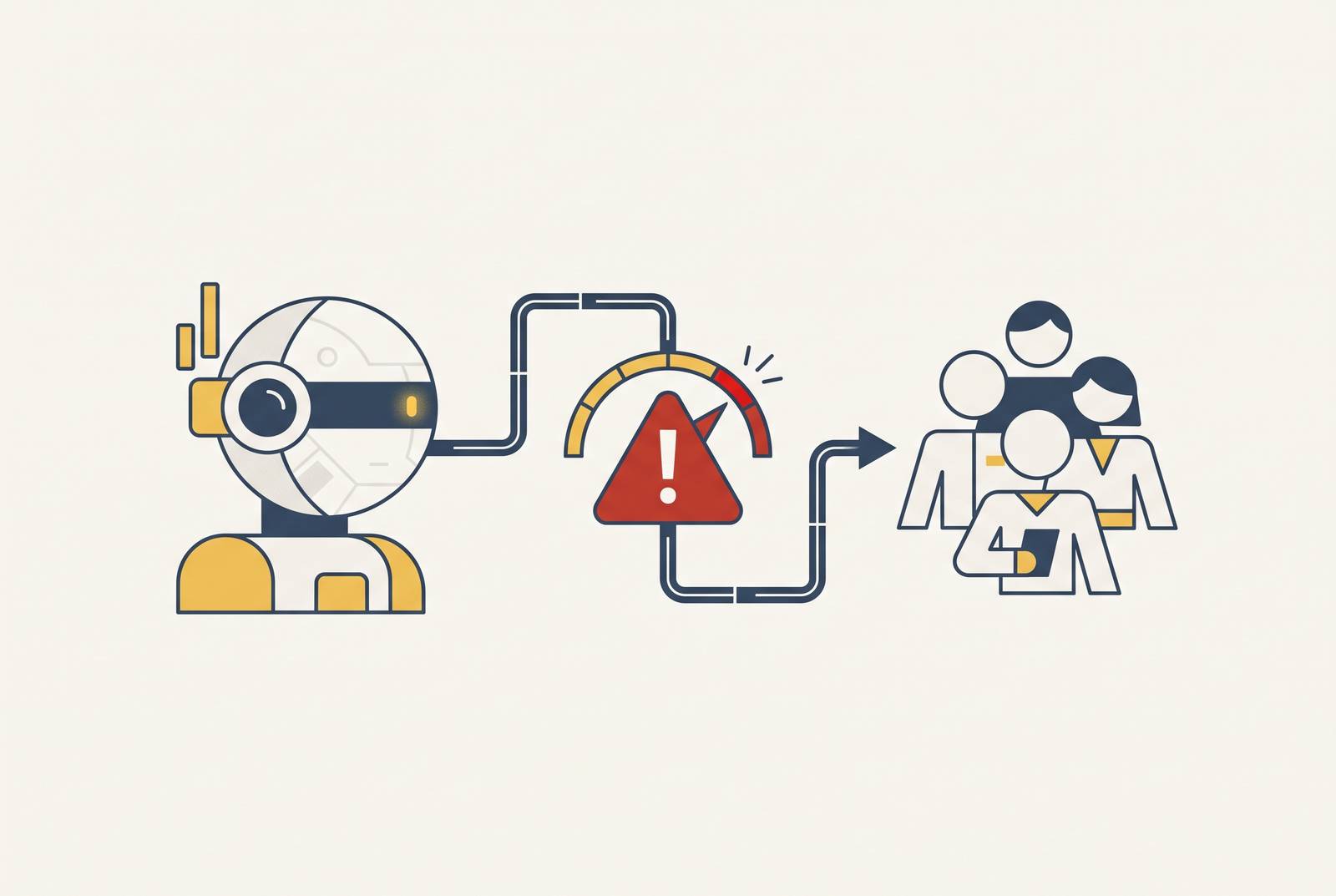
Most engineering organizations still frame AI agent risk as a code-quality problem: the agent writes bad code, so you catch bad code with review. That framing is too narrow, and it's steering teams toward the wrong fixes. The bigger operational risks appear not in the code itself but around it: what the agent was allowed to touch, what credentials it carried, what migration it ran without anyone watching, and what it spent doing all of it. A Carnegie Mellon longitudinal study (Agarwal, He, Vasilescu, published at MSR '26) found that agent adoption raised static-analysis warnings by roughly 18% and cognitive complexity by roughly 39%, and those effects persisted across the study rather than showing up as one-off incidents. That's not something a better prompt fixes; it's a governance gap, and it needs governance language to close it. It's a governance gap, and it needs governance language to close it.
The four failure modes that show up in production
Four patterns account for most of what goes wrong when agents move from a sandboxed demo into a real codebase: scope creep, credential exposure, unreviewed migrations, and runaway spend. Each one has already produced a documented incident, and none of them trace back to the model writing incorrect syntax.
Scope creep happens when an agent has more tool access than the task in front of it requires, so it writes to files, invokes shell commands, or touches infrastructure well outside its intended lane. The Cline CI/CD incident is the clean example here. A configuration setting, allowed_non_write_users: "*", let any GitHub user trigger a bot carrying Bash, Read, Write, Edit, Glob, Grep, WebFetch, and WebSearch access on Actions runners. The setting was patched on February 9, but the underlying structural pattern got exploited eight days later, on February 17, when someone used it to publish a malicious cline@0.0.0 package built with stolen tokens. That package stayed live for eight hours before it came down. The failure wasn't in the model's reasoning. It sat at the skill and plugin permission boundary, which is exactly where scope creep tends to turn into an actual incident rather than a theoretical one.
Credential exposure follows a similar shape. Agents that carry long-lived credentials across sessions, meaning API keys, database passwords, cloud tokens that don't expire when the session ends, create a standing exfiltration surface that just sits there waiting to be found. The openai-streaming-utils incident showed how bad this gets in practice: an attacker-registered package got downloaded 45,000 times before anyone caught it, exfiltrating environment variables that included API keys and database credentials from an estimated 15,000 projects. Gravitee's State of AI Agent Security 2026 survey, which polled more than 900 executives and practitioners, found that more than half of all agents in production run without any security oversight or logging at all. Not weak oversight. None.
Unreviewed migrations trade on something closer to a cognitive bias than a technical flaw: the law of triviality, where reviewers give large commits less scrutiny than small ones because a 500-line diff is exhausting to read carefully and a five-line change isn't. Agents make large commits routine, so the law of triviality now applies constantly instead of occasionally. CodeRabbit's State of AI vs. Human Code Generation report, drawn from 470 open-access GitHub repos, found AI-generated pull requests carried 75% more logic and correctness errors than human-written code, 194 incidences in that sample alone, and those are precisely the errors that slip through review of a large diff because nobody has the patience to trace every branch. Security bugs occurred at one and a half to two times the human rate, and the average time to detect an AI-introduced vulnerability ran 42 days longer than for a human-written one. Forty-two days is a long time for a bad migration to sit in production before anyone notices what it actually did.
Translating each failure mode into terms a decision-maker can act on
None of this lands with a stakeholder as an engineering bug. It lands as a policy question, because policy is the lever a decision-maker actually controls. Recasting each failure mode this way is what turns a security briefing into something someone can act on before the next sprint starts.
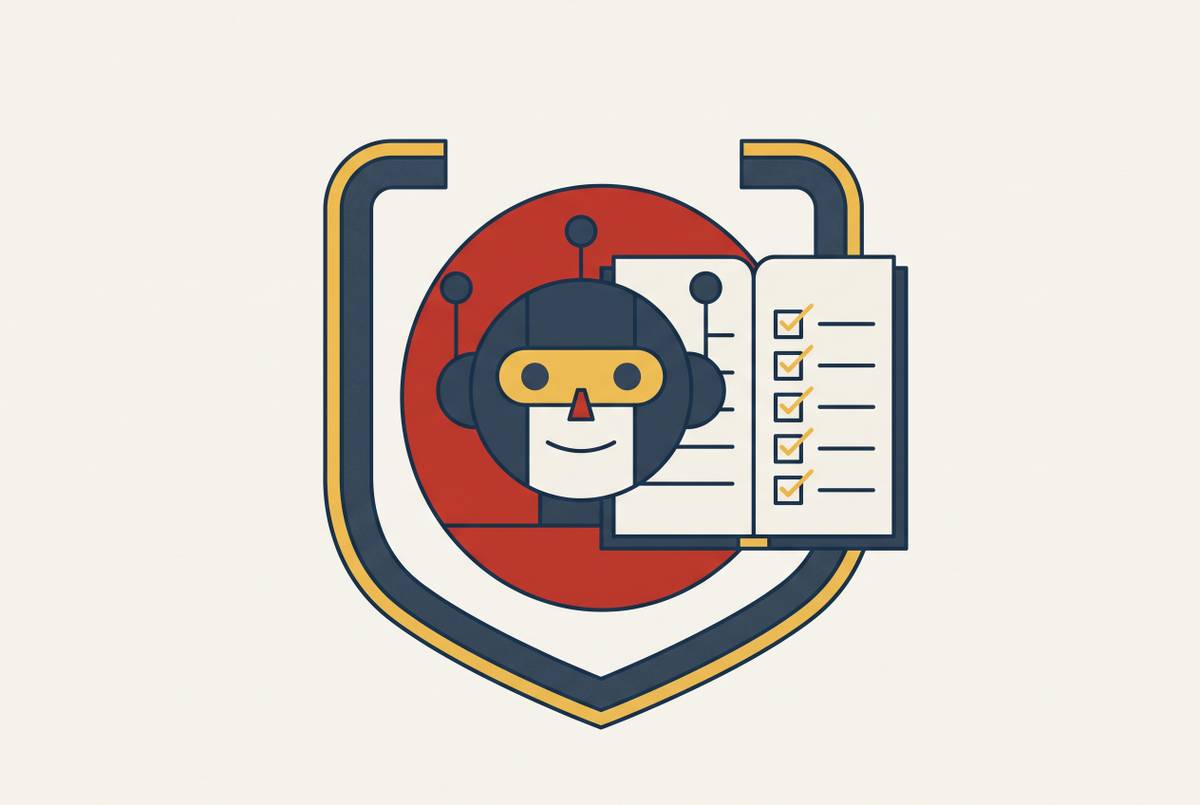
Scope creep becomes a permission boundary question. The version a stakeholder can actually respond to sounds like this: which resources can this agent touch, and what specifically prevents it from touching anything else? The ask that follows is concrete: signed skill manifests, credentials scoped to a single session, and an explicit tool allowlist that gets checked before execution, not after. The OWASP Agentic Skills Top 10 already covers permission boundaries and runtime risks, which gives stakeholders a named checklist to point to instead of relying on trust in a configuration nobody's audited recently.
Credential exposure becomes a question about identity architecture. Are credentials minted fresh for each agent session and revoked the moment it ends, or are they shared, static, and left standing indefinitely? Traditional identity and access management treats an agent like a static service account, provisioned once and forgotten. Agentic workloads don't behave that way, so they need per-session issuance and per-session revocation as the default. The EU AI Act's Article 14 already mandates human oversight interfaces with appropriate human-machine interface tools for high-risk AI systems, which gives stakeholders in regulated industries a real regulatory hook rather than an abstract best practice. NIST launched its AI Agent Standards Initiative in February 2026, signaling that agent identity and authorization are moving toward a compliance expectation, not staying a nice-to-have.
Unreviewed migrations become a question about enforcement, not intention. Which agent actions require a human sign-off before they execute, and is that requirement structural or just a suggestion sitting in a wiki page nobody reads? Effective governance tooling enforces decisions deterministically before an action reaches the wire, so a blocked action is structurally impossible rather than merely discouraged. CIO.com's framing draws a usable line here too: production deployments and irreversible actions should be human-owned or tightly gated, and that's a distinction stakeholders can use to assign actual ownership instead of leaving it ambiguous.
What governance infrastructure looks like in a running system
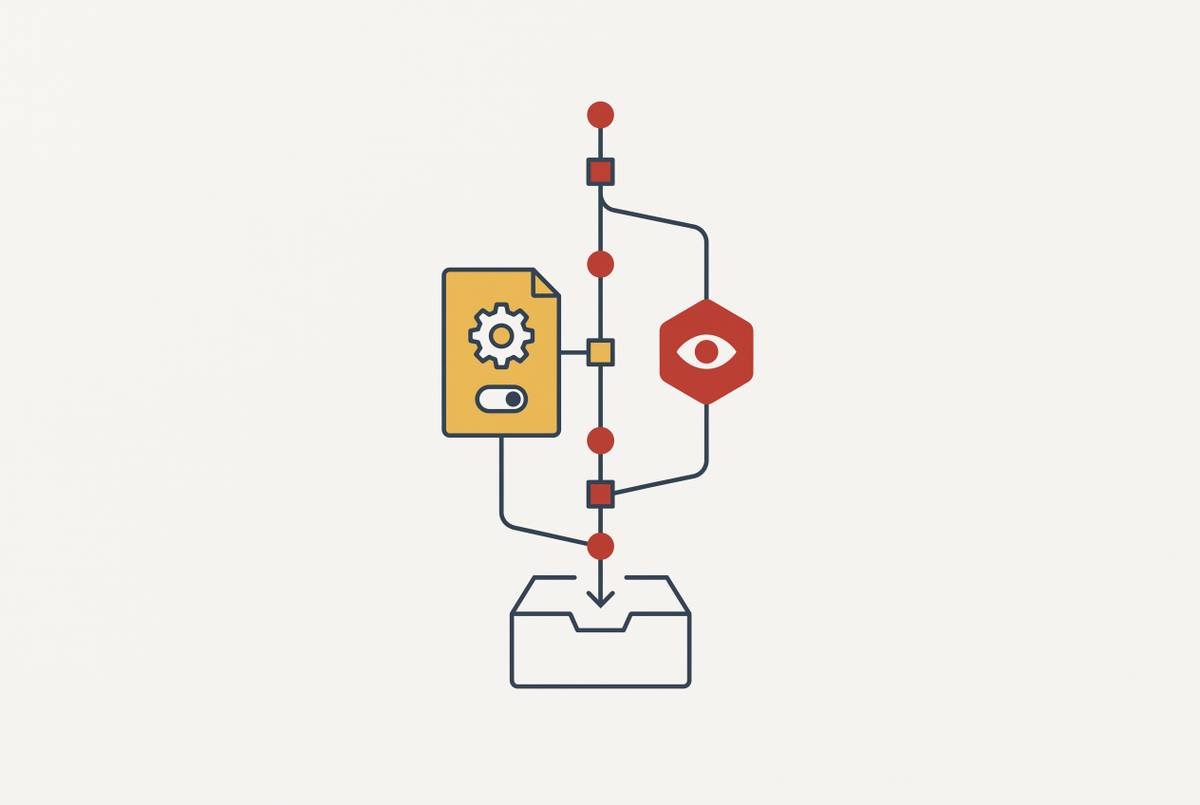
Three elements have to exist at the same time for any of this to hold together: isolation, observability, and enforcement. Treat them as separate initiatives and each one becomes optional the moment budget gets tight.
Isolation means each agent session runs in its own sandbox, credentials get minted specifically for that session and revoked the moment it completes, and no shared state bleeds from one session into the next. This matters for security, obviously, but it also makes debugging tractable in a way that shared context never does: reconstructing exactly what happened in a session doesn't require untangling it from five other sessions that touched the same state.
Observability is where most teams underbuild, because generic LLM monitoring, the kind that logs prompt, response, token count, cost, and latency, was built for a single call and response, not for an agent workflow. Production agent observability needs to explain what happened across every intermediate step. In a multi-agent workflow, the real question isn't what did the agent say, it's what did the agent network do across N internal steps before it produced anything visible. Structured event logs, OpenTelemetry-compatible distributed traces, per-agent cost and latency metrics, quality signal hooks, and immutable audit trails with SIEM export show up consistently in the research on this. Research into AI deployment failures consistently names the lack of step-level visibility as one of the top reasons agent rollouts stall, which makes this a business consequence, not just a technical inconvenience buried in an engineering backlog. Audit trail quality carries regulatory weight too: when regulators examine an AI-involved incident, they'll expect an organization to reconstruct what the agent did, why it did it, and under whose authorization. Logs need to capture not just the action but the policy and the identity behind it.
Enforcement separates a policy from a control, and whether any of this actually holds under pressure depends on that distinction. Agent configuration that lives in a repo, reviewed and versioned the same way any other code gets reviewed, is auditable. Configuration that lives in a UI setting or in one engineer's head is not, and it won't survive that engineer leaving the team. Spend enforcement that terminates a session at a defined threshold is a control. A Slack notification that arrives after the money's already spent is just a receipt. The Gravitee State of AI Agent Security 2026 report put a number on how wide this gap actually is: only 14.4% of organizations deploy AI agents with full security approval. The gap here is the absence of infrastructure to actually operationalize the controls everyone already knows they need. It's the absence of infrastructure to actually operationalize the controls everyone already knows they need.
The scale of the gap between agent deployment and governance maturity
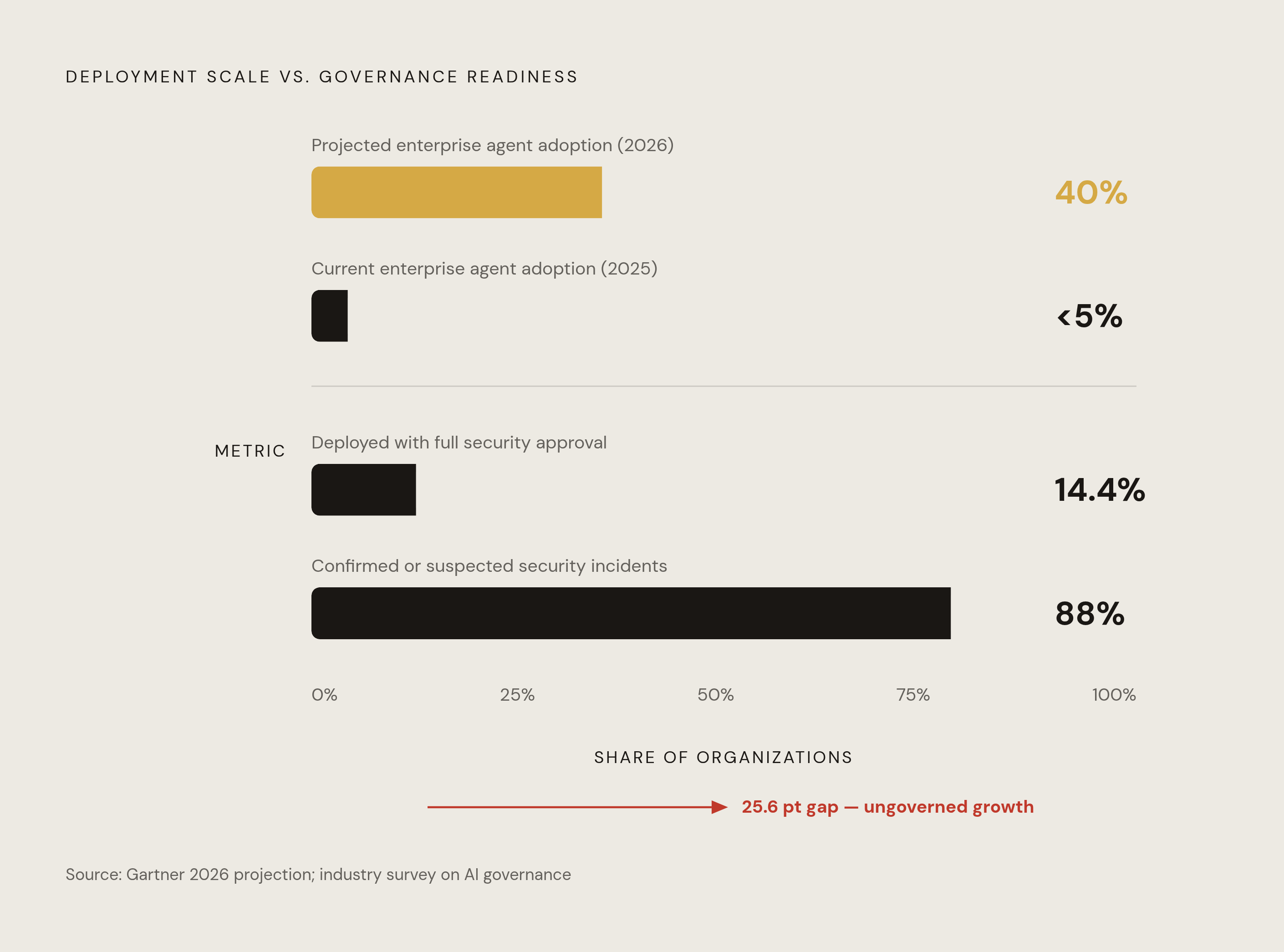
Gartner projects that 40% of enterprise applications will embed task-specific AI agents by the end of 2026, up from under 5% in 2025. That's close to a tenfold increase in a single year, and no governance function scales that fast without deliberate investment ahead of the deployment curve, not behind it.
The consequences are already visible in the data. Eighty-eight percent of organizations report confirmed or suspected AI agent security incidents, and 80% documented risky agent behaviors that included unauthorized system access and data exposure. These aren't edge cases anymore; they're closer to the median experience. Financial exposure backs this up: 64% of companies with revenue above $1 billion reported losses exceeding $1 million tied to AI system failures during 2025.
Cancellation is the clearest signal of all, because it shows the failure isn't technical. Over 40% of agentic AI projects are expected to be cancelled by 2027, and the drivers cited are escalating costs, unclear business value, and inadequate risk controls, not agents failing to write functional code. The projects getting cancelled are failing because nobody built the governance layer before scaling past the point where informal trust was enough. They're failing because nobody built the governance layer before scaling past the point where informal trust was enough.
How to structure the stakeholder conversation without overstating or underselling risk
Two ways to get this conversation wrong, and both are common. Treating every agent deployment as a breach waiting to happen shuts down adoption and alienates the engineering teams who'd actually have to build the governance controls in question. Framing agents as just a faster developer ignores the structural risks, scope, credentials, cost, and review gaps, that only appear once you're operating at production scale rather than in a demo.
A three-part structure holds up better than either extreme. Start by establishing what the agent can do autonomously versus what requires a human sign-off, using the CIO.com framing as a starting point: routine, reversible actions get delegated, while production deployments and irreversible actions stay human-owned or tightly gated. Get explicit sign-off from stakeholders on exactly where that line sits, because a vague agreement here is where the whole framework falls apart later.
Second, show what governed actually looks like in concrete terms rather than describing it abstractly. A real agent session produces a sandbox that spun up and came back down, credentials issued at the start and revoked at the end, a log of every tool call and every diff, a cost figure that traces back to a specific trigger. It's what governance infrastructure generates when it's actually running, and showing it beats describing it every time. It's what governance infrastructure generates when it's actually running, and showing it beats describing it every time.
Third, name the controls that are and aren't in place today, specifically. Don't generalize about security posture in the abstract. Inventory whether the team has session isolation, per-session credentials, spend enforcement that actually terminates sessions rather than just alerting after the fact, and immutable audit trails. Gaps identified this way become a project backlog with clear line items.
Adaptive autonomy gives stakeholders a model that's easier to say yes to than a binary approved or not approved. Agents start in assisted mode, and autonomy gets promoted only when logs show stable behavior against thresholds defined in advance, with every promotion decision traceable by an auditor after the fact. That turns the approval conversation into a ladder instead of a single high-stakes gate, which is a much easier thing for a stakeholder to sign off on.
For teams making the jump from running an agent locally, on a laptop, to deploying agents across an engineering organization, the gap is the same every time: the laptop prototype has none of the governance layer that a production conversation requires. So a platform's speed or capability is the wrong measure to focus on. The platform either makes governance the default behavior, or the team has to design, build, and maintain that layer entirely on its own.