Remote Agent Environments at Scale for Large Engineering Organizations
Security and infrastructure, not agent quality.
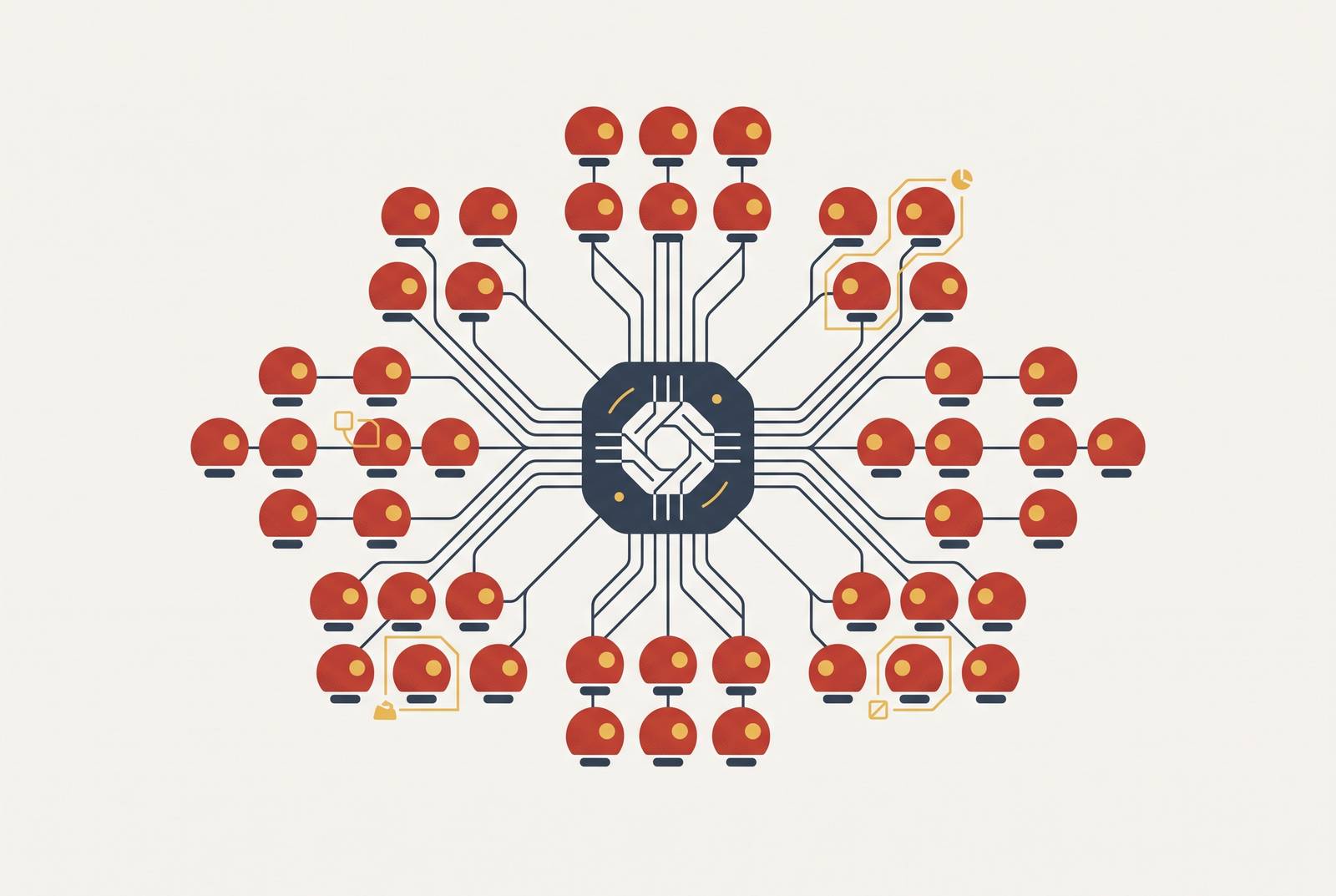
A year ago, most engineering teams had one developer running one coding agent on one laptop, watching it work through a single pull request. Now the same organizations are being asked to run that agent dozens or hundreds of times over, across every team, every repository, every environment, and the machinery built for the single-developer case is starting to buckle. The shift is not about finding a better agent. 2023 was the year of AI code completion, 2024 and 2025 the rise of AI IDEs, and 2026 is the arrival of the agent engineering phase, where the operating model moves from assistance to delegation.
That transition is not theoretical. Large enterprises are already ahead of the curve on production adoption, and the surveys behind that finding make clear the scaling problem is live rather than hypothetical. What breaks first is not the model. Quality remains the top barrier to production agent use across the board, but security climbs to the second-largest concern specifically at large enterprises, overtaking latency as organizations scale. That reordering means the failure mode that appears at scale is not "the agent got something wrong" but "the agent did something it shouldn't have been able to do.
Analysis published in February 2026 frames the deeper mechanism at work here. Agentic AI amplifies whatever technical discipline already exists in an organization, rather than replacing the need for it. Teams with strong GitOps, CI/CD, and platform engineering foundations get faster, cleaner output because the agents inherit those guardrails automatically. Teams without them get chaos faster, because an agent will scale a bad practice with the same enthusiasm it scales a good one. Gartner's projection makes the timeline urgent: 40% of enterprise applications are expected to embed task-specific AI agents by the end of 2026, up from a small fraction today. The infrastructure gap most organizations are currently ignoring is about to get a lot more expensive to ignore.
What "at scale" changes about agent execution
Running one agent on one machine and running agents across an organization are different engineering problems, not different sizes of the same problem. Concurrency is the first difference: agents now run simultaneously across teams, codebases, and environments, sharing execution surfaces in ways that let one agent's misbehavior bleed into another's context, credentials, or cost envelope. None of that exists when there's a single agent and a single operator watching it.
The organizations that handle this well are not the ones with the smartest agent tooling. Among organizations above a certain size threshold, 67% already have agents in production, and they move from pilot to durable system faster because they invested early in platform teams, security infrastructure, and reliability tooling. That reflects an infrastructure investment rather than a procurement decision.
Scale also multiplies what agents are asked to do. Where a single-developer setup might use an agent to finish a function or write a test, an organization-wide deployment uses agents to review pull requests, build entire features, investigate live production incidents, and handle the recurring grunt work that used to eat junior engineers' weeks. Each of those categories carries its own permission requirements, its own isolation needs, and its own audit trail obligations, and treating them as one undifferentiated "agent access" tier is how organizations end up granting far more privilege than any single task requires.
The natural response is to think the fix belongs inside the tool: add more guardrails to the agent itself, tighten its prompt, restrict what it can suggest. That instinct misses where the actual boundary needs to sit. Compute isolation, role-based access control, network controls, and data residency requirements live at the infrastructure layer, entirely separate from whichever AI coding tool a team has chosen. Most enterprise deployments run into trouble because they treat the tool decision as the deployment decision and skip the infrastructure layer, entirely. As the delegation model takes hold, engineers stop being the ones who write every line and become the ones who design the system architecture the agents operate inside, set the objectives and guardrails those agents work under, and validate what comes out the other end. That orchestration layer is not something that emerges on its own. It has to be built, deliberately, and it starts with isolation.
Isolation as the non-negotiable foundation of agent infrastructure
Every agent session needs to run inside its own isolated environment. This isn't a matter of distrusting agents on principle; it follows from a basic engineering constraint: at scale, the blast radius of any single session's failure has to be bounded by design, because there is no human watching every session closely enough to catch a failure before it spreads.
The technical pattern for this is remote sandboxing. Agents run inside isolated environments built on Kata Containers or Firecracker, both microVM-backed with a dedicated kernel per instance, or on gVisor, a user-space application kernel that intercepts system calls without needing a full guest kernel of its own. Each of these approaches gives strong network isolation as a baseline property, not an optional add-on. GitHub's own agentic workflow architecture starts from an explicit premise: agents cannot be trusted by default, especially when exposed to untrusted inputs, so the system relies on kernel-enforced communication boundaries that hold even if the agent's container itself gets compromised.
Session isolation solves one problem; tenancy isolation solves a related but distinct one. One business unit's agent context, credentials, and spending should never bleed into another's, and that boundary has to be enforced structurally rather than assumed because two teams happen to use the same platform.
The clearest illustration of why kernel-level isolation earns its cost involves a threat pattern security researchers have flagged as an emerging risk: an agent reads a service account token and quietly exfiltrates it to an unfamiliar external host, while the agent framework's own logs report nothing more alarming than "running tests". Framework-level logging catches what the framework was told to watch for, but has no visibility into what the underlying operating system actually did, so OS-level isolation catches what that framework logging misses. Enterprise deployment guidance now lists sandbox isolation among seven controls treated as non-negotiable, alongside SSO integration, SIEM-connected audit logging, secret scanning on agent-generated pull requests, PR policy gates, license governance, and incident response runbooks. On a well-governed platform, each session gets credentials minted fresh at session start and revoked the moment the session ends, which is the design pattern that turns credential scope into something enforced by the system rather than something hoped for by policy.
Credentials and identity management breakdown for agents at organizational scale
Credential systems built around human engineers assume a human is the one making each request. Agents break that assumption immediately: they call APIs, query databases, invoke MCP tools, and chain actions across cloud environments, often simultaneously and without anyone reviewing a given action before it executes.
Most enterprises are deploying agents faster than they are building the governance structures meant to contain them. Agents are already processing customer data, reaching into internal APIs, and chaining multi-step actions across cloud environments with minimal human oversight along the way. Long-lived API keys shared across agents, or credentials simply inherited from a developer's own environment, were never designed to be handed to a system that can act autonomously and repeatedly within seconds.
Regulators are starting to name this gap explicitly, and the signal is worth reading as a warning rather than a current mandate. Singapore's IMDA published its Model AI Governance Framework for Agentic AI in January 2026, addressing agent-specific risks that include delegation chains and multi-agent coordination directly. NIST launched its AI Agent Standards Initiative in February 2026, with agent security and identity named as core pillars of the effort. Neither of these constitutes binding law yet, but both point in the same direction: the expectation that organizations manage agent identity with the same rigor as human identity is forming now, and organizations that build toward it early will not be scrambling to retrofit compliance later.
The pattern that holds up under this pressure scopes credentials to a session: minted when the session starts, revoked when it ends, never persisted beyond that window. Role-based access control needs to apply to agents on the same terms it applies to engineers, scoped by the specific task at hand rather than inherited wholesale from whichever developer happened to trigger the agent run. Much of the security investment made so far has focused on the model layer, hardening prompts and filtering outputs, while the execution layer sits comparatively unguarded. That is precisely where agent attacks land in 2026: the moment an agent calls an API, writes to a database, triggers a downstream workflow, or pushes an instruction to a connected system is the moment where real damage becomes possible.
Observability gaps that make agent failures undetectable until they compound
Knowing that an agent ran and knowing why it did what it did are two different kinds of knowledge, and most organizations only have the first. Traditional infrastructure monitoring, the Datadog and New Relic category, captures latency figures and span counts; application logging captures whatever events a developer thought to instrument. Agent observability sits a layer above both, capturing which tool the agent chose, what arguments it passed into that tool, what came back, and how that result changed the agent's next reasoning step.
Most tools marketed as "LLM observability" stop well short of that layer. They track prompts, token counts, and latency, which is enough to tell an engineer that something went wrong but not why it went wrong, because that requires business, data, and governance context those tools were never built to hold. Adoption of basic agent observability is now close to universal. Detailed tracing, the kind that lets someone inspect individual agent steps and tool calls rather than just a summary, is at only 62% of organizations, separating teams that can actually debug a failed agent run from teams that are left guessing. Adoption of that deeper tracing skews higher among organizations that already have agents running in production, which suggests it gets built once the pain of not having it becomes acute enough to justify the investment.
The gap widens further once agents start talking to each other. A survey run by the EY and AIUC-1 Consortium found that only a minority of organizations monitor AI traffic end-to-end across prompts, tool calls, and outputs, and fewer still maintain continuous monitoring of agent-to-agent interactions. As multi-agent workflows become standard, framework-level logging tends to miss delegation chains where one agent's output becomes another agent's input, and most organizations fail to monitor these interactions.
Closing that gap means capturing every authentication event, every tool invocation, every delegation handoff, and every policy decision an agent makes, logged not just as "what happened" but as who it happened on behalf of and under what policy conditions it was permitted. That data needs to route directly into the enterprise SIEM systems already in place, such as Splunk, Datadog, or Microsoft Sentinel, because an agent acting inside a company's network deserves the same monitoring rigor as an engineer or a system administrator would face. Anything less leaves agent behavior effectively invisible until a failure compounds into something too large to ignore.
Cost control as a structural requirement, not a finance team concern
Agentic workloads consume tokens at a rate that has nothing in common with a chatbot answering questions, and organizations that budget for agents the way they budgeted for chat features are setting themselves up for an unpleasant surprise. Reasoning steps, tool orchestration, context growth, and retry logic each add cost individually, and each one looks reasonable in isolation.
68% of companies report that their AI initiatives ran over budget, and only a minority have real-time visibility into what their AI systems actually cost to run at any given moment, a pattern a separate quarterly study from KPMG reinforces. Without real-time visibility, an organization does not find out it has a cost problem until the invoice arrives, by which point the spend has already happened and there is nothing left to control.
The pattern taking hold in response is the AI gateway, a control plane sitting between applications and model providers that enforces budgets, rate limits, and caching policy from one central point rather than leaving those controls scattered across every codebase an agent might touch. Per-key rate limiting lets a platform team cap individual engineers at a fixed number of tokens per hour, with separate, higher tiers reserved for production workloads that need more headroom. Once a key exhausts its allotted budget, the gateway returns a structured error instead of quietly continuing to rack up charges.
Model routing is the other lever worth building into that gateway layer. Most enterprises now run several frontier models concurrently, and that reality makes cross-provider routing and model tiering the central cost decision rather than a minor optimization. Sending the same agent task through a lighter, cheaper model for first-pass work and reserving a heavier model for final review can cut costs meaningfully without giving up output quality. None of this works as a monthly dashboard review. Budget controls need to be enforceable at the session level, the developer level, and the time-period level simultaneously, because monitoring spend after the fact is not the same thing as controlling it.
Agents-as-code: making agent configuration reviewable, versioned, and reproducible
Isolation, credentialing, and cost controls only hold if the configuration that defines an agent's permissions can't be changed by anyone with access to a settings panel. Agent behavior defined outside version control is, by construction, ungovernable, and the discipline teams already apply to infrastructure-as-code needs to extend to how agents themselves get defined, scoped, and modified.
The mechanism is straightforward: agents defined as YAML configuration files checked directly into a repository go through the same review, approval, and rollback workflow as any other code change. A change to what an agent is permitted to do requires a pull request, with a reviewer looking at the diff, rather than someone flipping a toggle in a UI where the change leaves no trail. Goose's Recipes feature is a working example of the pattern: portable YAML workflow definitions bundle an agent's extensions, instructions, parameters, and settings into a repeatable automation that runs in CI or gets shared across a team, rather than living in one person's local setup. By mid-2026, serious usage of CLI coding agents runs from CI pipelines, over SSH, and on machines with no GUI at all, fully scripted and decoupled from any individual developer's laptop.
This is where the isolation and credential arguments made earlier stop being abstract. The YAML file is where a team declares exactly which credentials an agent is allowed to request and exactly which tools it's permitted to call, and because that file has to pass review before merging, an agent cannot quietly acquire new capabilities without someone signing off on the diff first. Version control also makes agent behavior auditable in a way a GUI-configured agent never can be: given a commit hash, an engineer can reconstruct precisely what instructions, permissions, and tool access an agent had at any point in its history.
The CIO analysis frames this as the broader operating model, delegate, review, and own: agents handle first-pass execution, engineers review outputs for correctness, risk, and alignment, and ownership of architecture, trade-offs, and outcomes remains human. Version-controlled agent configuration is the structural piece that makes that model actually work, rather than a slogan a team repeats without a mechanism behind it.
Managed cloud platforms and the build-vs-operate calculus for agent infrastructure
Every requirement covered so far, microVM-backed sandboxes, ephemeral session credentialing, SIEM-connected audit logging, per-session budget caps, and trace-replay observability, is individually manageable. Maintaining all of them together, continuously, across every team in an organization, is a platform engineering project on the scale of the ones that take a dedicated team a year or more to get right.
Building that stack in-house remains a legitimate choice for some organizations, and in certain cases it is the only choice. Self-hosted options such as OpenHands, open-source, self-hostable, and compatible with a pluggable model backend, fit organizations whose compliance requirements forbid sending source code to external APIs, or teams that specifically want to own their infrastructure end to end. The tradeoff is direct: the organization that builds this way also owns the full operational burden of running it, patching it, and keeping it current as threats and requirements evolve.
Managed cloud platforms change that calculation by bundling the governance layer, isolation, credentialing, logging, and cost controls, as a service that a platform team consumes rather than builds from scratch. Engineering teams still define their agents in YAML files checked into their own repositories, still run them in isolated sandboxes, and still get the audit trail and budget enforcement described throughout this piece. What changes is who maintains the microVM runtime, who patches the sandbox images, and who keeps the SIEM integration working when a logging schema shifts upstream. For most organizations scaling past the pilot stage, keeping agent definition and review in-house while handing infrastructure operation to a platform built for that purpose turns the wall so many teams are hitting right now temporary instead of permanent.
Sources
- How agentic AI will reshape engineering workflows in 2026 | CIO
- State of AI Agents
- How Enterprises Are Building AI Agents in 2026: From Pilots to Production - BeamSec
- Agentic Development: What It Means for Engineering Infrastructure in 2026 | Bunnyshell
- Agentic Enterprise: AI Governance | CSA
- AI Agents at Work 2026: Securing the agentic enterprise