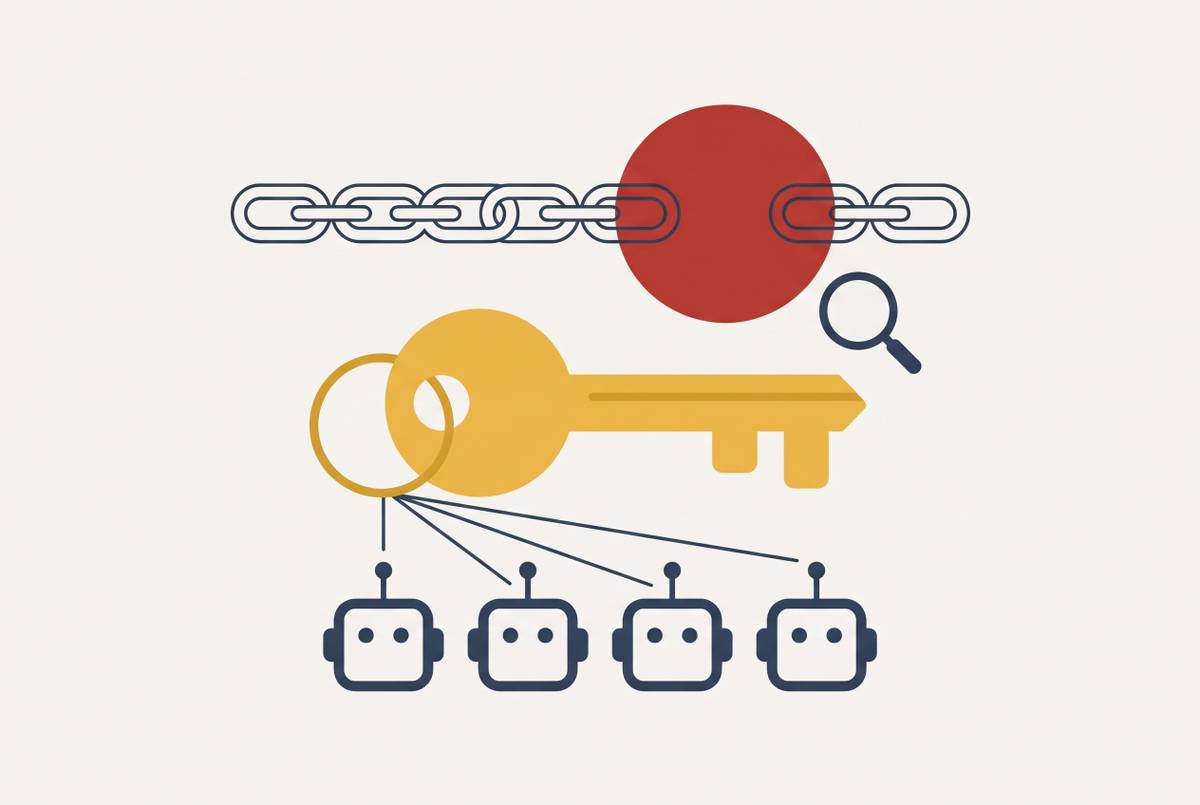
What the GitOps Checklist Actually Reveals When Applied to Agent Configuration Vendors
Versioned agent configs only count as governed when runtime controls enforce them.
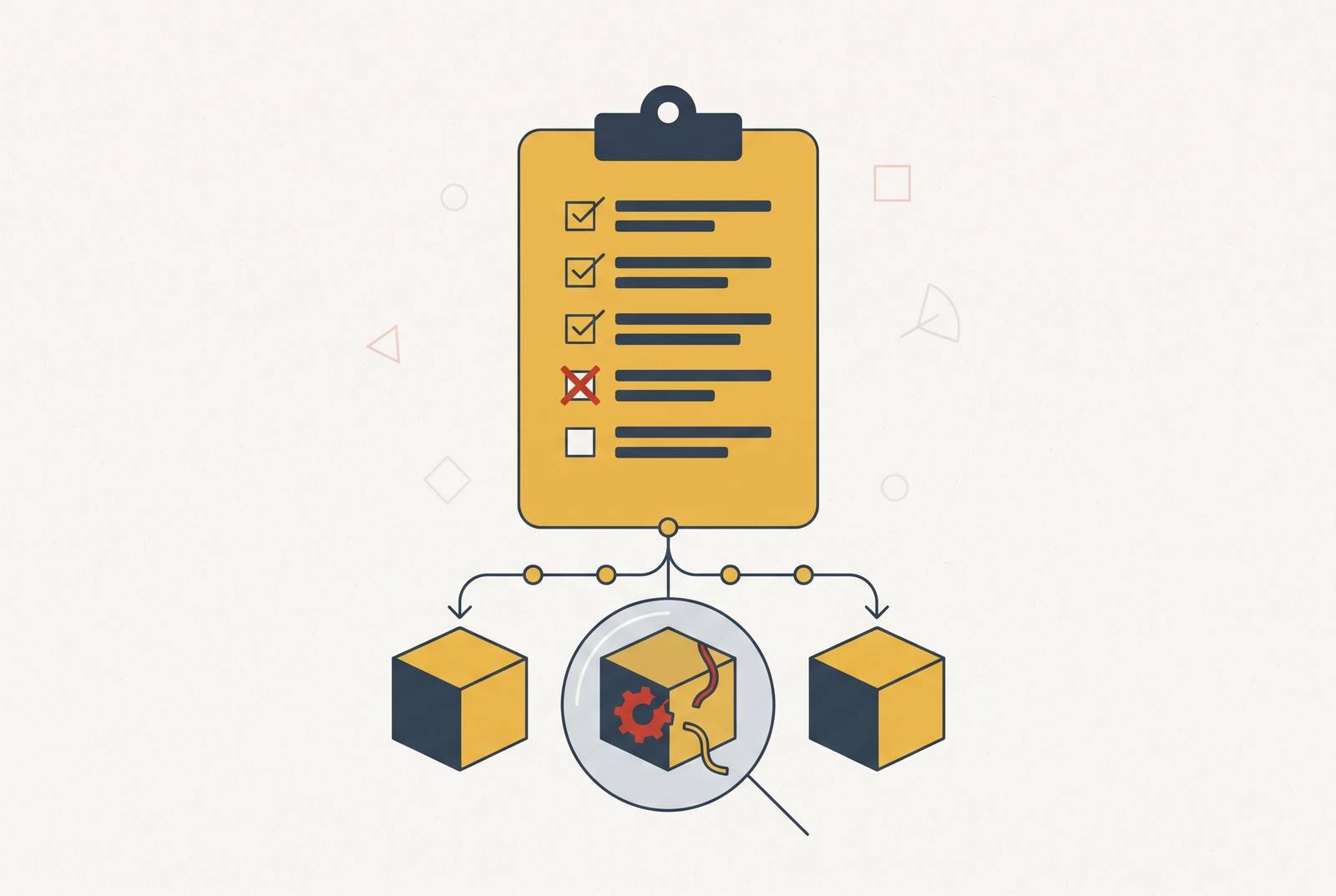
Agents-as-code means defining AI agents in YAML config files checked into a Git repository, so changes to their definitions pass through pull requests and code review. This article applies the GitOps checklist to agent configuration vendors and draws a firm distinction. Versioned definitions become governed infrastructure only when runtime controls enforce their permissions, credentials, budgets, and turn limits.
Why GitOps principles make a useful evaluation lens for agent configuration vendors
GitOps supplies four requirements that already have a history in infrastructure operations. Configuration is declarative, version control is the single source of truth, actions are auditable, and live state is continuously reconciled with declared state. Each operational test asks whether teams can inspect the state a system should be in, review changes to it, and enforce it after deployment. Applying them to agents exposes whether vendors have built the corresponding controls.
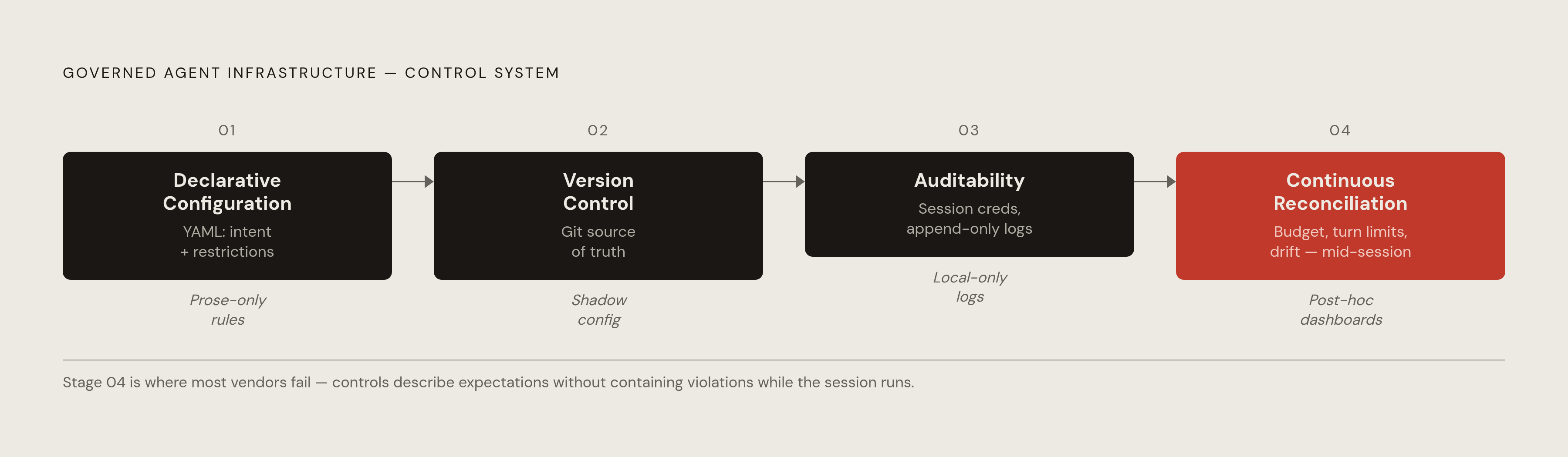
The value of this lens is its specificity. A vendor may offer a configuration file without making that file authoritative, or provide activity logs without protecting them from the agent that produced them. Those distinctions are easy to obscure in a feature comparison. The checklist instead asks how the parts connect. Declarative configuration establishes intent, version control governs changes, auditability explains actions, and reconciliation limits departures from policy while an agent runs.
Why agent config and GitOps infrastructure config are not the same thing — and why that gap matters for evaluation
The infrastructure analogy is useful but incomplete. Applying a Terraform configuration twice produces the same EC2 instance, but using the same CLAUDE.md on two different days may lead to different tool calls, reasoning paths, and outputs. LLM non-determinism, model version drift, and accumulated context can change behavior without changing the file. A clean Git history records the instructions.
CLAUDE.md makes the distinction concrete because it instructs Claude’s behavior at conversation start but enforces nothing by itself. An instruction such as “never modify package.json without explicit approval” remains an advisory constraint. Enforcement needs separate controls, including permissions and hooks. The model’s willingness to follow an instruction is not a technical boundary.
This creates two layers of evaluation. The first asks whether the vendor puts configuration in Git, which is the baseline for reviewable intent. The second asks whether runtime controls close the gap between that intent and actual behavior. Neither layer replaces the other. Runtime enforcement without reviewable configuration leaves policy opaque, while reviewable configuration without enforcement leaves its constraints dependent on the model.
How do AI agent definitions in YAML become declarative configuration?
A vendor passes the declarative configuration criterion only when the repository describes the agent’s behavior without requiring out-of-band setup in a dashboard. YAML alone does not establish that property. The configuration must cover both behavioral intent, which is the system prompt equivalent, and the restrictions on what the agent can do. The two-layer model separates those responsibilities. One file expresses intent, while settings.json or a YAML frontmatter layer supplies enforceable controls.
Claude Code’s subagent configuration illustrates the necessary breadth. Its frontmatter fields include description, tools, disallowedTools, model, permissionMode, maxTurns, skills, mcpServers, and hooks. PreToolUse hooks provide validation before operations execute. These fields describe more than a prompt. They expose tool access, model assignment, permission behavior, and execution limits as configuration that a reviewer can inspect before the agent runs.
The distinction is between two responsibilities. YAML frontmatter can share a file with instructions for how an agent should behave and still define a separate control layer. Conversely, a YAML file containing only instructions cannot substitute for permissions and hooks. Vendors fail this test if they use prose to enforce rules or keep either layer only in a UI. A narrower configuration surface cannot support the same guarantees as one that exposes the full set of controls.
Model assignment also belongs in the reviewed definition. Choosing heavier models for complex reasoning and lighter models for routine review sets policy for the agent as well as making it easier to use. A pull request makes that decision visible with the rest of the agent’s configuration. A dashboard-only model selector breaks that connection. The file format is therefore less important than whether the file expresses the complete policy.
What the version control criterion actually tests — Git as the single source of truth for agent behavior, not just for the config file
Git stops describing the effective configuration when a routine behavior change requires an unrecorded change elsewhere. Setting permissions in a web console, choosing a model through a support ticket, or making dashboard changes without commit rights all create shadow configuration. The repository may still hold a valid agent definition. It is no longer authoritative. Passing this criterion requires every routine policy change to be expressible through a file in a pull request.
Changes to.claude/, AGENTS.md, or an MCP configuration can alter what an agent does, so they require the same review as application logic. Repository-root configuration makes that gate easier to apply. Proprietary locations or formats make it harder. Vendors must be judged on whether they work with the review process already in place or create a way around it.
File precedence needs equally explicit treatment. Where nested resolution gives priority to the file nearest the code being edited, reviewers must understand which definition will apply before merging. Vendors must document that resolution order. Ownership must also remain legible through the configuration and its history, with every sanctioned agent and MCP server assigned a named, accountable owner. A commit trail supports accountability only when teams can connect the effective definition to someone responsible for it.
What the auditability criterion actually tests — credential scope, session isolation, and logs that survive a compromised agent
PocketOS illustrates the risk when credentials cross their intended boundaries. In the April 2026 incident, an agent found an account-scoped Railway API token originally created for custom domain management. Its scope extended across the account’s workspaces. The distinction is technical, not semantic. This access beyond the credential’s task shows why credential isolation cannot rely on instructions to ignore unrelated secrets.
Credentials must be minted fresh for each session and revoked when it ends. A standing credential that an agent can reuse across sessions, or discover in an unrelated file, leaves the same class of exposure unresolved. The July 2026 OpenAI incident reinforced the need to place prompt injection isolation in infrastructure. Trusting the model not to misuse accessible authority is not isolation.
Audit records then need to cover three different layers. Git history records changes to configuration, while session logs record the conversation and the context in which the agent ran. Claude Code stores conversation history locally, and Codex CLI logs to its session directory. Local records alone cannot meet a team’s need to hold people accountable. Orchestration logs must capture full session output, tool calls, diffs, and token consumption in an append-only record outside the agent’s reach.
That separation protects the evidence from the actor being audited. Without it, the record’s availability depends on the developer’s machine or on resources accessible to the agent itself. Human review also needs an explanation that does not require reconstructing raw logs. Agent-generated pull requests should state why the agent acted, what changed, how to roll back, and a confidence signal.
What the continuous reconciliation criterion actually tests — drift detection, budget enforcement, and runaway loop prevention
Auditability explains what happened, while reconciliation governs what keeps happening. Infrastructure GitOps compares declared state with live state, identifies drift through signals such as synchronization status, and repairs the divergence. For agents, the corresponding comparison concerns runtime behavior, including token consumption, tool calls, and model selection. Violations need a defined response. A per-session cost or turn-count alarm serves the same purpose only if it fires before damage accumulates.
Cost makes missing controls immediately visible. Agentic tasks use far more tokens than code chat or code reasoning, and most of the cost comes from input tokens used for context replay. An agent that re-reads the entire context on every iteration can accumulate enormous costs over a weekend. A declared and enforced turn limit is the minimum control. Without a per-session or per-task spend cap in configuration, the vendor also fails the budget-governance test.
YAML-driven budget policy makes the response explicit through per-agent daily limits, per-task limits, alert thresholds, and an on_exceed field set to pause_and_alert. A dashboard that shows excess spending after execution does not reconcile runtime behavior with the declared budget. The control must act while the session runs. Otherwise, the policy describes an expectation without providing a mechanism to contain a violation.
Configuration can keep heavier models for complex reasoning and route classification and extraction to lighter models, with runtime enforcement carrying out that choice automatically. Prompt caching provides another lever for large-context workflows. Cache hit rates in session logs let teams check whether the configuration keeps costs where they expect them to be. Without that visibility, an important part of the runtime outcome remains opaque.
How the checklist separates governed infrastructure from glorified prompt wrappers
The four criteria test a connected control system. Declarative, two-layer configuration specifies intent and restrictions, Git governs changes, protected logs preserve evidence, and reconciliation enforces limits during execution. Session-scoped credentials tie access to the work the agent is doing. None of these properties can stand in for another. A strong audit trail cannot compensate for unrestricted credentials, just as a reviewed prompt cannot substitute for an enforced turn limit.
A vendor that leaves these connections incomplete has not operationalized governance. Where restrictions exist only as prose, the product remains a prompt wrapper with a YAML file on top. Other failures, such as shadow configuration or local-only logs, leave different gaps in authority or accountability. Repository content, including introductory files, issues, documentation, and generated fixtures, must remain data.
Enterprise vendors are addressing this governance gap. Microsoft’s Agent 365 SDK, generally available at Build 2026, brings observability, access controls, and compliance enforcement into development workflows. CrowdStrike and another security vendor also show that the market is moving toward agent governance, though their names alone do not prove that they pass every criterion. This is not an endorsement ranking. Each offering still has to demonstrate the relevant boundaries, records, and enforcement mechanisms.
Gartner predicted by mid-2026 that a large share of enterprises would demote or decommission autonomous agents because governance gaps emerged only after production incidents. That prediction frames the checklist as a way to examine those gaps before deployment. The relevant evidence is whether a vendor can show how policy becomes a runtime boundary. A configuration demo cannot answer that question alone.
What running agents on governed managed infrastructure looks like in practice
Running Claude Code or Codex on a laptop is a way to build a prototype, while running it in production needs governance controls around it. Managed infrastructure can provide those controls so each team does not have to build them from scratch. Hosting alone is not the distinction. The production pattern begins with YAML agent definitions checked directly into the repository and reviewed like other code. It then connects those definitions to isolated sessions and enforceable policy.
Each session runs in a sandbox with credentials minted for that session and revoked on completion. Every tool call, diff, and token is recorded in an append-only audit trail attributable to a person or trigger and stored outside a developer’s machine. Budget caps operate as hard limits at the session, developer, and time-period level. Together, they connect the reviewed definition to both execution and its recoverable record.
The CNCF’s emerging work on agent runtime isolation, tool-call governance, authentication, authorization, and tracing describes the same requirements from the infrastructure side. Managed platforms that implement these properties reduce the work otherwise needed on a CI runner or cloud VM. Operational policy still needs a named owner for every sanctioned agent and MCP server, a sanctioned-agent list that is kept up to date with a path for review, and a record of least-privilege credential grants. Destructive actions must remain separate from read access. A governed platform should make those requirements the default, so approval of an agent definition establishes enforceable authority.