Git Worktree Isolation for Parallel Agent Code Review
Isolate parallel code review agents with Git worktrees to prevent silent conflicts.
Git worktrees give each AI code review agent its own isolated working directory and branch, eliminating the silent file conflicts, stale context, and lock contention that make naive parallel agent setups unreliable, and this guide shows engineering teams how to set that pattern up for production code review workflows.
Parallel AI code review and the problem of shared directories
Engineering teams have stopped asking whether to run AI agents in their code review pipelines and started asking how many to run at once, marking a shift from pilot programs to infrastructure bunnyshell.com baytechconsulting.com Glite ARF: Verifier-Driven Research with Parallel LLM Coding Agents. That's a figure describing infrastructure, not a pilot-program statistic.
The shift that matters is what adoption changed about how work gets divided. Teams no longer hand a single agent one task and wait. They split a sprint into parallel workstreams, auth changes, an API refactor, a payment bug fix, and assign each to a different agent running at the same time. The logic is sound on paper: if agents can work independently, why serialize them?
The trouble is what independence actually costs when nobody defines it. A report from Faros AI, drawing on more than 10,000 developers across 1,255 teams, found GenAI adoption drove a 98 percent increase in merged pull requests, alongside a 91 percent jump in review time and a 9 percent rise in defects per developer arxiv.org Glite ARF: Verifier-Driven Research with Parallel LLM Coding Agents. That's a volume problem masquerading as a productivity win: code is shipping faster than anyone can actually review it, and quality is slipping in the gap.
The naive fix, the one most teams try first, is to open several agent sessions against the same repository and let them loose in parallel. It fails in ways that are almost too mundane to take seriously until they cost someone an afternoon. One agent switches branches mid-task, and the filesystem state shifts under the other agent's feet. An agent reads uncommitted, in-progress changes left by another session and reasons forward from a context that was never meant to be final.
None of this is exotic. It happens routinely, and it happens quietly: the agent doesn't stop and announce that its context is broken, it just keeps producing output, confidently, from a corrupted starting point. The fix that solves this isn't a new platform or a paid add-on. It's a Git feature that has existed for years, sitting unused in most teams' toolchains: the worktree.
Git worktrees versus cloning
A Git worktree lets a single repository check out multiple branches into separate directories on disk, all at the same time, all sharing one underlying .git object store. History, commit objects, and refs live in one place, so nothing gets duplicated, and a commit made in one worktree appears immediately in every other worktree attached to that repository. Creating one is close to instant, and it costs almost nothing in disk space beyond the working files themselves, because the object store itself isn't copied.
That's a genuinely different animal from cloning. A clone stands up a full, independent .git directory with its own copy of the entire history, isolated from the original in every sense. A linked worktree, by contrast, is a lightweight directory: its own checked-out branch, its own working files, its own index, but no second copy of the object database sitting behind it.
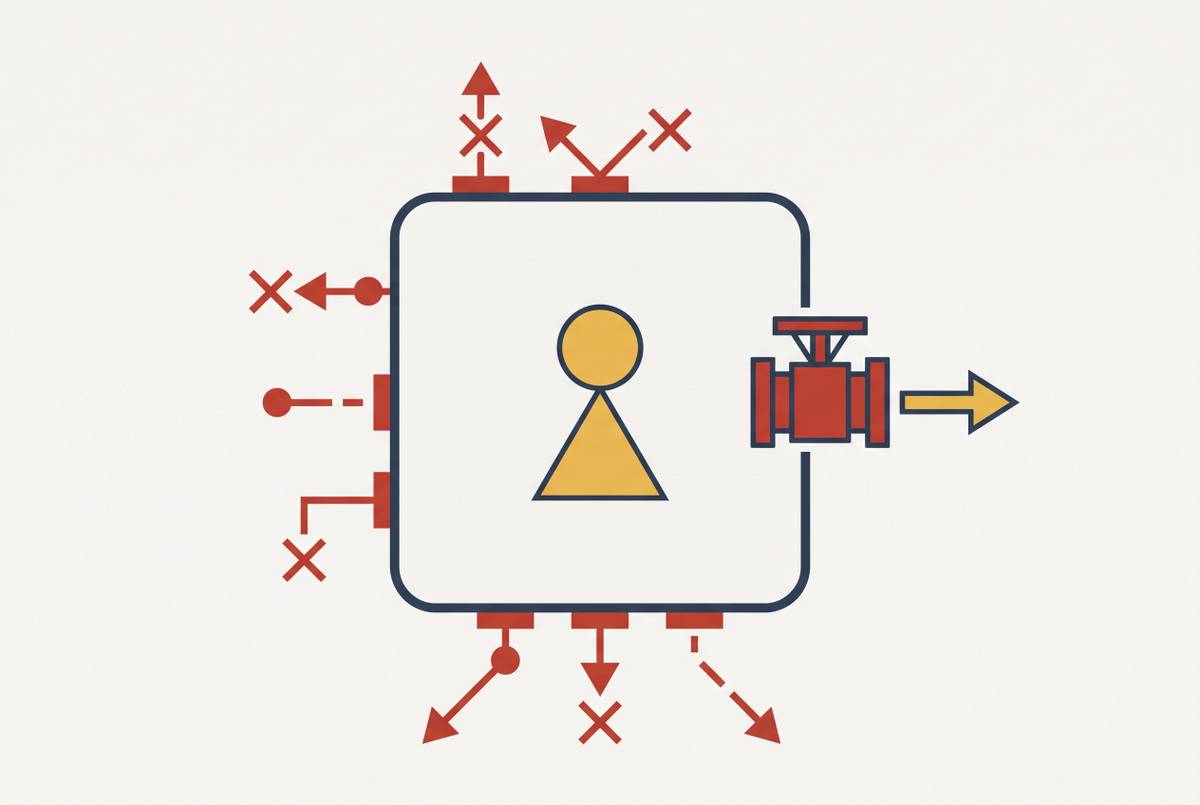
For parallel agents, the property that matters is blunt and physical rather than clever: an agent editing files inside one worktree directory cannot touch files inside another, because they are separate directories on disk. Each worktree also carries its own Git index, so there's no longer .git/index.lock fights between sessions.
Picture a repository named my-project. The main worktree stays checked out on main. A second directory, my-project-feat-auth, sits on the feat/auth branch. A third, my-project-refactor-api, sits on refactor/api. Three agents, three directories, one shared history underneath. The conflict that used to happen invisibly, mid-task, at the filesystem level, now happens at merge time instead, where ordinary Git tooling can actually see it and flag it. That relocation, from silent corruption during work to visible conflict at merge, is the entire safety property worktrees offer.
Step-by-step setup for a parallel code review workflow using worktrees
The prerequisites are almost nothing: Git 2.5 or newer, since that's the release where worktrees first shipped (as an experimental feature at the time), a repository with at least one commit, and whatever agent a team already uses.
Start by creating a linked worktree for the first reviewer. Running git worktree add ../my-project-feat-auth feat/auth checks out the feat/auth branch into a sibling directory. If the branch doesn't exist yet, git worktree add -b feat/auth../my-project-feat-auth main creates it off main in the same step.
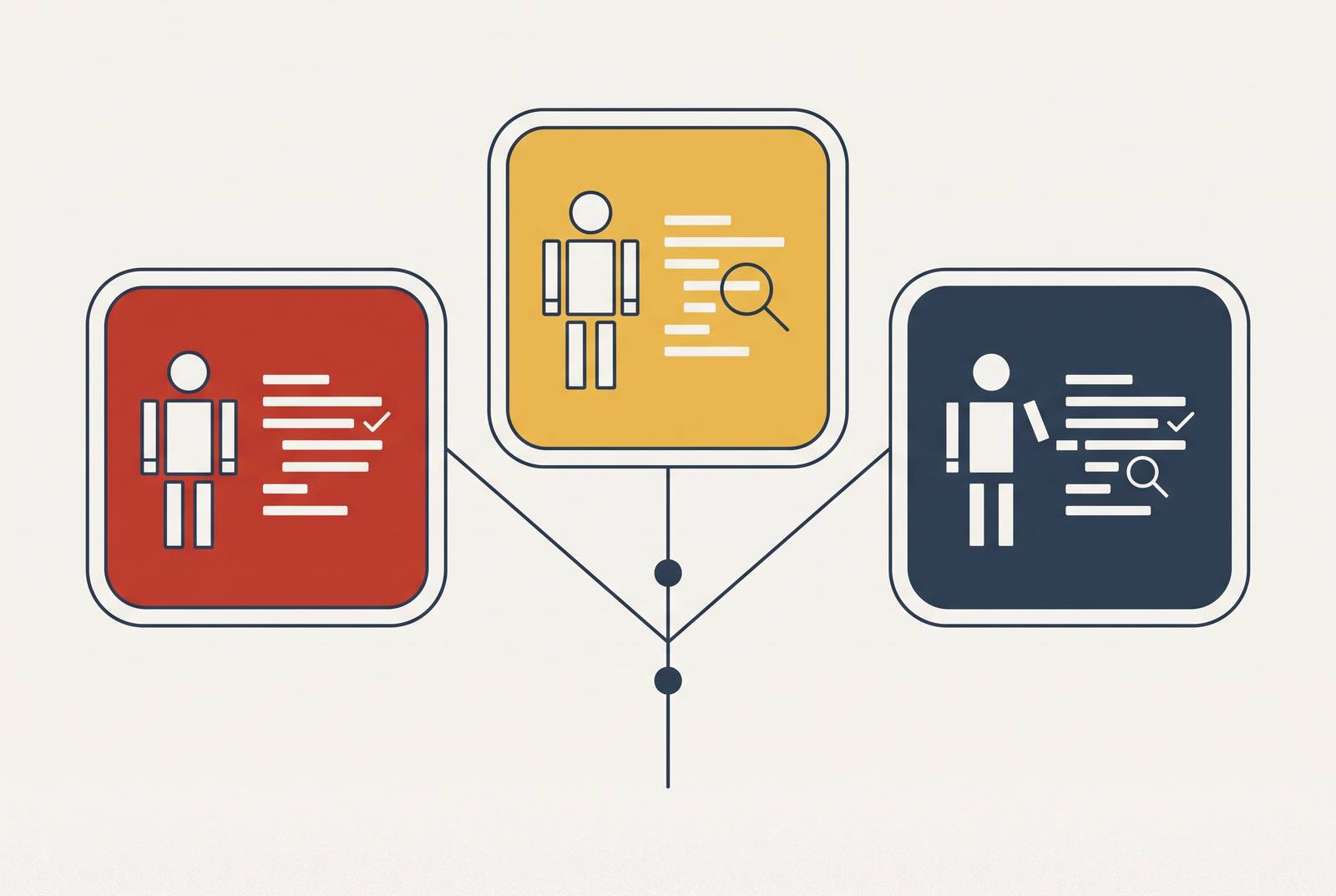
From there, add one worktree per parallel reviewer, each pointed at its own branch and its own directory. A team running three specialist reviewers, say one on architecture, one on line-level correctness, one on deployment risk, would run the command three times, once per reviewer.
git worktree list confirms the layout: every directory, its current commit, and its checked-out branch, all in one glance. It's worth checking before launching any agent session, not after something has already gone sideways.
Launch each agent inside its own worktree directory, in separate terminals or separate tmux panes. For a Claude Code session, that's as simple as cd ~/my-project-feat-auth && claude. Each session then sees only the files inside its own worktree; it cannot see another session's uncommitted changes, cannot switch branches out from under a neighboring agent, and starts from a clean, isolated checkout.
The step teams skip, and shouldn't, is decomposing the review itself by domain rather than by file. The practitioner pattern that's emerged treats review as a set of specialist roles: one agent for architecture, security, and design concerns, one for line-by-line correctness, one for deployment and routing risk. Each specialist owns a functionally distinct slice of the change, so file-level overlap stays low by construction rather than by luck.
Finally, merge and clean up. Merge the branch as usual, then run git worktree remove ../my-project-feat-auth. Worktrees don't tidy themselves up automatically; removal has to be a scheduled step in the workflow, not something remembered three weeks later when disk usage looks strange.
Conflicts that survive filesystem isolation
Worktrees solve exactly one problem: workspace isolation at the filesystem level.
The sharpest gap is what the STORM paper calls semantic conflict. Two agents can edit related files under mutually incompatible assumptions, and both branches can compile cleanly in isolation, and the two still break the moment they're combined. Standard Git tooling has no way to catch this automatically, because there's no textual conflict for it to flag; the code is syntactically fine, just wrong together.
Contamination at the reasoning level survives worktree isolation too. Suppose Agent A finishes refactoring a service while Agent B, working in a separate worktree, is midway through building a consumer of that same service. Agent B's plan is built on assumptions about the service's old shape, assumptions that are already stale the moment Agent A merges.
Then there's everything outside the working directory that worktrees were never built to touch. Agents in separate worktrees can still write to the same test database at the same time. Dev servers launched from different sessions collide on identical ports. Build caches and shared configuration registries sit outside the worktree boundary entirely, mutable and shared regardless of how many directories an agent's files live in.
Monorepos add a more mundane pressure: each worktree needs its own full working directory checkout, and in a large repository that means file watchers, test runners, and build tooling all competing for the same disk I/O across every active session. One practical mitigation pairs git worktree add with git sparse-checkout set <paths>, so each agent only materializes the files it actually needs rather than the entire tree.
Worktrees, in short, are necessary but not sufficient. They remove one entire category of failure and leave several others exactly where they were.
Adding a coordination layer above the worktree: task allocation and merge sequencing
The pattern that holds up in practice is two layers, not one. Worktrees handle isolation at the filesystem level. A shared task list or coordinator handles allocation at the level of work itself, deciding who gets what and when the results get combined. Skipping the second layer means the first one just delays the collision instead of preventing it.
The payoff for getting both layers right is visible in the numbers. The Vesper research system reported execution time speedups of 3.2x to 3.9x from worktree-enabled parallelism. A more striking data point comes from the Glite ARF project: during a research campaign, twelve agent sessions ran in parallel on a single 48 GB Mac, covering 273 tracked tasks and 146 experiment runs across 129 feature sets, for roughly $450 in total LLM API spend, with no merge conflict ever reaching the main branch arxiv.org. That's not a claim about worktrees alone; it's a claim about worktrees paired with disciplined coordination above them.
A coordinator's job, concretely, is threefold: assign tasks so they don't overlap on shared files, sequence merges after verification rather than all at once, and catch the moment one agent's finished work quietly invalidates another agent's in-progress assumptions. Research into optimistic concurrency control, the approach STORM takes, finds it beats lock-based coordination over shared state, but even STORM's authors note it isn't enough on its own without hierarchical task decomposition sitting above it.
Deterministic scripts, not prose instructions, enforce task isolation, immutable completed work, and a corrections overlay for fixing mistakes after the fact in the Glite ARF pattern. The rule lives in code that fails loudly the moment it's violated. Telling an agent in a system prompt not to touch another agent's files is a suggestion. A script that refuses the write is a guarantee.
The last piece is knowing when to trust an agent's output enough to merge it without a human in the loop. Teams that saw 70 percent more pull requests merged did it by using confidence thresholds to gate autonomous merges, building trust incrementally rather than granting it all at once alexlavaee.me. Auto-merging without a verification gate, regardless of how well the worktree setup is built, defeats the entire purpose of adding one.
STORM and the alternative approach: detecting conflicts at write time instead of merge time
The STORM paper makes a specific criticism of worktree isolation: isolation prevents interference while agents are actively editing, but it does that by pushing every conflict into the merge step, after agents have already committed to designs that might be mutually incompatible. By the time anyone finds out, the work is done and the fix is expensive.
STORM's answer is to skip isolation entirely and instead check, at write time, whether an agent's view of a file and its dependencies is still current. If another agent has touched any of those files since the writing agent last read them, the write is rejected and the agent retries from a fresh, correct baseline. Conflict detection moves from "after the fact, expensively" to "before the fact, cheaply."
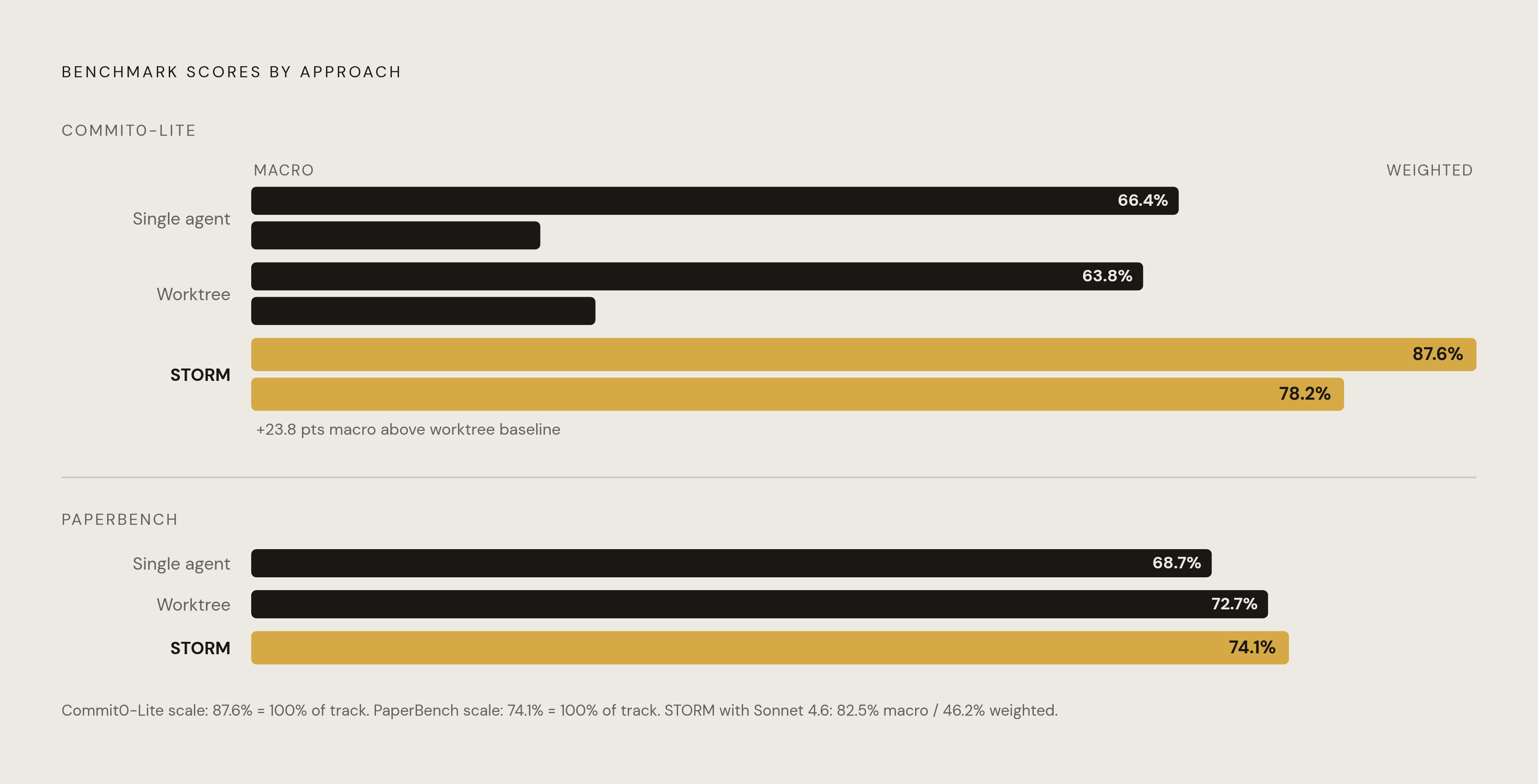
The benchmark numbers back the claim up, at least on one dataset. The worktree baseline scored 63.8 percent macro and 24.6 percent weighted, and a single agent working alone scored 66.4 percent macro and 20.7 percent weighted beam.ai arxiv.org.
Combining STORM with single-agent runs pushed scores to 87.6 and 78.2 across the two benchmarks respectively, the highest results reported arxiv.org.
None of this makes worktree isolation obsolete. For code review pipelines, write-time semantic conflict detection affects outcomes more than strict filesystem separation, so a STORM-style approach is worth evaluating on its own merits. Benchmark results on Commit0-Lite (with Sonnet 4.6) are presented. STORM achieves an 82.5% macro pass rate and a 46.2% weighted pass rate arxiv.org. STORM outperforms the worktree baseline by +18.7 on Commit0-Lite arxiv.org. On PaperBench, STORM scores 74.1 versus 72.7 for the worktree approach and 68.7 for the single-agent approach (a narrower margin suggesting the advantage is task-dependent) arxiv.org.
Governance requirements that apply to any parallel agent code review setup
Running agents in parallel multiplies the blast radius of every governance gap that already existed with a single agent. Set against that, only 6 percent of security budgets are currently allocated to AI agent security specifically beam.ai. That gap between exposure and investment is the single most important number in this entire discussion.
Regulation is arriving inside the same window teams are deploying into, not after it. Engineering teams running agents against production-path repositories right now are operating inside the compliance window already, whether or not their agent architecture was designed with that in mind. Article 14 of the Act requires human oversight interfaces for high-risk systems, though the strictest requirement, verified dual-person confirmation, applies specifically to remote biometric identification systems rather than code review generally; even so, agents touching production-path repositories may well fall inside that broader high-risk scope.
Completing a task and doing it safely are not the same claim, and conflating them is a mistake. Across 6,560 runs in the AgentS4D benchmark, 66.22 percent were both unsafe under a prespecified safety signal and complete, the task got done and something went wrong simultaneously, in the same run arxiv.org. Task completion, in other words, tells you nothing reliable about whether the agent behaved safely getting there.
For a parallel worktree setup specifically, governance means treating each agent session as its own digital identity, scoped to permissions for its own worktree rather than blanket access to the whole repository. Credentials should be minted per session and revoked the moment that session ends, not shared as static tokens across every parallel agent running that day. Every tool call, every diff, every action needs to trace back to the specific session and the trigger that launched it, and budget caps belong at the session level, since parallel agents multiply token spend fast enough that one runaway session can burn through a team's entire allocation before anyone notices.
The trust model that scales is adaptive rather than fixed: agents start in an assisted mode, and autonomy gets promoted only once logs show stable precision and a low false-positive rate over time. The OWASP Top 10 for Agentic Applications, published in December 2025 with input from more than 100 security experts, is the practitioner-level threat model worth auditing against before promoting any parallel agent setup into production.
Running parallel worktree agents in production: what managed infrastructure adds over a local setup
A local worktree setup, built by hand with the commands above, requires Git 2.5 or later, a repo with at least one commit, and an AI agent of choice. What it doesn't give a team, on its own, is the coordination layer, the credential scoping, or the audit trail that governance at scale demands beam.ai.
That's the gap managed infrastructure is built to close. Where a hand-rolled setup needs someone to remember to run git worktree remove after every merge, a managed platform can tie that cleanup to the merge event itself. Where a local setup relies on a human noticing a stale .git/index.lock file, a managed environment can isolate each session's credentials and permissions by default, scoped per worktree rather than granted across the whole repository, and revoked automatically once a session ends.
The verifier-driven pattern that made the Glite ARF campaign work, deterministic scripts enforcing task isolation and immutability rather than agents merely being asked nicely to respect boundaries, is easier to run consistently on shared infrastructure than to rebuild by hand on every engineer's laptop.
None of that makes the local setup wrong for every team. For a small group running two or three specialist review agents on one repository, the commands in this guide are the whole solution https://arxiv.org/pdf/2605.20563. The calculation changes once the number of parallel sessions, the compliance exposure, and the cost of a silent semantic conflict all grow past what one engineer can track in a terminal window.